Root System — Important Questions
NIOS · Class 12 · Biology
45 important questions from Root System for NIOS Class 12 Biology, with answers. Includes multiple choice questions. Written for the board exams 2027.
Interactive on Super Tutor
Studying Root System? Get the full interactive chapter.
Quizzes, flashcards, AI doubt-solver and a step-by-step study plan — built for important questions and more.
Free trial, no card needed.
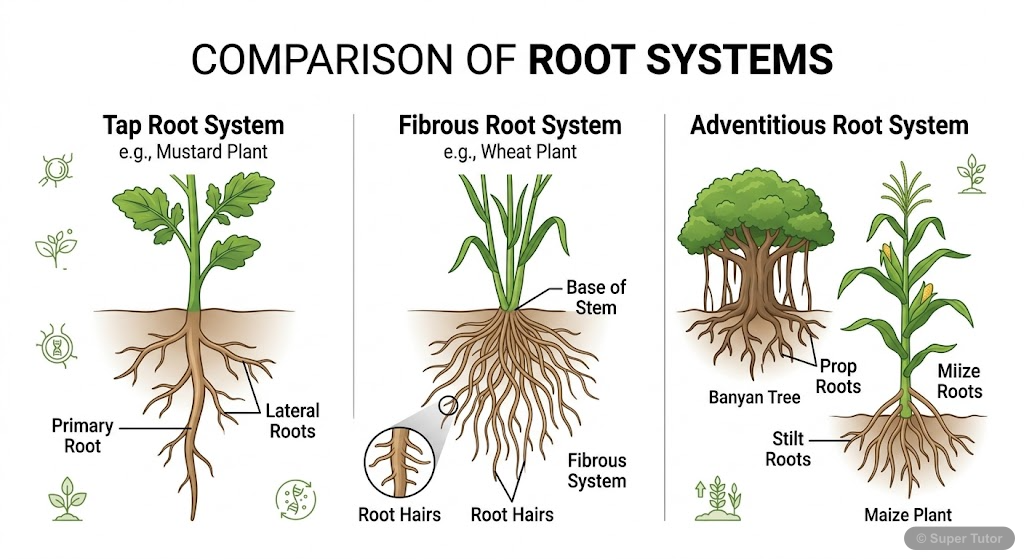
One of 5 illustrations for Root System in Super Tutor — alongside flashcards, concept maps and practice questions.
Important Questions from Root System
Radish is an example of which type of tap root modification?
Show answer
Fusiform
Step 1: Recall the four types of tap root modifications for food storage. Step 2: Conical roots are broad at the base and taper gradually towards the apex — example is carrot. Step 3: Fusiform roots are swollen in the middle and taper towards both ends (like a spindle shape) — example is radish. Step 4: Napiform roots are spherical at the base but taper sharply towards the tip — example is turnip. Step 5: Tuberous roots are thick and fleshy with no definite shape — example is 4 o'clock plant. Radish is swollen in the middle and narrower at both ends, which perfectly describes a fusiform shape.
Pneumatophores are found in mangrove plants. What is their primary function?
Show answer
Absorbing oxygen from air for better gaseous exchange in waterlogged soil
Step 1: Mangrove plants (like Rhizophora) grow in marshy, waterlogged areas where the soil is poorly aerated. Step 2: Since the soil is flooded, normal underground roots cannot get enough oxygen for respiration. Step 3: To solve this problem, some roots grow vertically upward (they are negatively geotropic) into the air. Step 4: The tips of these exposed roots have minute pores through which the roots can absorb oxygen from the atmosphere — these are called pneumatophores or respiratory roots. Step 5: Option A describes velamen in epiphytic orchid roots. Option B describes prop roots or stilt
Which of the following plants has haustoria (sucking roots) that penetrate the host plant to absorb food?
Show answer
Cuscuta
Step 1: Haustoria are special sucking roots developed by parasitic plants to extract nutrition from a host plant. Step 2: These roots penetrate the living host plant and tap into the phloem to suck food (organic nutrients). Step 3: Cuscuta (also called dodder) is a well-known example of a parasitic plant that has haustoria — it appears as orange or yellow thread-like structures growing over its host. Step 4: Vanda (an orchid) has epiphytic roots with velamen tissue that absorb atmospheric moisture — it is an epiphyte, not a parasite. Step 5: Tinospora has assimilatory roots that turn green for
In the primary structure of a dicot root, the band-like thickenings on the radial walls of endodermal cells are called:
Show answer
Casparian strips
Step 1: In the cross-section of a dicot root, identify the endodermis — it is the innermost layer of the cortex, made of barrel-shaped closely packed cells. Step 2: These endodermal cells have a special feature — band-like thickenings on their radial (side) walls. These are called Casparian strips. Step 3: Casparian strips are made of suberin and lignin, which make the cell walls impermeable. They control the movement of water and dissolved minerals entering the stele. Step 4: Passage cells are the endodermal cells that LACK casparian strips (found opposite the protoxylem) — they allow water t
+41 more questions on Root System (NIOS Class 12 Biology)
Practise AllFrequently Asked Questions
What are the important topics in Root System for NIOS Class 12 Biology?
How many important questions are there in Root System?
Sources & Official References
Content is aligned to the official syllabus. Refer to the board website for the latest curriculum.
More resources for Root System
For serious students
Get the full Root System chapter — start free.
Quizzes, flashcards, an AI doubt solver and a study plan for NIOS Class 12 Biology. Free to start, no card needed.