Shoot System — Practice Quiz
NIOS · Class 12 · Biology
Try a 4-question quiz on Shoot System for NIOS Class 12 Biology: tap an answer to check it and see why. 44 questions in the full chapter test.
Interactive on Super Tutor
Studying Shoot System? Get the full interactive chapter.
Quizzes, flashcards, AI doubt-solver and a step-by-step study plan — built for practice quiz and more.
Free trial, no card needed.
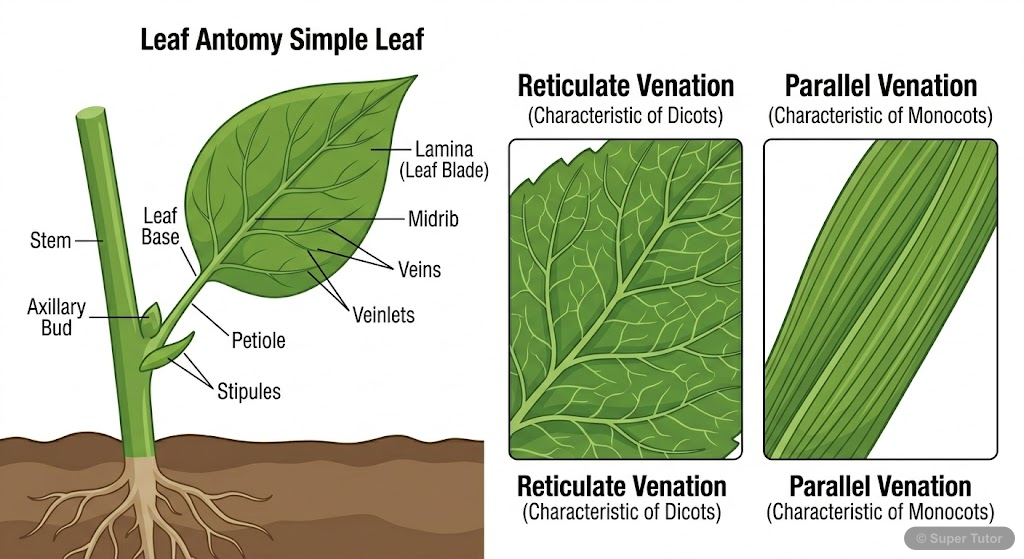
Learn better with visuals Super Tutor pairs illustrations like this with notes and quizzes for Shoot System.
Quick Quiz: Shoot System
0/4Tap an answer to check it instantly. No sign-up needed for these 4.
In a dicot stem, the interfascicular cambium develops from which tissue, and what ring does it form together with the fascicular cambium?
Which of the following correctly distinguishes a stem tuber (potato) from a corm (Gladiolus)?
In a transverse section of a monocot stem, xylem vessels are arranged in the shape of letter 'Y' and the innermost protoxylem disintegrates. What is the cavity formed by this disintegration called, and what is its functional significance?
A student observes that a plant has its calyx, corolla, and androecium attached above the ovary with the thalamus fused to and enclosing the ovary. Which floral condition does this represent, and what is the position of the ovary?
Sample Questions
Which of the following correctly pairs the type of placentation with the correct description and example?
Show answer
Parietal – polycarpellary syncarpous, unilocular, ovules on inner wall at margins of adjoining carpels; example: mustard
Step 1: Parietal placentation occurs when the ovary is polycarpellary, syncarpous and has one chamber (unilocular), with ovules attached to the inner wall where margins of adjoining carpels meet. Example: mustard, cucumber. Step 2: Free central placentation is also syncarpous and unilocular BUT the placenta is central (no septa), and ovules are on the central placenta – example: Dianthus. Option A incorrectly says multilocular. Step 3: Marginal placentation (not axile) involves a monocarpellary one-chambered ovary with ovules along fused margins – example: pea. Step 4: Basal placentation has o
The science of determining the age of a tree by counting annual rings is called Dendrochronology. In temperate regions, which wood has wider vessels and is formed during which season?
Show answer
Early wood (spring wood) with wider vessels formed in spring
Step 1: In temperate regions, cambium activity is seasonal. Step 2: In spring, the cambium is highly active and produces more xylem vessels with wider cavities — this is called early wood or spring wood. Step 3: In summer, the cambium is less active and produces vessels with narrow cavities — this is called late wood or summer wood. Step 4: One annual ring = one spring wood layer + one summer wood layer together. Step 5: Heart wood and sap wood are not directly related to seasonal vessel width — they relate to functional status of secondary xylem. Option A reverses the correct association.
In which type of inflorescence does the main axis end in a flower, the terminal flower is the oldest, and flowers arise in basipetal order?
Show answer
Cymose inflorescence
Step 1: Inflorescence is the arrangement of flowers on the floral axis (peduncle). Step 2: In cymose inflorescence, the main axis terminates in a flower, thus limiting its growth. Step 3: Since the terminal flower opens first, it is the oldest. New lateral branches arise below, and their flowers open subsequently — this is called basipetal order (from apex downward). Step 4: In racemose inflorescence, the main axis keeps growing (unlimited), flowers arise in acropetal order (oldest at base, youngest at top). Step 5: Capitulum and umbel are types of racemose inflorescence, not cymose. The key i
Bulliform cells are found in monocot leaves. Which of the following correctly describes their location, mechanism, and function?
Show answer
Found in upper epidermis; lose water under high transpiration; cause leaf to roll, reducing water loss
Step 1: Bulliform cells (also called motor cells) are large, bubble-like epidermal cells present in the upper epidermis of certain monocot leaves (e.g., maize, bajra, jowar). Step 2: On hot, sunny days, the rate of transpiration is very high. These cells lose water rapidly, losing turgidity. Step 3: This loss of turgidity causes the leaf to roll inward (into a tube shape), thereby reducing the exposed surface area. Step 4: By rolling, fewer stomata are exposed to the environment, significantly reducing further water loss — a xerophytic adaptation. Step 5: They are NOT in guard cells or mesophy
+40 more questions on Shoot System (NIOS Class 12 Biology)
Practise AllFrequently Asked Questions
What are the important topics in Shoot System for NIOS Class 12 Biology?
How many practice questions are there for Shoot System?
Sources & Official References
Content is aligned to the official syllabus. Refer to the board website for the latest curriculum.
More resources for Shoot System
For serious students
Get the full Shoot System chapter — start free.
Quizzes, flashcards, an AI doubt solver and a study plan for NIOS Class 12 Biology. Free to start, no card needed.