Shoot System — Flashcards
NIOS · Class 12 · Biology
32 flashcards for Shoot System (NIOS Class 12 Biology) to test yourself on key terms and facts. Sample: "What is the shoot system and what are its"
Interactive on Super Tutor
Studying Shoot System? Get the full interactive chapter.
Quizzes, flashcards, AI doubt-solver and a step-by-step study plan — built for flashcards and more.
Free trial, no card needed.
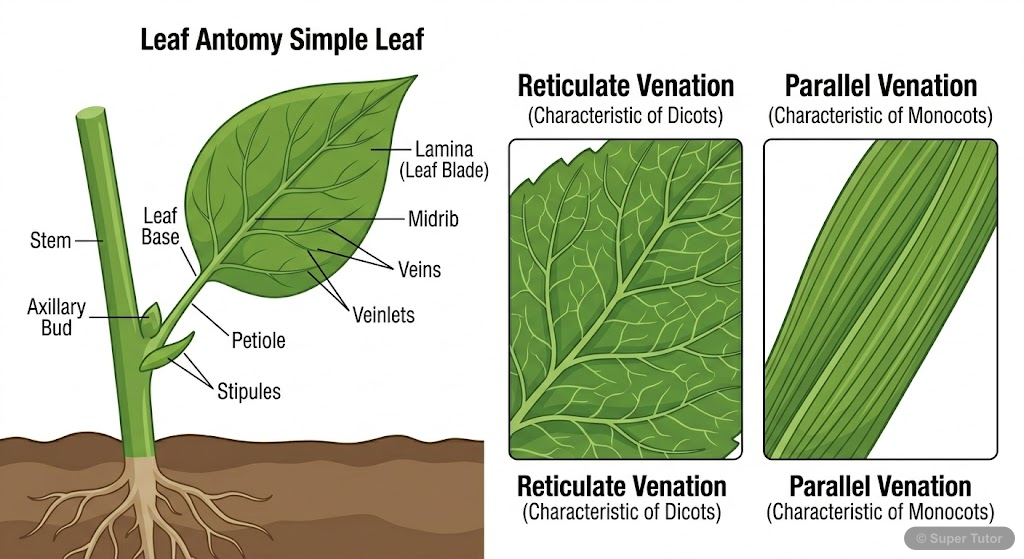
Learn better with visuals Super Tutor pairs illustrations like this with notes and quizzes for Shoot System.
What is the shoot system and what are its main components?
Answer
The shoot system is the aerial and erect part of the plant body that grows upward, developing from the plumule of the embryo. Its main components are: (1) Stem - provides support and conducts material…
Compare the morphological differences between stem and root.
Answer
Key differences: (1) Origin - Stem develops from plumule, root from radicle. (2) Color - Young stem is green (chlorophyll present), root is non-green. (3) Segmentation - Stem has nodes and internodes,…
What is the shoot apex and what are its two main regions?
Answer
The shoot apex is the terminal, dome-shaped meristematic region at the tip of the shoot responsible for primary growth and development of permanent tissues. Its two main regions are: (1) Tunica - The …
How do lateral branches originate in plants, and what type of origin is this?
Answer
Lateral branches originate from axillary buds present in the axil of leaves (the angle between leaf and stem). Each axillary bud is a compact, underdeveloped shoot covered with overlapping leaf primor…
What are the three types of stems based on their growth habit and orientation?
Answer
The three types of stems are: (1) Aerial stems - These are erect, rigid, strong, and upright, found in herbs, shrubs, and trees. They grow directly upward against gravity and are fully exposed to sunl…
Describe the structure and functions of rhizomes and corms.
Answer
Rhizome: A thick, fleshy, flattened underground stem that grows horizontally near the soil surface. Characteristics: bears scale leaves on nodes, has terminal and axillary buds, produces adventitious …
What is a bulb and how does it differ structurally from a corm or rhizome?
Answer
A bulb is a highly modified underground stem consisting of: (1) A reduced, flattened, discoid (disc-shaped) stem at the base. (2) Crowded nodes bearing overlapping scale leaves that are fleshy (inner …
Explain the structure of a potato tuber and how it represents a modified stem.
Answer
A potato tuber is a swollen tip of an underground lateral branch of the stem. Structural features that prove it is a stem (not a root): (1) Bears 'eyes' - each eye is actually a node containing a bud …
+24 more flashcards
Practise AllFrequently Asked Questions
What are the important topics in Shoot System for NIOS Class 12 Biology?
How many flashcards are available for Shoot System?
How should I revise Shoot System for the NIOS Class 12 board exam?
Sources & Official References
Content is aligned to the official syllabus. Refer to the board website for the latest curriculum.
More resources for Shoot System
For serious students
Get the full Shoot System chapter — start free.
Quizzes, flashcards, an AI doubt solver and a study plan for NIOS Class 12 Biology. Free to start, no card needed.