Chapter 6 of 9
Revision Notes
Shoot System — Revision Notes
NIOS · Class 12 · Biology
Shoot System revision notes for NIOS Class 12 Biology: 4 topics in quick points. Part of the NIOS Class 12 Biology syllabus.
44 questions32 flashcards5 concepts
Interactive on Super Tutor
Studying Shoot System? Get the full interactive chapter.
Quizzes, flashcards, AI doubt-solver and a step-by-step study plan — built for revision notes and more.
Free trial, no card needed.
Super Tutor
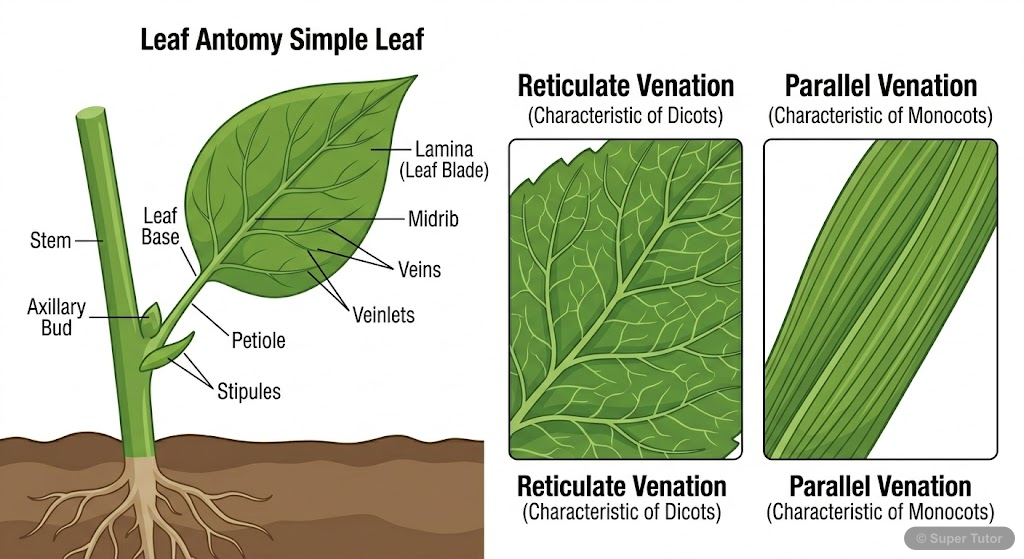
Learn better with visuals Super Tutor pairs illustrations like this with notes and quizzes for Shoot System.
Key Topics to Revise
1
7.1 STEM - Structure, Types, and Functions
- Stem arises from plumule and grows upward (positively phototropic and negatively geotropic)
- Divided into nodes (leaf attachment points) and internodes (regions between nodes)
- Bears leaves, buds (vegetative and floral), and flowers on nodes
2
Stem Modifications - Adaptations for Specific Functions
- Underground modifications: Rhizome (horizontal, near soil surface), Corm (vertical, spherical), Bulb (compressed, fleshy scales), Tuber (swollen tips, eyes present)
- Sub-aerial modifications: Runner (long internodes, adventitious roots at nodes), Stolon (weak, arches down), Offset (thick, short), Sucker (underground runner emerging upward)
- Aerial modifications: Tendril (spirally coiled, climbing), Thorn (pointed, defense), Phylloclade (green, fleshy, photosynthetic), Cladode (phylloclade with 1-2 internodes)
3
Anatomy of Stem - Internal Structure
- Dicot stem (e.g., sunflower): Epidermis → Cortex (Hypodermis + Middle layers + Endodermis) → Stele (Pericycle + Ring of Vascular bundles + Medullary rays + Pith)
- Vascular bundles in dicot: Conjoint (xylem and phloem together), Collateral (on same radius, phloem outside), Open (cambium present for secondary growth)
- Monocot stem (e.g., maize): Epidermis → Ground tissue (undifferentiated) with scattered, closed vascular bundles each surrounded by sclerenchymatous bundle sheath
4
Secondary Growth and Wood Formation
- Secondary growth increases stem girth; occurs only in dicots a little away from apex
- Two lateral meristems responsible: Vascular cambium (produces secondary xylem and phloem) and Cork cambium/Phellogen (produces periderm)
- Fascicular cambium present in vascular bundles; interfascicular cambium develops in medullary rays
Get complete notes with diagrams and examples
Full NotesKey Concepts
A stem is the main axisThe shoot apex is the terminalStems are classified asIn transverse sectionA monocot stem (e
Frequently Asked Questions
What are the important topics in Shoot System for NIOS Class 12 Biology?
Key topics in Shoot System include 1 STEM - Structure, Types, and Functions, Stem Modifications - Adaptations for Specific Functions, Anatomy of Stem - Internal Structure, Secondary Growth and Wood Formation. Study these first, then practise questions on each for the NIOS Class 12 board exam.
How should I revise Shoot System for the NIOS Class 12 board exam?
Learn the core ideas first, then work through the 44 practice questions on Shoot System. Revise definitions regularly and use flashcards for quick recall before the exam.
Sources & Official References
Content is aligned to the official syllabus. Refer to the board website for the latest curriculum.
More resources for Shoot System
For serious students
Get the full Shoot System chapter — start free.
Quizzes, flashcards, an AI doubt solver and a study plan for NIOS Class 12 Biology. Free to start, no card needed.