Shoot System — Chapter Summary
NIOS · Class 12 · Biology
Summary of Shoot System for NIOS Class 12 Biology. Key concepts: A stem is the main axis, The shoot apex is the terminal and Stems are classified as.
Interactive on Super Tutor
Studying Shoot System? Get the full interactive chapter.
Quizzes, flashcards, AI doubt-solver and a step-by-step study plan — built for chapter summary and more.
Free trial, no card needed.
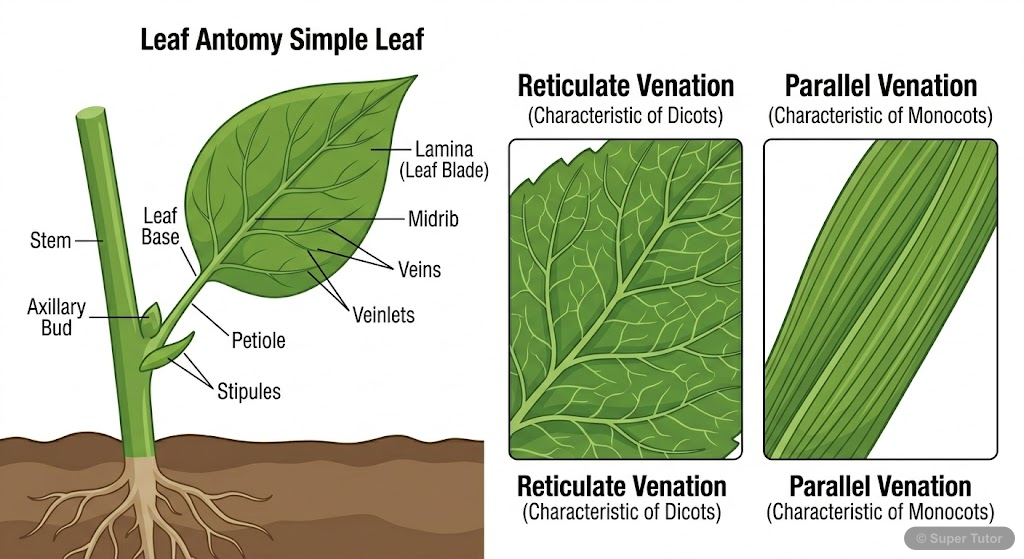
Learn better with visuals Super Tutor pairs illustrations like this with notes and quizzes for Shoot System.
Overview
The shoot system is the aerial, above-ground part of a plant that develops from the plumule (embryonic shoot) and grows upward toward light. Unlike roots which grow downward into the soil, the shoot system is positively phototropic (grows toward light) and negatively geotropic (grows away from gravi
Key Concepts
A stem is the main axis
A stem is the main axis of the shoot system that develops from the plumule. Key characteristics include: (1) divided into nodes (leaf attachment point
The shoot apex is the terminal
The shoot apex is the terminal, dome-shaped meristematic region at the tip of the stem responsible for primary growth (growth in length). It consists
Stems are classified as
Stems are classified as: (1) Aerial stems (erect, rigid, strong) - typical of herbs, shrubs, and trees; (2) Sub-aerial stems (weak, trail on ground as
In transverse section
In transverse section, a young dicot stem (e.g., sunflower) shows: (1) Epidermis - single-layered protective layer with cuticle and multicellular hair
A monocot stem (e
A monocot stem (e.g., maize) shows: (1) Epidermis - single-layered, no hairs; (2) Ground tissue - largely parenchymatous with only peripheral sclerenc
Learning Objectives
- List general characteristics of stems and distinguish them from roots based on morphological features
- Describe the shoot apex and explain the origin of lateral branches from axillary buds
- Explain types, modifications, and functions of stems in various plant species
- Describe and compare primary structure of dicot and monocot stems with diagrams
- Understand secondary growth in dicot stems and the formation of annual rings
Frequently Asked Questions
What are the important topics in Shoot System for NIOS Class 12 Biology?
How should I revise Shoot System for the NIOS Class 12 board exam?
Sources & Official References
Content is aligned to the official syllabus. Refer to the board website for the latest curriculum.
More resources for Shoot System
For serious students
Get the full Shoot System chapter — start free.
Quizzes, flashcards, an AI doubt solver and a study plan for NIOS Class 12 Biology. Free to start, no card needed.