Forms of Business Organisations — Chapter Summary
NIOS · Class 12 · Business Studies
Summary of Forms of Business Organisations for NIOS Class 12 Business Studies. A business organisation is a systematic arrangement of resources.
Interactive on Super Tutor
Studying Forms of Business Organisations? Get the full interactive chapter.
Quizzes, flashcards, AI doubt-solver and a step-by-step study plan — built for chapter summary and more.
Free trial, no card needed.
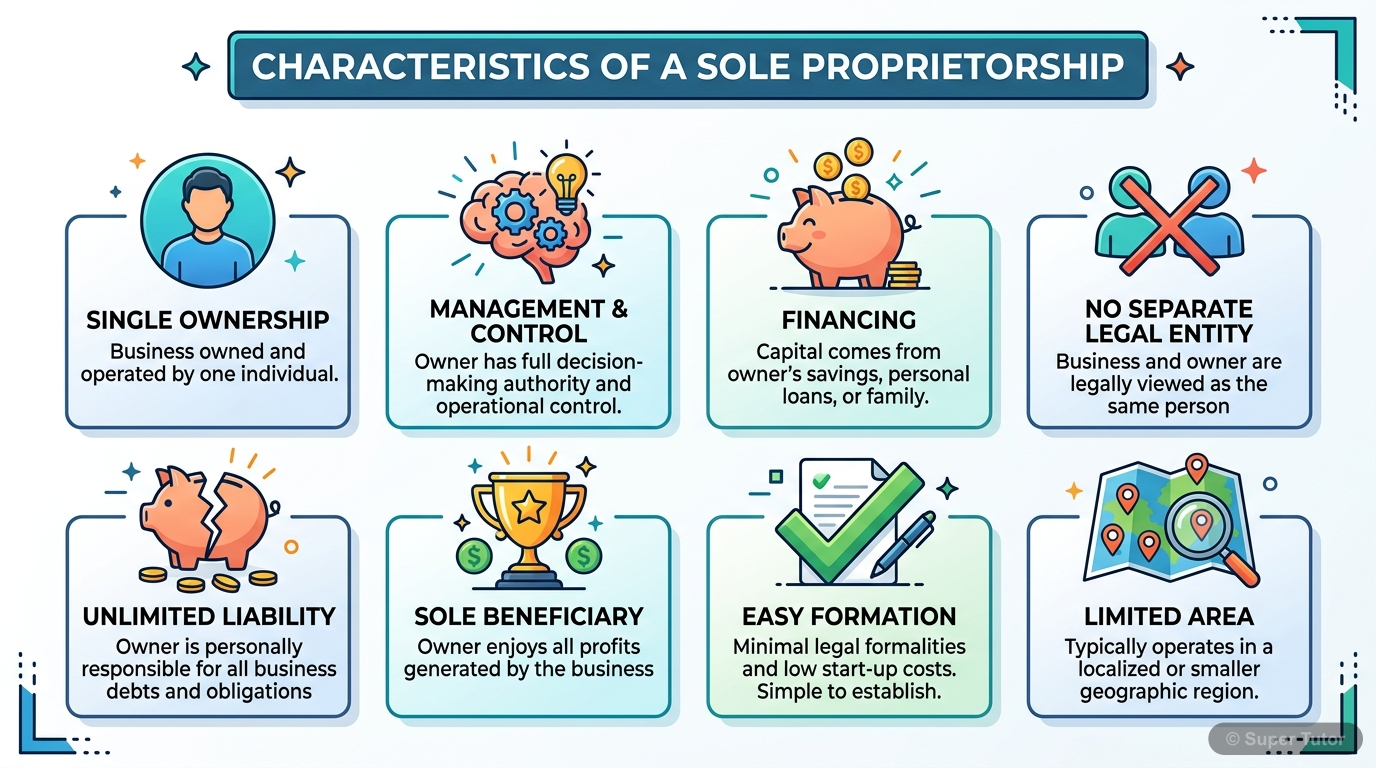
Learn better with visuals Super Tutor pairs illustrations like this with notes and quizzes for Forms of Business Organisations.
Overview
A business organisation is a systematic arrangement of resources (men, money, materials, methods, machines, and technology) brought together to carry out business activities and achieve profit. Different individuals and groups choose different forms of business organisation based on their capital, r
Key Concepts
A form of business organisation where
A form of business organisation where a single individual owns, manages, and controls the business entirely. The proprietor brings capital, bears all
A contractual association of two
A contractual association of two or more persons who agree to pool resources, carry on a lawful business together, and share profits or losses. Govern
A unique form of ancestral business
A unique form of ancestral business organisation in India where family members of three successive generations own the business jointly. The senior-mo
A voluntary association of persons
A voluntary association of persons with common economic interests who work together on principles of self-help and mutual help. Requires minimum 10 me
A legal obligation where the proprietor
A legal obligation where the proprietor or partner is personally liable for all business debts and obligations. If business assets are insufficient to
Learning Objectives
- Understand the meaning and importance of business organisation
- Describe the characteristics of different forms of business organisations
- Distinguish between sole proprietorship, partnership, joint Hindu family, and cooperative society
- Analyze the merits and limitations of each form of business organisation
- Identify the suitability of different forms for various types of businesses
Frequently Asked Questions
What are the important topics in Forms of Business Organisations for NIOS Class 12 Business Studies?
How should I revise Forms of Business Organisations for the NIOS Class 12 board exam?
Sources & Official References
Content is aligned to the official syllabus. Refer to the board website for the latest curriculum.
More resources for Forms of Business Organisations
For serious students
Get the full Forms of Business Organisations chapter — start free.
Quizzes, flashcards, an AI doubt solver and a study plan for NIOS Class 12 Business Studies. Free to start, no card needed.