Planning and Organising — Chapter Summary
NIOS · Class 12 · Business Studies
Summary of Planning and Organising for NIOS Class 12 Business Studies. Part of the NIOS Class 12 Business Studies syllabus.
Interactive on Super Tutor
Studying Planning and Organising? Get the full interactive chapter.
Quizzes, flashcards, AI doubt-solver and a step-by-step study plan — built for chapter summary and more.
Free trial, no card needed.
Learn better with visuals Super Tutor pairs illustrations like this with notes and quizzes for Planning and Organising.
Overview
Planning and Organising are the first two fundamental functions of management that form the foundation of all business activities. Planning involves deciding in advance what needs to be done and how to do it, while organising involves arranging resources and establishing relationships to execute tho
Key Concepts
Planning is the process of setting
Planning is the process of setting future objectives and deciding on the ways and means of achieving them. It involves deciding in advance what is to
Planning has eight distinctive features
Planning has eight distinctive features: (1) It is the primary function of management, (2) It is goal-directed, (3) It is pervasive across all levels
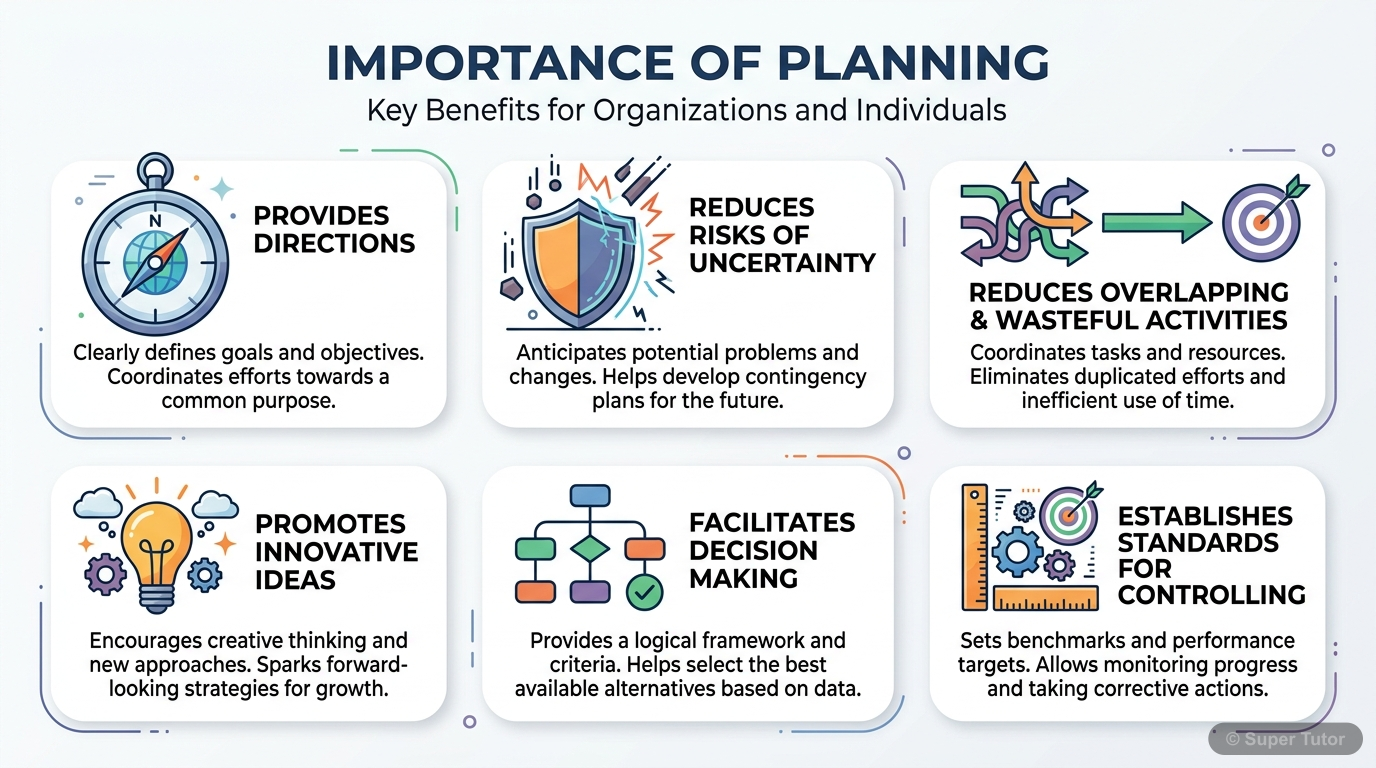
Planning provides direction to action
Planning provides direction to action, reduces risk and uncertainty, helps achieve coordination and control, facilitates decision-making, leads to eco
Planning has six key limitations
Planning has six key limitations: (1) Rigidity - plans may make operations inflexible, (2) Probabilistic nature - plans are based on uncertain forecas
The planning process consists of seven
The planning process consists of seven sequential steps: (1) Establishment of Objectives - defining clear goals, (2) Making Assumptions - establishing
Learning Objectives
- Understand the definition, features, and importance of planning in business management
- Learn the step-by-step process of planning and its limitations
- Identify and differentiate between various types of plans used in organisations
- Comprehend the meaning, features, and importance of organising
- Understand the process of organising and how organisational structures are designed
Frequently Asked Questions
What are the important topics in Planning and Organising for NIOS Class 12 Business Studies?
How should I revise Planning and Organising for the NIOS Class 12 board exam?
Sources & Official References
Content is aligned to the official syllabus. Refer to the board website for the latest curriculum.
More resources for Planning and Organising
For serious students
Get the full Planning and Organising chapter — start free.
Quizzes, flashcards, an AI doubt solver and a study plan for NIOS Class 12 Business Studies. Free to start, no card needed.