Financial Planning and Management
NIOS · Class 12 · Business Studies
Most important questions from Financial Planning and Management for NIOS Class 12 Business Studies board exam 2026. MCQs, short answer, and long answer questions with marks.
Interactive on Super Tutor
Studying Financial Planning and Management? Get the full interactive chapter.
Quizzes, flashcards, AI doubt-solver and a step-by-step study plan — built for important questions and more.
1,000+ Class 12 students started this chapter today
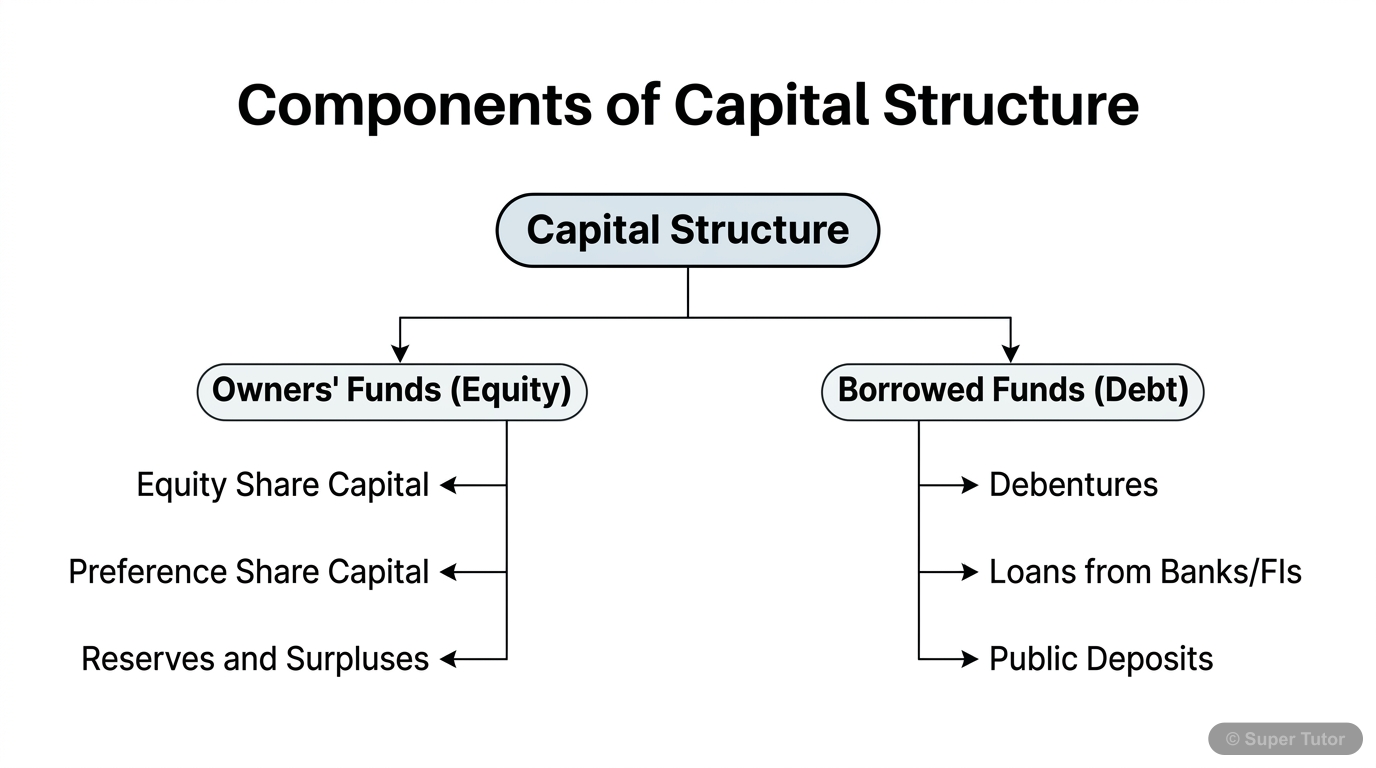
Super Tutor has 5+ illustrations like this for Financial Planning and Management alone — flashcards, concept maps, and step-by-step visuals.
See them allSample Questions
Financial planning deals with framing of policies related to procurement, investment, and administration of funds. Which of the following is an essential characteristic of a sound financial plan?
Show answer
It must be flexible
Step 1: The chapter lists several essentials of a sound financial plan. Step 2: These include: simplicity, long-term view, flexibility, optimal use of funds, low cost of funds, and adequate liquidity. Step 3: Flexibility means the plan should be capable of being adjusted and revised without difficulty to meet future requirements. Step 4: 'Abundant availability of funds' is NOT an essential — the plan should ensure optimal, not excess, use of funds. 'Short-term focus only' is wrong; a long-term view is required. 'Highly complex' is also wrong — the plan must be simple. Step 5: Therefore, 'It mu
The combination of debt and equity used to finance the operations of a business is called:
Show answer
Capital Structure
Step 1: Understand the basic terms. Working capital is for day-to-day operations; Fixed capital is invested in long-term assets. Step 2: Capital Structure refers to the choice of combination of debt and equity used to finance business operations, aiming to maximize the market value of shares. Step 3: Financial Structure is broader — it includes capital structure PLUS current liabilities. Step 4: Capital Structure specifically refers to long-term sources (equity shares, preference shares, debentures, long-term loans, retained earnings). Step 5: Therefore, 'Capital Structure' is the correct answ
Which of the following is TRUE about Debt Capital compared to Equity Capital?
Show answer
Debt involves less cost as interest is tax-deductible
Step 1: Compare the features of debt and equity as described in the chapter. Step 2: Debt involves LESS cost because the interest paid on debt is treated as a revenue expense and is subject to tax-shield (tax deduction), reducing the effective cost. Step 3: Equity is expensive because dividend payment is NOT tax-deductible, and shareholders expect high returns. Step 4: Debt holders (debenture holders) do NOT have voting rights — that belongs to equity shareholders. Step 5: Debt is actually RISKY for the company because interest payment is a legal obligation. Therefore, 'Debt involves less cost
The formula for Financial Leverage is:
Show answer
EBIT / EBT
Step 1: Recall the three leverage formulas from the chapter. Step 2: Financial Leverage = EBIT / EBT (Earnings Before Interest and Tax divided by Earnings Before Tax). Step 3: Operating Leverage = Contribution / EBIT. Step 4: Combined Leverage = Contribution / EBT (or Financial Leverage × Operating Leverage). Step 5: Financial leverage measures the effect of fixed financial charges (interest) on EPS. It compares EBIT (before interest) to EBT (after interest), so EBIT / EBT is the correct formula. Option 'EBT / EBIT' is the inverted formula and is incorrect.
+41 more questions available
Practice AllFrequently Asked Questions
What are the important topics in Financial Planning and Management for NIOS Class 12 Business Studies?
How to score full marks in Financial Planning and Management — NIOS Class 12 Business Studies?
How many important questions are there in Financial Planning and Management?
Sources & Official References
Content is aligned to the official syllabus. Refer to the board website for the latest curriculum.
More resources for Financial Planning and Management
Practice Quiz
Test yourself with a quick quiz
Revision Notes
Key points for last-minute revision
Formula Sheet
All formulas in one place
Chapter Summary
Understand the chapter at a glance
Concept Maps
See how topics connect visually
Study Plan
Step-by-step plan to ace this chapter
Flashcards
Quick-fire cards for active recall
Syllabus
What topics to cover
NCERT Solutions
Every textbook question solved step by step
For serious students
Get the full Financial Planning and Management chapter — for free.
Quizzes, flashcards, AI doubt-solver and a step-by-step study plan for NIOS Class 12 Business Studies.