Trigonometric Functions - I — Syllabus
NIOS · Class 12 · Mathematics
What Trigonometric Functions - I covers in NIOS Class 12 Mathematics: 4 topics, for the 2026-27 session. Part of the NIOS Class 12 Mathematics syllabus.
Interactive on Super Tutor
Studying Trigonometric Functions - I? Get the full interactive chapter.
Quizzes, flashcards, AI doubt-solver and a step-by-step study plan — built for syllabus and more.
Free trial, no card needed.
One of 8 illustrations for Trigonometric Functions - I in Super Tutor — alongside flashcards, concept maps and practice questions.
Topics in Trigonometric Functions - I
Circular Measure of Angles: Degrees and Radians
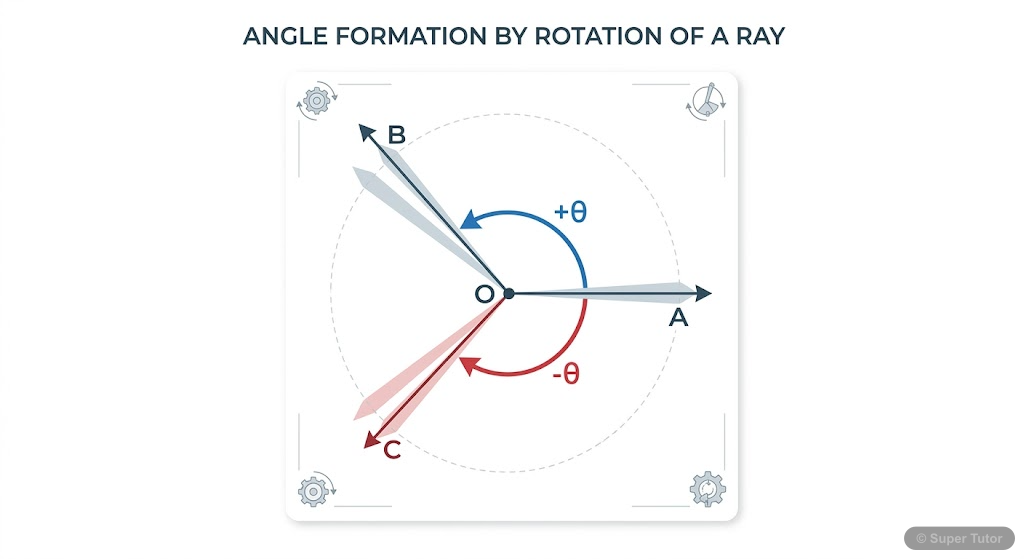
- An angle is formed by the rotation of a ray from its initial position to its final position.
- Anticlockwise rotation gives a positive angle; clockwise rotation gives a negative angle.
- A unit circle is a circle with radius equal to 1 unit.
Trigonometric Functions Using the Unit Circle
- For any point P(x, y) on the unit circle corresponding to angle θ, we define: sin θ = y, cos θ = x.
- The coordinates of P can also be written as (cos θ, sin θ).
- tan θ = y/x (defined when x ≠ 0), cot θ = x/y (defined when y ≠ 0).
Trigonometric Values of Standard Angles
- The values of sin and cos at 0, π/6, π/4, π/3, π/2 must be memorised perfectly.
- Memory trick for sin values: sin 0 = √(0/4), sin π/6 = √(1/4), sin π/4 = √(2/4), sin π/3 = √(3/4), sin π/2 = √(4/4). Simplify to get 0, 1/2, 1/√2, √3/2, 1.
- Cosine values are the reverse: cos 0 = 1, cos π/6 = √3/2, cos π/4 = 1/√2, cos π/3 = 1/2, cos π/2 = 0.
Graphs of Trigonometric Functions
- Graph of y = sin θ: starts at 0, rises to maximum 1 at π/2, returns to 0 at π, falls to minimum -1 at 3π/2, returns to 0 at 2π. It is continuous and wave-shaped.
- Graph of y = cos θ: starts at maximum 1 at θ=0, falls to 0 at π/2, reaches minimum -1 at π, rises to 0 at 3π/2, returns to 1 at 2π. It is also continuous and wave-shaped.
- Graph of y = tan θ: increases from 0 to +∞ in (0, π/2), then from -∞ to 0 in (π/2, π). Has vertical asymptotes at θ = π/2 and 3π/2. Discontinuous.
Key Concepts
Work through every topic in Trigonometric Functions - I with notes and quizzes
Start This ChapterFrequently Asked Questions
What are the important topics in Trigonometric Functions - I for NIOS Class 12 Mathematics?
How should I revise Trigonometric Functions - I for the NIOS Class 12 board exam?
Sources & Official References
Content is aligned to the official syllabus. Refer to the board website for the latest curriculum.
More resources for Trigonometric Functions - I
Practice Quiz
Test yourself with a quick quiz
Important Questions
Exam-style questions with answers
Revision Notes
Key points for last-minute revision
Formula Sheet
The chapter's formulas in one place
Chapter Summary
Understand the chapter at a glance
Concept Maps
See how topics connect
Flashcards
Quick-fire cards for active recall
For serious students
Get the full Trigonometric Functions - I chapter — start free.
Quizzes, flashcards, an AI doubt solver and a study plan for NIOS Class 12 Mathematics. Free to start, no card needed.