Trigonometric Functions - I
NIOS · Class 12 · Mathematics
Summary of Trigonometric Functions - I for NIOS Class 12 Mathematics. Key concepts, important points, and chapter overview.
Interactive on Super Tutor
Studying Trigonometric Functions - I? Get the full interactive chapter.
Quizzes, flashcards, AI doubt-solver and a step-by-step study plan — built for chapter summary and more.
1,000+ Class 12 students started this chapter today
This is just one of 8+ visuals inside Super Tutor's Trigonometric Functions - I chapter
Explore the full setOverview
Trigonometric Functions form the foundation of advanced mathematics, connecting angles with real numbers through the unit circle. This chapter transforms the trigonometric ratios you learned in earlier classes into proper mathematical functions defined for all real numbers. By studying trigonometric
Key Concepts
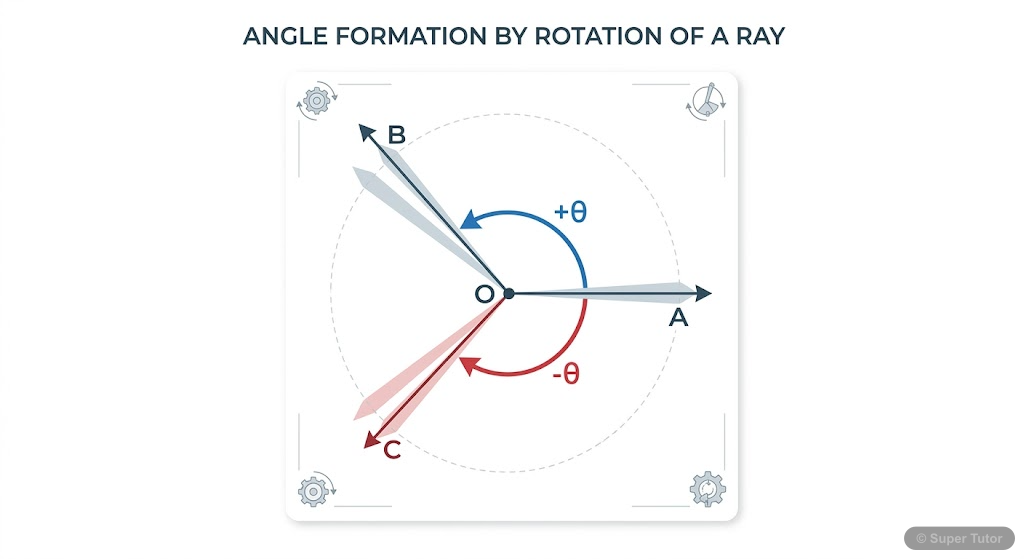
An angle is formed by rotating
An angle is formed by rotating a ray from its initial position. When the rotation is counterclockwise, the angle is positive; when clockwise, it is ne
A degree (°) measures an angle
A degree (°) measures an angle by dividing a complete rotation into 360 equal parts. A radian is the angle subtended at the center of a circle by an a
When an angle θ (in radians)
When an angle θ (in radians) is subtended at the center of a circle with radius r, the corresponding arc length is ℓ = rθ. This formula connects three
A unit circle (radius = 1)
A unit circle (radius = 1) centered at the origin provides the geometric foundation for defining trigonometric functions. For any angle θ measured cou
Since (x
Since (x, y) coordinates on the unit circle satisfy x² + y² = 1, we have -1 ≤ cos θ ≤ 1 and -1 ≤ sin θ ≤ 1. The domain of sin and cos is all real numb
Learning Objectives
- Define and distinguish between positive and negative angles based on rotational direction
- Understand and convert angle measurements between degrees and radians using proper conversion formulas
- Apply the arc-length formula ℓ = rθ to solve real-world problems involving circular motion
- Define trigonometric functions using the unit circle approach with real number inputs
- Derive and apply fundamental trigonometric identities and relationships
Frequently Asked Questions
What are the important topics in Trigonometric Functions - I for NIOS Class 12 Mathematics?
How to score full marks in Trigonometric Functions - I — NIOS Class 12 Mathematics?
Sources & Official References
Content is aligned to the official syllabus. Refer to the board website for the latest curriculum.
More resources for Trigonometric Functions - I
Practice Quiz
Test yourself with a quick quiz
Important Questions
Practice with board exam-style questions
Revision Notes
Key points for last-minute revision
Formula Sheet
All formulas in one place
Concept Maps
See how topics connect visually
Study Plan
Step-by-step plan to ace this chapter
Flashcards
Quick-fire cards for active recall
Syllabus
What topics to cover
NCERT Solutions
Every textbook question solved step by step
For serious students
Get the full Trigonometric Functions - I chapter — for free.
Quizzes, flashcards, AI doubt-solver and a step-by-step study plan for NIOS Class 12 Mathematics.