Chapter 2 of 5
Revision Notes
Biological Classification — Revision Notes
Punjab Board · Class 11 · Biology
Biological Classification revision notes for Punjab Board Class 11 Biology: 4 topics in quick points. Part of the Punjab Board Class 11 Biology syllabus.
45 questions28 flashcards5 concepts
Interactive on Super Tutor
Studying Biological Classification? Get the full interactive chapter.
Quizzes, flashcards, AI doubt-solver and a step-by-step study plan — built for revision notes and more.
Free trial, no card needed.
Super Tutor
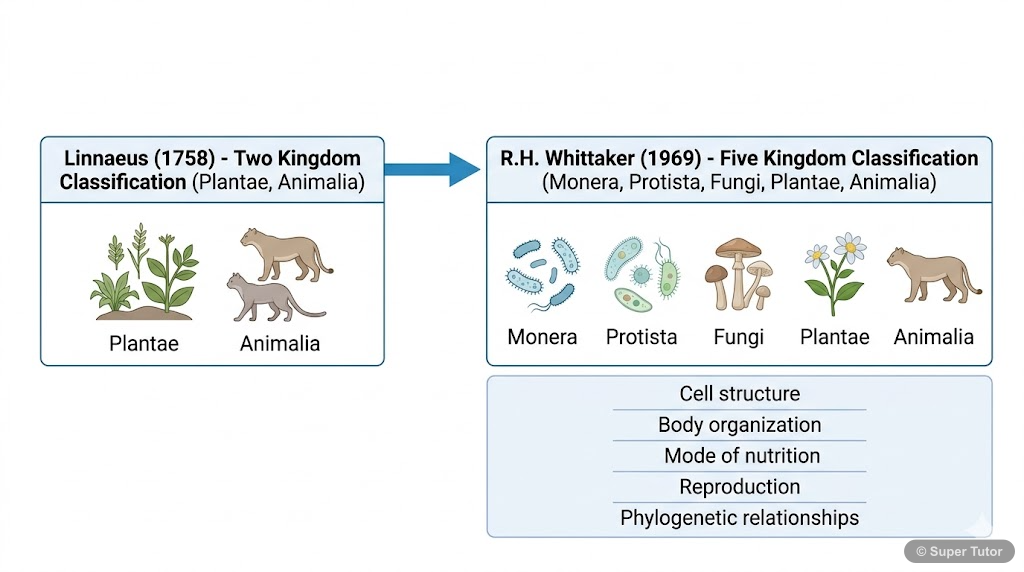
Learn better with visuals Super Tutor pairs illustrations like this with notes and quizzes for Biological Classification.
Key Topics to Revise
1
History and Need for Classification
- Aristotle was the first to attempt scientific classification – he classified plants into trees, shrubs, and herbs, and animals into those with red blood and those without.
- Linnaeus proposed the Two Kingdom Classification: Kingdom Plantae and Kingdom Animalia.
- The Two Kingdom system was inadequate because it did not separate prokaryotes from eukaryotes, unicellular from multicellular organisms, and photosynthetic from non-photosynthetic organisms.
2
Five Kingdom Classification – Comparative Overview
- Kingdom Monera: Prokaryotic cells, no nuclear membrane, cell wall of polysaccharide + amino acids (non-cellulosic), cellular body organisation, both autotrophic and heterotrophic nutrition.
- Kingdom Protista: Eukaryotic cells, nuclear membrane present, cell wall present in some, cellular body organisation, both autotrophic and heterotrophic nutrition.
- Kingdom Fungi: Eukaryotic cells, nuclear membrane present, cell wall made of CHITIN, multicellular/loose tissue organisation, heterotrophic (saprophytic/parasitic) nutrition.
3
Kingdom Monera
- Bacteria are the SOLE members of Kingdom Monera.
- Most abundant micro-organisms; found everywhere including extreme habitats (hot springs, deserts, snow, deep oceans).
- Four shapes of bacteria: Coccus (spherical), Bacillus (rod-shaped), Vibrio (comma-shaped), Spirillum (spiral).
4
Kingdom Protista
- All single-celled eukaryotes are placed under Protista.
- Primarily aquatic; form a link between plants, animals, and fungi.
- Have well-defined nucleus and other membrane-bound organelles.
Get complete notes with diagrams and examples
Full NotesKey Concepts
The systematic arrangement of organisms intoProposed by RContains prokaryotic organisms that lackArchaeabacteria are special bacteria that surviveContains all single
Frequently Asked Questions
What are the important topics in Biological Classification for Punjab Board Class 11 Biology?
Key topics in Biological Classification include History and Need for Classification, Five Kingdom Classification – Comparative Overview, Kingdom Monera, Kingdom Protista. Study these first, then practise questions on each for Class 11 exams.
How should I revise Biological Classification for Class 11 exams?
Learn the core ideas first, then work through the 45 practice questions on Biological Classification. Revise definitions regularly and use flashcards for quick recall before the exam.
Sources & Official References
Content is aligned to the official syllabus. Refer to the board website for the latest curriculum.
More resources for Biological Classification
For serious students
Get the full Biological Classification chapter — start free.
Quizzes, flashcards, an AI doubt solver and a study plan for Punjab Board Class 11 Biology. Free to start, no card needed.