Biological Classification — Chapter Summary
Punjab Board · Class 11 · Biology
Summary of Biological Classification for Punjab Board Class 11 Biology. Part of the Punjab Board Class 11 Biology syllabus.
Interactive on Super Tutor
Studying Biological Classification? Get the full interactive chapter.
Quizzes, flashcards, AI doubt-solver and a step-by-step study plan — built for chapter summary and more.
Free trial, no card needed.
Learn better with visuals Super Tutor pairs illustrations like this with notes and quizzes for Biological Classification.
Overview
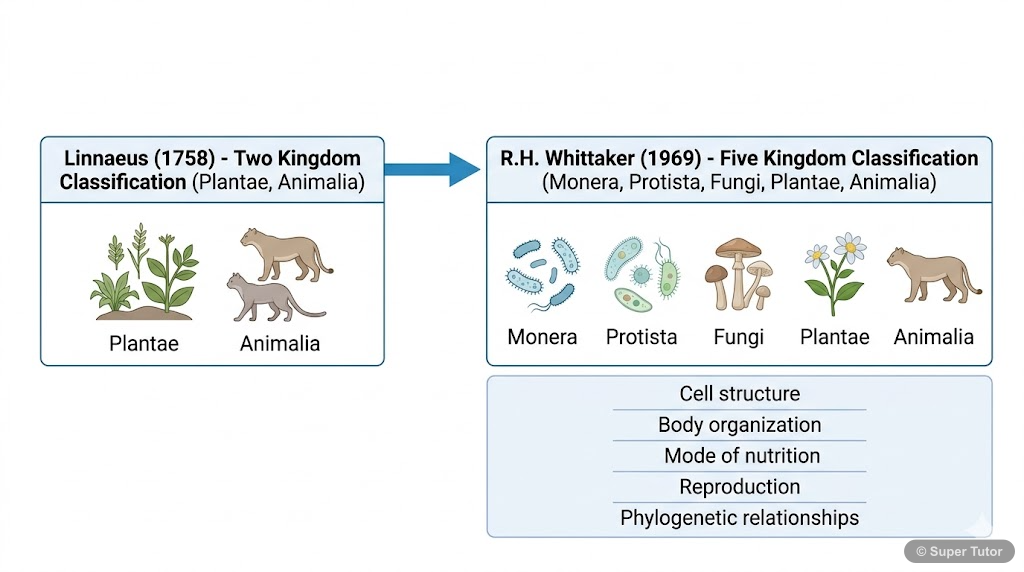
Biological classification is the scientific way of organizing living organisms into groups based on their characteristics, relationships, and evolutionary history. Since ancient times, humans have tried to classify organisms - from Aristotle's simple grouping into trees, shrubs, and herbs, to Linnae
Key Concepts
The systematic arrangement of organisms into
The systematic arrangement of organisms into groups and subgroups based on shared characteristics. Classification provides order to the incredible div
Proposed by R
Proposed by R.H. Whittaker in 1969, this system divides all living organisms into five kingdoms: Monera (bacteria), Protista (single-celled eukaryotes
Contains prokaryotic organisms that lack
Contains prokaryotic organisms that lack a membrane-bound nucleus and organized organelles. Bacteria are classified by shape: Coccus (spherical), Baci
Archaeabacteria are special bacteria that survive
Archaeabacteria are special bacteria that survive in extreme environments - halophiles in salty areas, thermoacidophiles in hot springs, and methanoge
Contains all single
Contains all single-celled eukaryotic organisms that have a defined nucleus and membrane-bound organelles. Protists are primarily aquatic and include
Learning Objectives
- Understand the historical development of biological classification systems from Aristotle to Whittaker
- Learn the five-kingdom classification system and the criteria used to define each kingdom
- Identify the characteristics of Kingdom Monera including Archaeabacteria and Eubacteria
- Understand the diverse organisms of Kingdom Protista including Chrysophytes, Dinoflagellates, Euglenoids, Slime moulds, and Protozoans
- Study Kingdom Fungi and its classes: Phycomycetes, Ascomycetes, Basidiomycetes, and Deuteromycetes
Frequently Asked Questions
What are the important topics in Biological Classification for Punjab Board Class 11 Biology?
How should I revise Biological Classification for Class 11 exams?
Sources & Official References
Content is aligned to the official syllabus. Refer to the board website for the latest curriculum.
More resources for Biological Classification
For serious students
Get the full Biological Classification chapter — start free.
Quizzes, flashcards, an AI doubt solver and a study plan for Punjab Board Class 11 Biology. Free to start, no card needed.