Morphology of Flowering Plants — Revision Notes
Punjab Board · Class 11 · Biology
Morphology of Flowering Plants revision notes for Punjab Board Class 11 Biology: 4 topics in quick points. Includes The Root System, The Stem and The Leaf.
Interactive on Super Tutor
Studying Morphology of Flowering Plants? Get the full interactive chapter.
Quizzes, flashcards, AI doubt-solver and a step-by-step study plan — built for revision notes and more.
Free trial, no card needed.
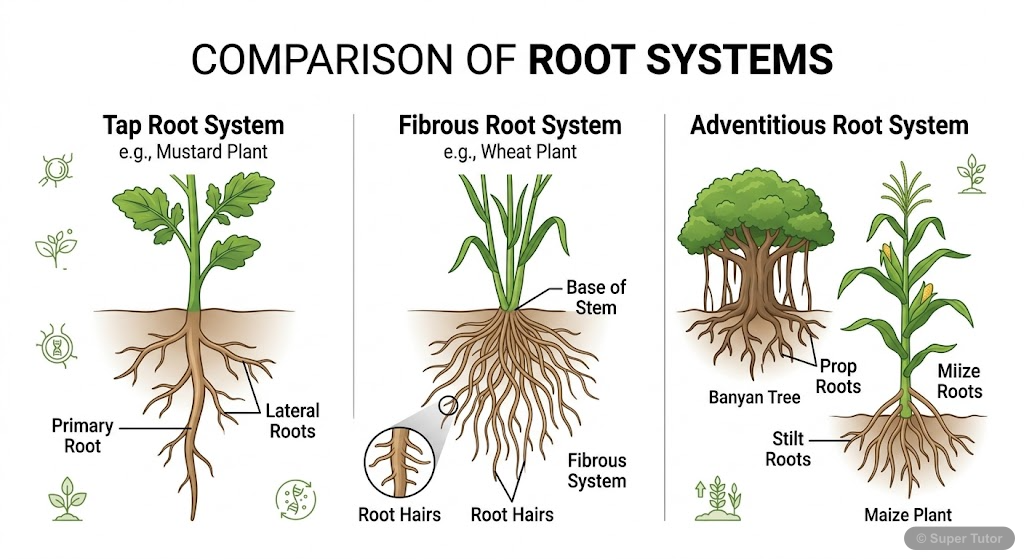
One of 16 illustrations for Morphology of Flowering Plants in Super Tutor — alongside flashcards, concept maps and practice questions.
Key Topics to Revise
The Root System
- The root system is the underground part of the plant that develops from the radicle of the embryo.
- Three main types of root systems: Tap root system, Fibrous root system, and Adventitious roots.
- Tap root system: Primary root (elongation of radicle) with secondary and tertiary branches — found in dicotyledons (e.g., Mustard).
The Stem
- Stem is the ascending axis of the plant that develops from the plumule of the embryo.
- Key features of stem: bears nodes and internodes, has terminal and axillary buds, is positively phototropic.
- Node: The region on stem where leaves are borne.
The Leaf
- Leaf is a lateral, generally flattened structure borne on the stem at the node; develops from shoot apical meristem.
- Primary function: Photosynthesis; also performs transpiration, gaseous exchange.
- Three main parts of a typical leaf: Leaf base, Petiole, and Lamina (leaf blade).
The Inflorescence
- A flower is a modified shoot — the shoot apical meristem converts to a floral meristem.
- Inflorescence: The arrangement of flowers on the floral axis (peduncle).
- Two major types of inflorescence: Racemose and Cymose.
Get complete notes with diagrams and examples
Full NotesKey Concepts
Frequently Asked Questions
What are the important topics in Morphology of Flowering Plants for Punjab Board Class 11 Biology?
How should I revise Morphology of Flowering Plants for Class 11 exams?
Sources & Official References
Content is aligned to the official syllabus. Refer to the board website for the latest curriculum.
More resources for Morphology of Flowering Plants
For serious students
Get the full Morphology of Flowering Plants chapter — start free.
Quizzes, flashcards, an AI doubt solver and a study plan for Punjab Board Class 11 Biology. Free to start, no card needed.