The Living World — Syllabus
Punjab Board · Class 11 · Biology
What The Living World covers in Punjab Board Class 11 Biology: 4 topics, for the 2026-27 session. Part of the Punjab Board Class 11 Biology syllabus.
Interactive on Super Tutor
Studying The Living World? Get the full interactive chapter.
Quizzes, flashcards, AI doubt-solver and a step-by-step study plan — built for syllabus and more.
Free trial, no card needed.
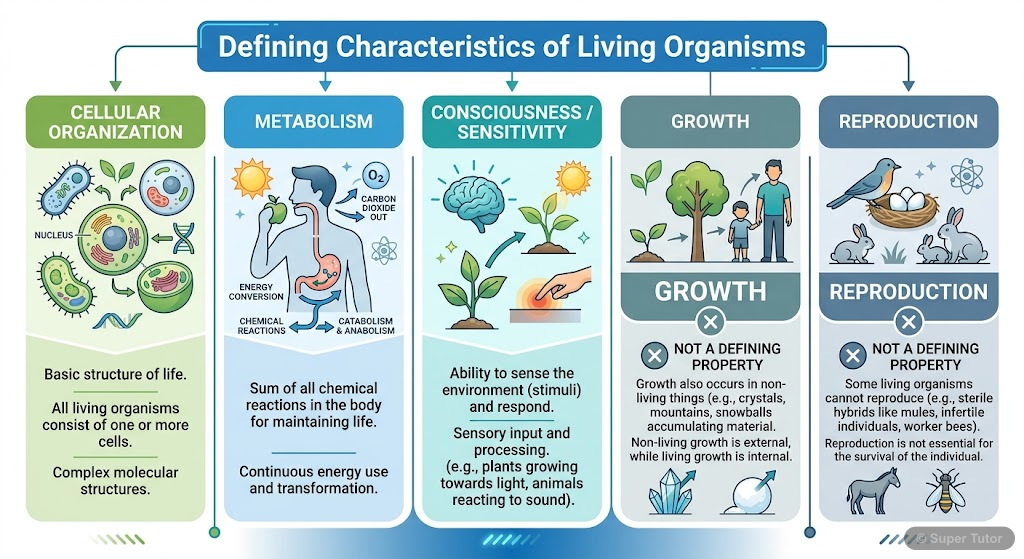
Learn better with visuals Super Tutor pairs illustrations like this with notes and quizzes for The Living World.
Topics in The Living World
1. Diversity in the Living World
- Earth is home to an incredibly diverse range of living organisms found in every type of habitat – from cold mountains and hot springs to deep oceans and deserts.
- The total number of known and described species ranges between 1.7 to 1.8 million. This is called BIODIVERSITY.
- Each different kind of plant, animal, or organism is called a SPECIES.
2. Rules of Binomial Nomenclature
- Biological names are generally in Latin and written in italics.
- They are Latinised or derived from Latin irrespective of their origin.
- The first word (genus) starts with a CAPITAL letter.
3. Taxonomic Categories and Hierarchy
- Classification is NOT a single-step process – it involves a HIERARCHY of steps called TAXONOMIC HIERARCHY.
- Each step in the hierarchy represents a rank or category called a TAXONOMIC CATEGORY.
- All categories together constitute the TAXONOMIC HIERARCHY.
4. Taxonomic Table – Key Examples (Table 1.1)
- Human (Man): Biological Name – Homo sapiens | Genus – Homo | Family – Hominidae | Order – Primata | Class – Mammalia | Phylum – Chordata
- Housefly: Biological Name – Musca domestica | Genus – Musca | Family – Muscidae | Order – Diptera | Class – Insecta | Phylum – Arthropoda
- Mango: Biological Name – Mangifera indica | Genus – Mangifera | Family – Anacardiaceae | Order – Sapindales | Class – Dicotyledonae | Division – Angiospermae
Key Concepts
Work through every topic in The Living World with notes and quizzes
Start This ChapterFrequently Asked Questions
What are the important topics in The Living World for Punjab Board Class 11 Biology?
How should I revise The Living World for Class 11 exams?
Sources & Official References
Content is aligned to the official syllabus. Refer to the board website for the latest curriculum.
More resources for The Living World
For serious students
Get the full The Living World chapter — start free.
Quizzes, flashcards, an AI doubt solver and a study plan for Punjab Board Class 11 Biology. Free to start, no card needed.