The Living World — Important Questions
Punjab Board · Class 11 · Biology
45 important questions from The Living World for Punjab Board Class 11 Biology, with answers. Includes multiple choice questions.
Interactive on Super Tutor
Studying The Living World? Get the full interactive chapter.
Quizzes, flashcards, AI doubt-solver and a step-by-step study plan — built for important questions and more.
Free trial, no card needed.
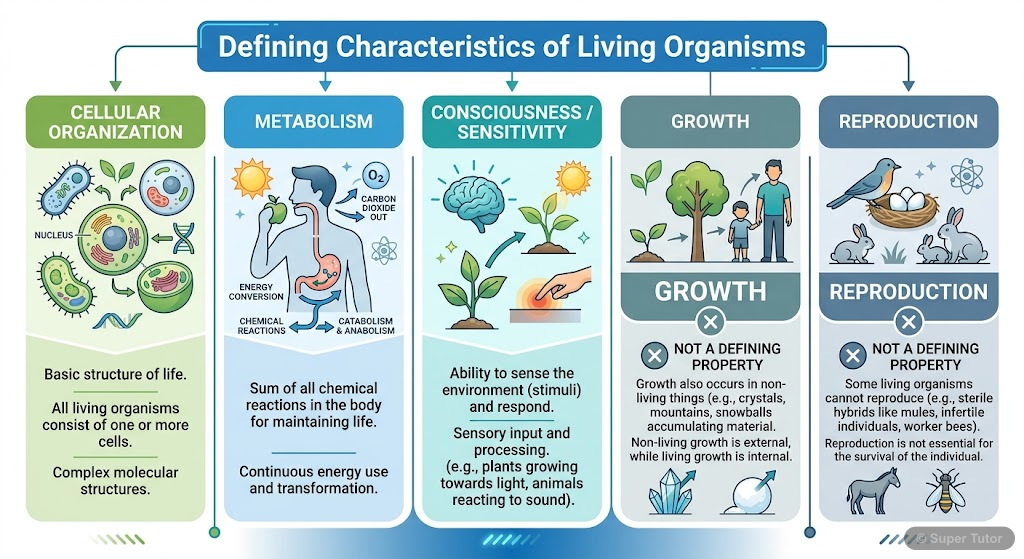
Learn better with visuals Super Tutor pairs illustrations like this with notes and quizzes for The Living World.
Important Questions from The Living World
The genus Panthera includes lion (Panthera leo), tiger (Panthera tigris), and leopard (Panthera pardus). What does this grouping tell us about the relationship between these species?
Show answer
They share more common morphological features with each other than with species of other genera like Felis
Step 1: A genus is defined as a group of related species that share more characters in common compared to species of other genera. Step 2: Lion, tiger, and leopard all belong to genus Panthera because they share more morphological similarities with each other (large size, roaring ability, similar skull structure) than with cats of genus Felis. Step 3: They are DIFFERENT species — they do NOT freely interbreed (that would make them the same species). Step 4: They all belong to the same family (Felidae) AND the same order (Carnivora) — they are not in different orders. Step 5: While they are all
Which rule of binomial nomenclature is VIOLATED in the following name: 'mangifera Indica'?
Show answer
The generic name should start with a capital letter and the specific epithet should start with a small letter
Step 1: In binomial nomenclature, strict capitalization rules must be followed. Step 2: The first word (generic name / genus) MUST start with a CAPITAL letter. Step 3: The second word (specific epithet) MUST start with a SMALL (lowercase) letter. Step 4: In 'mangifera Indica' — 'mangifera' (genus) starts with a lowercase letter (violation!) and 'Indica' (specific epithet) starts with a capital letter (another violation!). Step 5: The correct form is 'Mangifera indica'. There is no rule requiring three components — binomial means two components, and the specific epithet always follows the gener
International Code of Botanical Nomenclature (ICBN) and International Code of Zoological Nomenclature (ICZN) were established to govern scientific naming. What is the PRIMARY purpose these codes serve?
Show answer
To ensure each organism has only one universally accepted scientific name, preventing duplication or confusion
Step 1: The fundamental problem in biology is that the same organism may have different local names in different countries, languages, or regions. Step 2: ICBN (for plants) and ICZN (for animals) provide universally agreed-upon principles and criteria for naming organisms. Step 3: These codes ensure: (a) each organism has only ONE valid scientific name, (b) the same name is not used for two different organisms, and (c) the description of the organism is accurate and universally understood. Step 4: While names are often in Latin, the codes do more than just translate — they govern all rules of
Solanum tuberosum (potato) and Solanum nigrum (black nightshade) belong to the same genus Solanum. What is the MOST precise conclusion we can draw from this?
Show answer
They are different species but share more morphological similarities with each other than with species of other genera
Step 1: The definition of a genus states that it comprises a group of related species which have more characters in common compared to species of other genera. Step 2: 'tuberosum' and 'nigrum' are DIFFERENT specific epithets — meaning they are DIFFERENT species. They cannot produce identical offspring when crossed (that would require being the same species). Step 3: Since they share the same genus name 'Solanum', it tells us they share more common morphological features with each other than with plants of other genera (like Petunia or Datura). Step 4: Belonging to the same genus does NOT mean
+41 more questions on The Living World (Punjab Board Class 11 Biology)
Practise AllFrequently Asked Questions
What are the important topics in The Living World for Punjab Board Class 11 Biology?
How many important questions are there in The Living World?
Sources & Official References
Content is aligned to the official syllabus. Refer to the board website for the latest curriculum.
More resources for The Living World
For serious students
Get the full The Living World chapter — start free.
Quizzes, flashcards, an AI doubt solver and a study plan for Punjab Board Class 11 Biology. Free to start, no card needed.