Chapter 4 of 5
Syllabus
Animal Kingdom — Syllabus
Punjab Board · Class 11 · Biology
What Animal Kingdom covers in Punjab Board Class 11 Biology: 4 topics, for the 2026-27 session. Part of the Punjab Board Class 11 Biology syllabus.
45 questions30 flashcards5 concepts
Interactive on Super Tutor
Studying Animal Kingdom? Get the full interactive chapter.
Quizzes, flashcards, AI doubt-solver and a step-by-step study plan — built for syllabus and more.
Free trial, no card needed.
Super Tutor
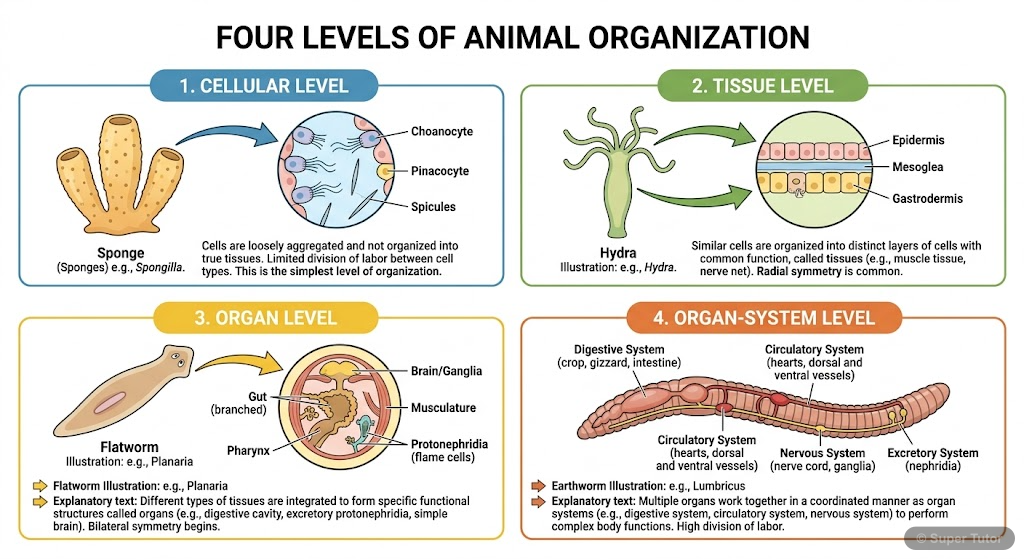
Learn better with visuals Super Tutor pairs illustrations like this with notes and quizzes for Animal Kingdom.
4 Topics · Punjab Board Class 11 Biology · 2026-27
Topics in Animal Kingdom
1
Basis of Classification - The Six Key Criteria
- Six fundamental features are used to classify animals: levels of organisation, symmetry, germinal layers, coelom, segmentation, and notochord.
- Levels of organisation progress from cellular → tissue → organ → organ-system level as we move from simpler to more complex animals.
- Cellular level: Porifera (sponges) — cells work together but no tissues formed.
2
Non-Chordate Phyla - Porifera to Hemichordata
- PORIFERA (Sponges): Marine, mostly asymmetrical, cellular level, water canal system (ostia → spongocoel → osculum), choanocytes/collar cells line canals, intracellular digestion, skeleton of spicules
- COELENTERATA (Cnidaria): Aquatic (mostly marine), radially symmetrical, diploblastic, tissue level, cnidoblasts with nematocysts on tentacles (for defense and prey capture), gastrovascular cavity with
- CTENOPHORA: Exclusively marine, radially symmetrical, diploblastic, tissue level, 8 rows of ciliated comb plates for locomotion, bioluminescence is marked, sexes not separate, only sexual reproduction
3
Phylum Chordata - Subphyla and Vertebrate Classes
- Three fundamental features of ALL Chordates: (1) Notochord, (2) Dorsal hollow nerve cord, (3) Paired pharyngeal gill slits.
- Additional chordate features: Bilateral symmetry, triploblastic, coelomate, organ-system level, post-anal tail, closed circulatory system.
- Chordata is divided into three subphyla: Urochordata (Tunicata), Cephalochordata, and Vertebrata.
4
Comparative Summary of All Phyla
- Porifera: Cellular, asymmetrical/various, no coelom, no segmentation, no digestive/circulatory/respiratory system — body with pores and canals.
- Coelenterata: Tissue, radial, no coelom, no segmentation, incomplete digestive system — cnidoblasts present.
- Ctenophora: Tissue, radial, no coelom, no segmentation, incomplete digestive system — comb plates for locomotion.
Key Concepts
Animals exhibit different levels of cellularAnimals can be classified based onThe coelom is a body cavitySegmentation is the division ofThe notochord is a flexible
Work through every topic in Animal Kingdom with notes and quizzes
Start This ChapterFrequently Asked Questions
What are the important topics in Animal Kingdom for Punjab Board Class 11 Biology?
Key topics in Animal Kingdom include Basis of Classification - The Six Key Criteria, Non-Chordate Phyla - Porifera to Hemichordata, Phylum Chordata - Subphyla and Vertebrate Classes, Comparative Summary of All Phyla. Study these first, then practise questions on each for Class 11 exams.
How should I revise Animal Kingdom for Class 11 exams?
Learn the core ideas first, then work through the 45 practice questions on Animal Kingdom. Revise definitions regularly and use flashcards for quick recall before the exam.
Sources & Official References
Content is aligned to the official syllabus. Refer to the board website for the latest curriculum.
More resources for Animal Kingdom
For serious students
Get the full Animal Kingdom chapter — start free.
Quizzes, flashcards, an AI doubt solver and a study plan for Punjab Board Class 11 Biology. Free to start, no card needed.