Some Basic Concepts of Chemistry — Important Questions
Punjab Board · Class 11 · Chemistry
44 important questions from Some Basic Concepts of Chemistry for Punjab Board Class 11 Chemistry, with answers. Includes multiple choice questions.
Interactive on Super Tutor
Studying Some Basic Concepts of Chemistry? Get the full interactive chapter.
Quizzes, flashcards, AI doubt-solver and a step-by-step study plan — built for important questions and more.
Free trial, no card needed.
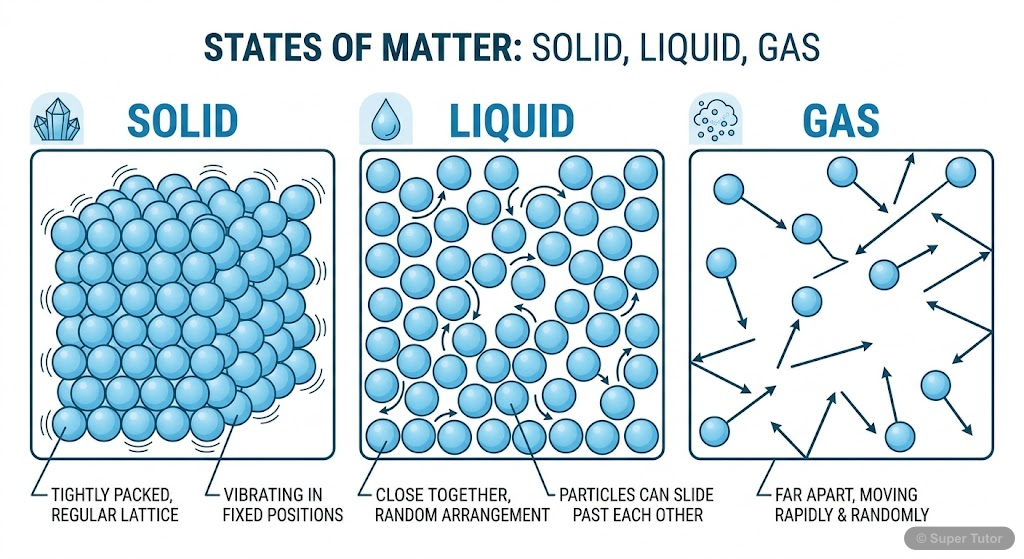
One of 17 illustrations for Some Basic Concepts of Chemistry in Super Tutor — alongside flashcards, concept maps and practice questions.
Important Questions from Some Basic Concepts of Chemistry
According to Avogadro's Law, 2 volumes of H₂ react with 1 volume of O₂ to give 2 volumes of water vapour. Which statement BEST explains why Dalton's original atomic theory FAILED to predict this result?
Show answer
Dalton believed atoms of the same element could not combine with each other, so he rejected diatomic molecules like H₂ and O₂
Step 1 - Recall Dalton's atomic theory: atoms are indivisible and atoms of the same element are identical; compounds form when atoms of DIFFERENT elements combine. Step 2 - The key flaw: Dalton believed same-type atoms CANNOT combine. This means he rejected the existence of H₂ and O₂ as diatomic molecules. Step 3 - Without diatomic molecules, the volume ratios cannot be explained. For example, if O is a single atom, you cannot get 2 water molecules from 1 oxygen. Step 4 - Avogadro later correctly proposed diatomic molecules (H₂, O₂) and his law of equal volumes containing equal molecules expla
A student dissolves 4 g of NaOH in enough water to prepare 250 mL of solution. What is the molarity of this NaOH solution? (Molar mass of NaOH = 40 g/mol)
Show answer
0.4 M
Step 1 - Write the formula: Molarity = moles of solute / volume of solution in litres. Step 2 - Calculate moles of NaOH: moles = mass / molar mass = 4 g / 40 g/mol = 0.1 mol. Step 3 - Convert volume to litres: 250 mL = 250/1000 = 0.25 L. Step 4 - Calculate molarity: M = 0.1 mol / 0.25 L = 0.4 mol/L = 0.4 M. Step 5 - Check: 0.1 M is wrong because it forgets to divide by 0.25 (not 1 L). 1.6 M multiplies instead of divides. 0.04 M divides moles by 2.5 instead of 0.25, a decimal point error.
Which of the following statements about the Law of Multiple Proportions is CORRECTLY illustrated?
Show answer
Carbon dioxide (CO₂) and carbon monoxide (CO): masses of oxygen combining with 12g of carbon are 32g and 16g — ratio 2:1
Step 1 - Recall Law of Multiple Proportions (Dalton, 1803): When two elements form more than one compound, masses of one element combining with a fixed mass of the other are in a simple whole number ratio. Step 2 - In CO: 12g C combines with 16g O. In CO₂: 12g C combines with 32g O. Step 3 - Ratio of oxygen masses = 16:32 = 1:2, a simple whole number ratio. This perfectly illustrates the law. Step 4 - Option B describes the Law of Definite Proportions (Proust), not multiple proportions. Step 5 - Option C describes Avogadro's Law. Option D describes Law of Conservation of Mass (Lavoisier). Each
The average atomic mass of chlorine is 35.5 u. Chlorine has two isotopes: ³⁵Cl (mass = 34.97 u) and ³⁷Cl (mass = 36.97 u). What is the approximate percentage abundance of ³⁵Cl?
Show answer
75%
Step 1 - Let the fractional abundance of ³⁵Cl = x. Then abundance of ³⁷Cl = (1 - x). Step 2 - Set up the weighted average equation: 34.97x + 36.97(1 - x) = 35.5. Step 3 - Expand: 34.97x + 36.97 - 36.97x = 35.5. Simplify: -2x = 35.5 - 36.97 = -1.47. Step 4 - Solve: x = 1.47/2 = 0.735 ≈ 0.75. Step 5 - % abundance of ³⁵Cl = 75%. This makes physical sense because the average (35.5) is much closer to 35 than to 37, indicating ³⁵Cl is more abundant. 50% would give average = 35.97, not 35.5. 25% is the abundance of ³⁷Cl.
+40 more questions on Some Basic Concepts of Chemistry (Punjab Board Class 11 Chemistry)
Practise AllFrequently Asked Questions
What are the important topics in Some Basic Concepts of Chemistry for Punjab Board Class 11 Chemistry?
How many important questions are there in Some Basic Concepts of Chemistry?
Sources & Official References
Content is aligned to the official syllabus. Refer to the board website for the latest curriculum.
More resources for Some Basic Concepts of Chemistry
For serious students
Get the full Some Basic Concepts of Chemistry chapter — start free.
Quizzes, flashcards, an AI doubt solver and a study plan for Punjab Board Class 11 Chemistry. Free to start, no card needed.