Some Basic Concepts of Chemistry — Flashcards
Punjab Board · Class 11 · Chemistry
32 flashcards for Some Basic Concepts of Chemistry (Punjab Board Class 11 Chemistry) to test yourself on key terms and facts.
Interactive on Super Tutor
Studying Some Basic Concepts of Chemistry? Get the full interactive chapter.
Quizzes, flashcards, AI doubt-solver and a step-by-step study plan — built for flashcards and more.
Free trial, no card needed.
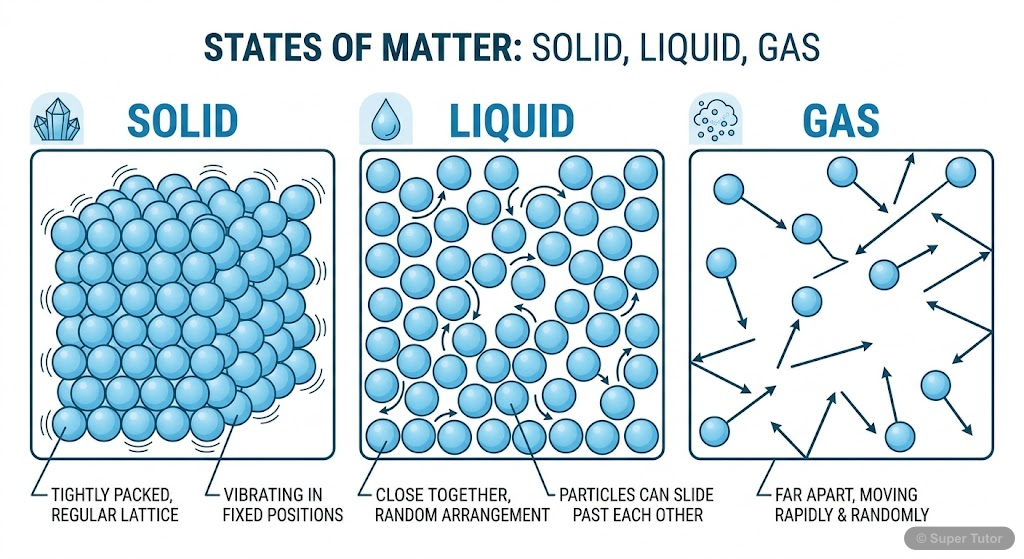
One of 17 illustrations for Some Basic Concepts of Chemistry in Super Tutor — alongside flashcards, concept maps and practice questions.
What is the difference between an element and a compound?
Answer
Element: A pure substance containing only one type of atom. Examples: Iron (Fe), Oxygen (O₂), Copper (Cu). Atoms of one element cannot be separated by physical methods. Compound: A pure substance for…
Define mixture. What are the two types of mixtures?
Answer
Mixture: A combination of two or more pure substances in any proportion where components retain their individual properties. Types: 1. Homogeneous Mixture: Components uniformly distributed throughout…
What are the three states of matter and their characteristics?
Answer
1. Solid: Definite shape and definite volume. Particles are tightly packed in orderly arrangement. Particles have very limited movement. Example: Ice, salt crystal. 2. Liquid: Definite volume but no …
Convert 25°C to Kelvin and Fahrenheit.
Answer
Given: Temperature in Celsius = 25°C Conversion to Kelvin: K = °C + 273.15 K = 25 + 273.15 = 298.15 K ≈ 298 K Conversion to Fahrenheit: °F = (9/5)(°C) + 32 °F = (9/5)(25) + 32 °F = (225/5) + 32 °F =…
Calculate the density of an object with mass 50 g and volume 25 cm³.
Answer
Formula: Density = Mass / Volume Given: Mass = 50 g Volume = 25 cm³ Solution: Density = 50 g / 25 cm³ Density = 2 g/cm³ To convert to SI units (kg/m³): 2 g/cm³ × 1000 = 2000 kg/m³ Answer: 2 g/cm³ …
How many significant figures are in the following numbers? (a) 0.0052 (b) 2.005 (c) 100.0
Answer
Significant figures rules: - Non-zero digits are always significant - Zeros between non-zero digits are significant - Leading zeros are NOT significant - Trailing zeros after decimal point ARE signifi…
Express 0.000456 in scientific notation.
Answer
Scientific notation format: N × 10ⁿ where 1 ≤ N < 10 For 0.000456: Step 1: Move decimal point to get a number between 1 and 10. Move decimal 4 places to the right: 4.56 Step 2: Count the places move…
Convert 2.5 liters to cubic centimeters and cubic meters.
Answer
Given: Volume = 2.5 L Conversion to cm³: 1 L = 1000 cm³ 2.5 L = 2.5 × 1000 = 2500 cm³ Conversion to m³: 1 L = 0.001 m³ (or 1 L = 10⁻³ m³) 2.5 L = 2.5 × 0.001 = 0.0025 m³ Alternatively: 2500 cm³ = 2…
+24 more flashcards
Practise AllFrequently Asked Questions
What are the important topics in Some Basic Concepts of Chemistry for Punjab Board Class 11 Chemistry?
How many flashcards are available for Some Basic Concepts of Chemistry?
How should I revise Some Basic Concepts of Chemistry for Class 11 exams?
Sources & Official References
Content is aligned to the official syllabus. Refer to the board website for the latest curriculum.
More resources for Some Basic Concepts of Chemistry
Practice Quiz
Test yourself with a quick quiz
Important Questions
Exam-style questions with answers
Revision Notes
Key points for last-minute revision
Formula Sheet
The chapter's formulas in one place
Chapter Summary
Understand the chapter at a glance
Concept Maps
See how topics connect
Syllabus
What topics to cover
For serious students
Get the full Some Basic Concepts of Chemistry chapter — start free.
Quizzes, flashcards, an AI doubt solver and a study plan for Punjab Board Class 11 Chemistry. Free to start, no card needed.