Thermodynamics — Important Questions
Punjab Board · Class 11 · Chemistry
45 important questions from Thermodynamics for Punjab Board Class 11 Chemistry, with answers. Includes multiple choice questions.
Interactive on Super Tutor
Studying Thermodynamics? Get the full interactive chapter.
Quizzes, flashcards, AI doubt-solver and a step-by-step study plan — built for important questions and more.
Free trial, no card needed.
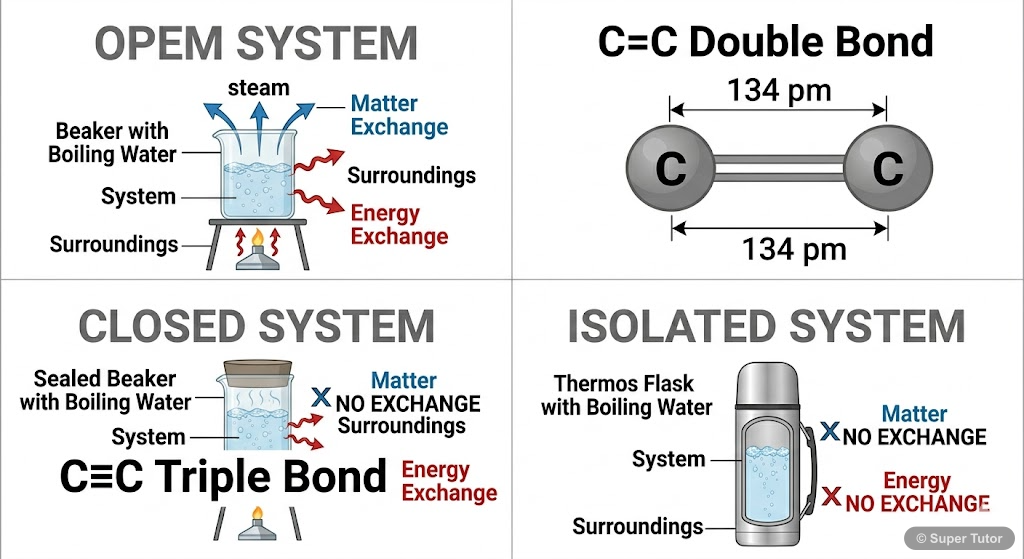
One of 2 illustrations for Thermodynamics in Super Tutor — alongside flashcards, concept maps and practice questions.
Important Questions from Thermodynamics
The relationship between ΔH and ΔU for a gaseous reaction is given by which equation?
Show answer
ΔH = ΔU + Δn_g RT
Step 1: We know ΔH = ΔU + pΔV at constant pressure. Step 2: For gases, using ideal gas law: pΔV = Δn_g RT, where Δn_g = moles of gaseous products − moles of gaseous reactants. Step 3: Substituting: ΔH = ΔU + Δn_g RT. Step 4: This equation is very useful — if Δn_g = 0 (equal moles of gas on both sides), then ΔH = ΔU. If Δn_g > 0 (more moles of gas produced), ΔH > ΔU. Step 5: The option ΔH = ΔU − Δn_g RT is incorrect as the sign is wrong. The other two options mix up variables incorrectly.
A bomb calorimeter is used to measure:
Show answer
Heat change at constant volume (ΔU)
Step 1: A bomb calorimeter consists of a strong sealed steel vessel (the bomb) immersed in a water bath. Step 2: Since the bomb is sealed and rigid, its volume cannot change — it operates at constant volume (ΔV = 0). Step 3: At constant volume, no pressure-volume work is done (w = 0), so ΔU = q_V — the heat measured equals the change in internal energy. Step 4: The heat released by the reaction warms the surrounding water, and by measuring the temperature rise, we can calculate q_V = C_V × ΔT. Step 5: To measure ΔH at constant pressure, we use a simple open calorimeter. Entropy and Gibbs energ
Hess's Law states that the enthalpy change of a reaction:
Show answer
Is the same whether the reaction occurs in one step or multiple steps
Step 1: Hess's Law is a direct consequence of enthalpy being a state function — meaning ΔH depends only on initial and final states, not on the path taken. Step 2: Hess's Law states: if a reaction takes place in several steps, the standard reaction enthalpy equals the sum of enthalpies of all intermediate steps. Step 3: This is extremely useful for reactions where direct measurement is impossible. For example, C(s) + ½O₂(g) → CO(g) cannot be measured directly, but can be calculated using enthalpies of other reactions. Step 4: Hess's Law allows us to add, subtract, or reverse thermochemical equ
The standard enthalpy of formation (Δ_f H°) of an element in its most stable reference state is:
Show answer
Zero
Step 1: Standard enthalpy of formation is defined as the enthalpy change when one mole of a compound is formed from its elements in their most stable reference states at 298 K and 1 bar. Step 2: By convention, elements in their most stable reference state are assigned Δ_f H° = 0. Step 3: Examples of reference states: H₂(g), O₂(g), C(graphite), S(rhombic), Na(s), Fe(s) — all have Δ_f H° = 0. Step 4: This makes logical sense — forming an element from itself involves no chemical change, so no enthalpy change occurs. Step 5: Any non-zero value would be incorrect. This convention helps us calculate
+41 more questions on Thermodynamics (Punjab Board Class 11 Chemistry)
Practise AllFrequently Asked Questions
What are the important topics in Thermodynamics for Punjab Board Class 11 Chemistry?
How many important questions are there in Thermodynamics?
Sources & Official References
Content is aligned to the official syllabus. Refer to the board website for the latest curriculum.
More resources for Thermodynamics
For serious students
Get the full Thermodynamics chapter — start free.
Quizzes, flashcards, an AI doubt solver and a study plan for Punjab Board Class 11 Chemistry. Free to start, no card needed.