Chapter 1 of 5
Revision Notes
Some Basic Concepts of Chemistry — Revision Notes
Punjab Board · Class 11 · Chemistry
Some Basic Concepts of Chemistry revision notes for Punjab Board Class 11 Chemistry: 4 topics in quick points.
44 questions32 flashcards2 formulas & key relations5 concepts
Interactive on Super Tutor
Studying Some Basic Concepts of Chemistry? Get the full interactive chapter.
Quizzes, flashcards, AI doubt-solver and a step-by-step study plan — built for revision notes and more.
Free trial, no card needed.
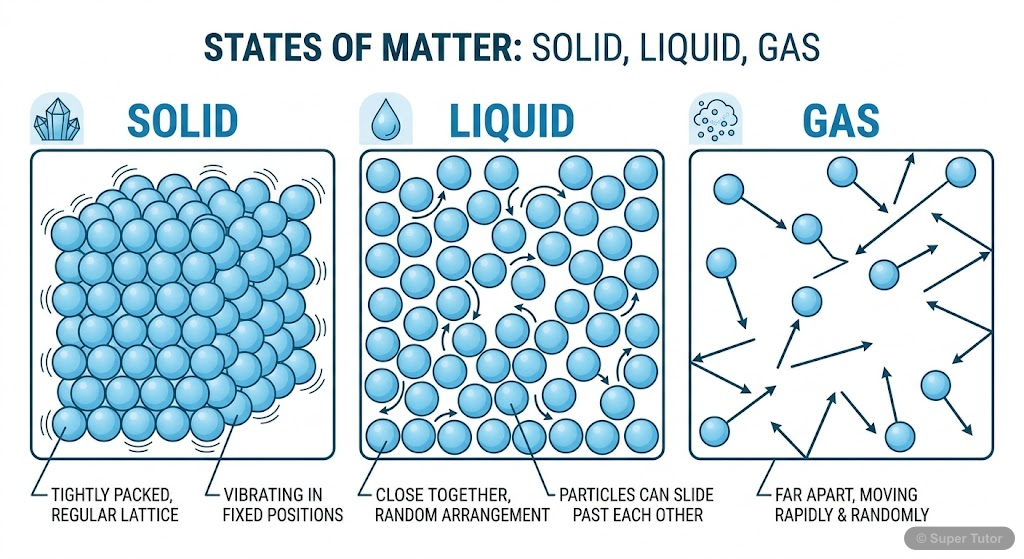
Super Tutor
One of 17 illustrations for Some Basic Concepts of Chemistry in Super Tutor — alongside flashcards, concept maps and practice questions.
Key Topics to Revise
1
1. Nature of Matter
- Matter is anything that has mass and occupies space.
- Three physical states of matter: Solid, Liquid, and Gas.
- In solids, particles are tightly packed in an orderly arrangement – definite shape and volume.
2
2. Properties of Matter and Their Measurement (SI Units)
- Physical properties can be measured without changing the substance (e.g., colour, melting point, density).
- Chemical properties require a chemical change to observe (e.g., combustibility, reactivity with acids).
- The International System of Units (SI) has 7 base units established in 1960.
3
3. Uncertainty in Measurement: Scientific Notation and Significant Figures
- Scientific Notation: Any number expressed as N × 10ⁿ where 1 ≤ N < 10 and n is an integer (positive or negative).
- Used for very large (e.g., 6.022 × 10²³) or very small numbers (e.g., 1.66 × 10⁻²⁴ g).
- For multiplication/division in scientific notation: multiply/divide coefficients and add/subtract exponents.
4
4. Laws of Chemical Combination
- Five fundamental laws govern how elements combine to form compounds.
- Law 1 – Conservation of Mass (Lavoisier, 1789): In a chemical reaction, mass of reactants = mass of products. Matter is neither created nor destroyed.
- Law 2 – Definite Proportions (Proust): A given compound always contains the same elements in the same fixed proportion by mass, regardless of source.
Get complete notes with diagrams and examples
Full NotesKey Concepts
Matter exists in three physical statesMatter is classified into pure substancesThe SI system provides seven baseFive fundamental laws govern how substancesAtomic mass (measured in atomic mass
Frequently Asked Questions
What are the important topics in Some Basic Concepts of Chemistry for Punjab Board Class 11 Chemistry?
Key topics in Some Basic Concepts of Chemistry include Nature of Matter, Properties of Matter and Their Measurement (SI Units), Uncertainty in Measurement: Scientific Notation and Significant Figures, Laws of Chemical Combination. Study these first, then practise questions on each for Class 11 exams.
How should I revise Some Basic Concepts of Chemistry for Class 11 exams?
Learn the core ideas first, then work through the 44 practice questions on Some Basic Concepts of Chemistry. Revise definitions regularly and use flashcards for quick recall before the exam.
Sources & Official References
Content is aligned to the official syllabus. Refer to the board website for the latest curriculum.
More resources for Some Basic Concepts of Chemistry
For serious students
Get the full Some Basic Concepts of Chemistry chapter — start free.
Quizzes, flashcards, an AI doubt solver and a study plan for Punjab Board Class 11 Chemistry. Free to start, no card needed.