Human Reproduction — Chapter Summary
Punjab Board · Class 12 · Biology
Summary of Human Reproduction for Punjab Board Class 12 Biology. Part of the Punjab Board Class 12 Biology syllabus.
Interactive on Super Tutor
Studying Human Reproduction? Get the full interactive chapter.
Quizzes, flashcards, AI doubt-solver and a step-by-step study plan — built for chapter summary and more.
Free trial, no card needed.
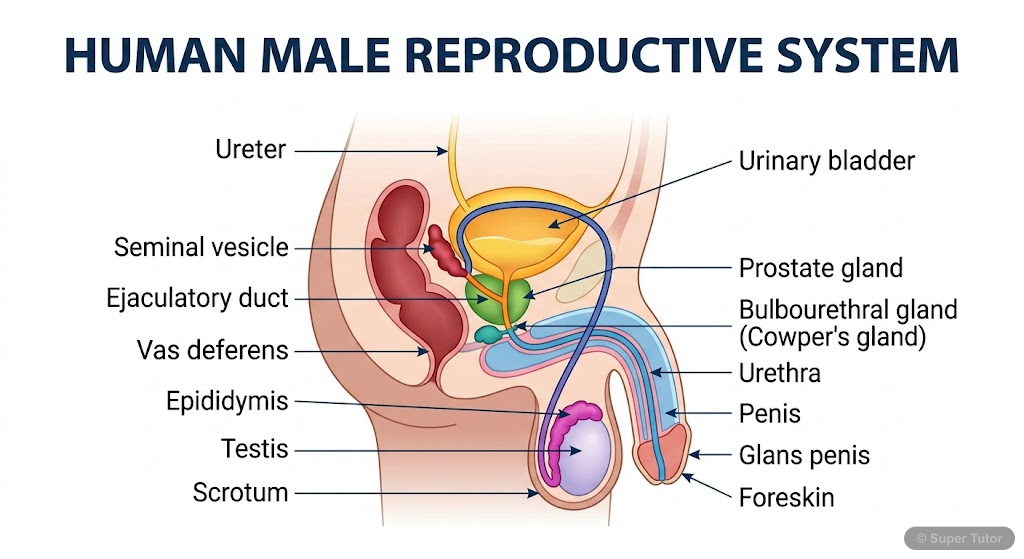
One of 12 illustrations for Human Reproduction in Super Tutor — alongside flashcards, concept maps and practice questions.
Overview
Human reproduction is a fundamental biological process that involves the formation of gametes (sperms and ova), their fusion during fertilization, and the subsequent development of a new individual. Humans are sexually reproducing organisms that are viviparous, meaning they produce live young that d
Key Concepts
The male reproductive system consists
The male reproductive system consists of paired testes located in the scrotum, accessory ducts (epididymis, vas deferens, urethra), accessory glands (
The female reproductive system includes paired
The female reproductive system includes paired ovaries, oviducts (fallopian tubes), uterus, cervix, vagina, and external genitalia. The ovaries produc
Spermatogenesis is the process of sperm
Spermatogenesis is the process of sperm formation occurring in seminiferous tubules of the testis. It begins at puberty and continues throughout adult
Oogenesis is the formation of mature
Oogenesis is the formation of mature female gametes (ova) and differs markedly from spermatogenesis. During embryonic development, oogonia develop in
A mature sperm is a microscopic
A mature sperm is a microscopic structure composed of four parts: (1) Head containing haploid nucleus covered by acrosome (enzyme-filled cap), (2) Nec
Learning Objectives
- Understand the structure and functions of the male reproductive system
- Understand the structure and functions of the female reproductive system
- Learn the process of gametogenesis (spermatogenesis and oogenesis)
- Comprehend the menstrual cycle and its hormonal regulation
- Understand fertilization, implantation, and early embryonic development
Frequently Asked Questions
What are the important topics in Human Reproduction for Punjab Board Class 12 Biology?
How should I revise Human Reproduction for the Punjab Board Class 12 board exam?
Sources & Official References
Content is aligned to the official syllabus. Refer to the board website for the latest curriculum.
More resources for Human Reproduction
For serious students
Get the full Human Reproduction chapter — start free.
Quizzes, flashcards, an AI doubt solver and a study plan for Punjab Board Class 12 Biology. Free to start, no card needed.