Sexual Reproduction in Flowering Plants — Chapter Summary
Punjab Board · Class 12 · Biology
Summary of Sexual Reproduction in Flowering Plants for Punjab Board Class 12 Biology. Part of the Punjab Board Class 12 Biology syllabus.
Interactive on Super Tutor
Studying Sexual Reproduction in Flowering Plants? Get the full interactive chapter.
Quizzes, flashcards, AI doubt-solver and a step-by-step study plan — built for chapter summary and more.
Free trial, no card needed.
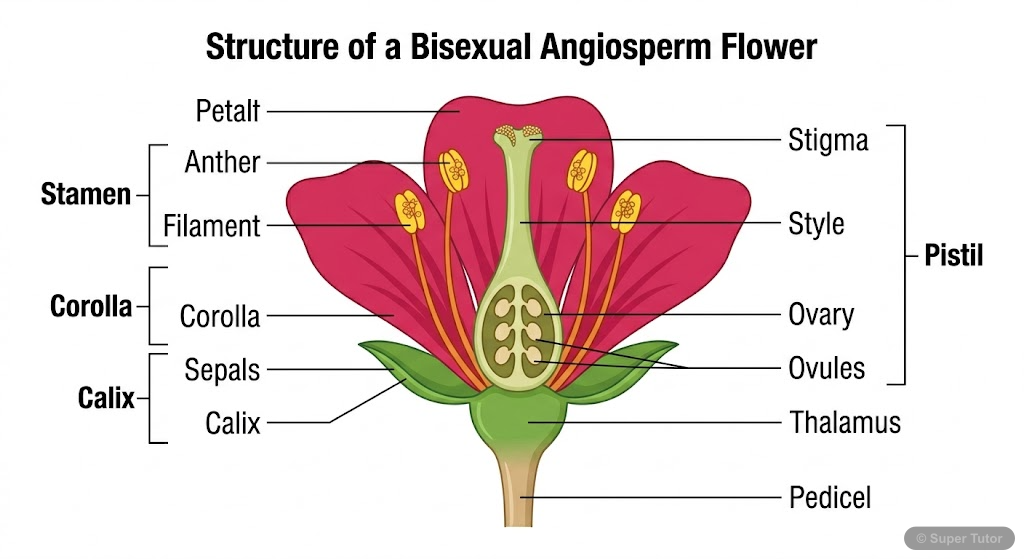
Learn better with visuals Super Tutor pairs illustrations like this with notes and quizzes for Sexual Reproduction in Flowering Plants.
Overview
Flowering plants (angiosperms) exhibit a complex and elegant system of sexual reproduction centered around the flower. Unlike lower plants that depend on water for male gamete transport, flowering plants have evolved sophisticated mechanisms for pollination and fertilization. The flower serves not o
Key Concepts
A typical flower consists of four
A typical flower consists of four whorls: sepals (protective), petals (attractive), androecium or stamens (male reproductive organs), and gynoecium or
Microsporogenesis is the process of microspore
Microsporogenesis is the process of microspore formation from pollen mother cells (PMCs) through meiosis. The sporogenous tissue in the anther's cente
Megasporogenesis occurs in the nucellus
Megasporogenesis occurs in the nucellus of the ovule, where a single megaspore mother cell (MMC) undergoes meiosis to produce four megaspores. In most
Pollination is the transfer of pollen
Pollination is the transfer of pollen from anther to stigma. Three types exist: (1) Autogamy - pollen transfer within the same flower, common in cleis
Following pollination
Following pollination, the pistil recognizes whether pollen is compatible (same species, not self if self-incompatible) or incompatible (wrong species
Learning Objectives
- Understand the morphology and structure of flower parts involved in sexual reproduction
- Explain the development of male gametophyte (pollen grain) through microsporogenesis
- Explain the development of female gametophyte (embryo sac) through megasporogenesis
- Describe the process and agents of pollination and the mechanisms preventing self-pollination
- Analyze pollen-pistil interactions and compatibility mechanisms
Frequently Asked Questions
What are the important topics in Sexual Reproduction in Flowering Plants for Punjab Board Class 12 Biology?
How should I revise Sexual Reproduction in Flowering Plants for the Punjab Board Class 12 board exam?
Sources & Official References
Content is aligned to the official syllabus. Refer to the board website for the latest curriculum.
More resources for Sexual Reproduction in Flowering Plants
For serious students
Get the full Sexual Reproduction in Flowering Plants chapter — start free.
Quizzes, flashcards, an AI doubt solver and a study plan for Punjab Board Class 12 Biology. Free to start, no card needed.