Human Reproduction — Practice Quiz
Punjab Board · Class 12 · Biology
Try a 4-question quiz on Human Reproduction for Punjab Board Class 12 Biology: tap an answer to check it and see why.
Interactive on Super Tutor
Studying Human Reproduction? Get the full interactive chapter.
Quizzes, flashcards, AI doubt-solver and a step-by-step study plan — built for practice quiz and more.
Free trial, no card needed.
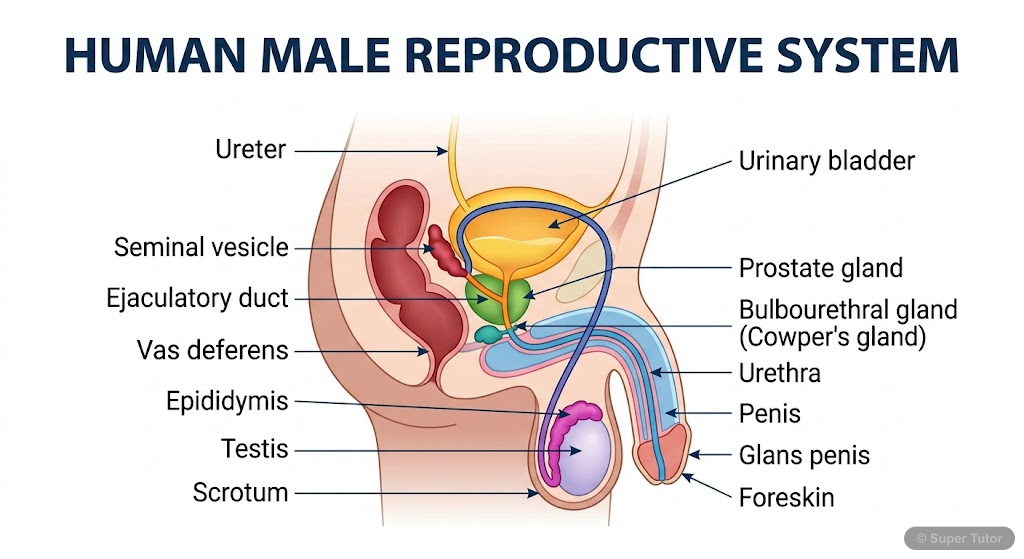
One of 12 illustrations for Human Reproduction in Super Tutor — alongside flashcards, concept maps and practice questions.
Quick Quiz: Human Reproduction
0/4Tap an answer to check it instantly. No sign-up needed for these 4.
During spermatogenesis, a primary spermatocyte undergoes meiosis I and meiosis II. If a single primary spermatocyte starts the process, what is the correct chromosomal composition of the final spermatids produced?
Which of the following correctly describes the role of Sertoli cells and Leydig cells in the testes?
During oogenesis, the secondary oocyte completes its second meiotic division only when:
The LH surge on approximately the 14th day of the menstrual cycle is critical because it directly triggers:
Sample Questions
Which structure is responsible for producing hCG (human chorionic gonadotropin) during early pregnancy, and what is its primary function?
Show answer
Placenta; it maintains the corpus luteum to sustain progesterone production
Step 1: After implantation, the trophoblast cells of the developing placenta begin secreting hCG. Step 2: hCG acts on the corpus luteum and prevents its degeneration. Step 3: The corpus luteum, maintained by hCG, continues to secrete progesterone, which is essential to maintain the endometrium and support early pregnancy. Step 4: Option B is wrong — FSH (not hCG) from the anterior pituitary stimulates follicle development. Step 5: Option C is wrong — the corpus luteum secretes progesterone but does NOT produce hCG; it is the placenta (trophoblast) that does. Option D is wrong — the endometrium
A sperm reaches the ampullary region of the fallopian tube. It comes in contact with the ovum. Which of the following correctly describes the sequence of events immediately after sperm-ovum contact?
Show answer
Acrosomal enzymes dissolve zona pellucida → sperm enters → meiosis II of oocyte completes → polar body released → haploid nuclei fuse → zygote formed
Step 1: The acrosome at the tip of the sperm head contains hydrolytic enzymes. These enzymes dissolve the zona pellucida, allowing the sperm to penetrate. Step 2: Sperm contact with the plasma membrane of the oocyte triggers a cortical reaction that prevents polyspermy (no additional sperms can enter). Step 3: The sperm entry stimulates the secondary oocyte to complete meiosis II, releasing the second polar body and forming a haploid ovum (ootid). Step 4: The haploid sperm nucleus and haploid ovum nucleus then fuse to form a diploid zygote (46 chromosomes). Step 5: Options B, C, and D all plac
In oogenesis, which of the following statements correctly distinguishes it from spermatogenesis regarding the number of functional gametes produced per primary cell?
Show answer
One primary spermatocyte gives 4 functional sperms; one primary oocyte gives only 1 functional ovum and 3 polar bodies
Step 1: In spermatogenesis, meiosis is equal — both divisions produce cells of equal size. One primary spermatocyte → 2 secondary spermatocytes → 4 spermatids → 4 functional sperms. Step 2: In oogenesis, meiosis is unequal. Meiosis I produces one large secondary oocyte and one tiny first polar body. Step 3: Meiosis II (after fertilisation) produces one large ootid (functional ovum) and one tiny second polar body. Step 4: The first polar body may divide into two, giving a total of 3 polar bodies and 1 functional ovum. Step 5: The unequal division ensures the ovum retains maximum cytoplasm and n
The scrotum maintains a temperature of 2–2.5°C lower than body temperature. What would most likely happen if the testes remained inside the abdominal cavity?
Show answer
Spermatogenesis would be impaired because higher temperature denatures enzymes required for sperm production
Step 1: Spermatogenesis is a highly temperature-sensitive process. The enzymes and cellular processes involved function optimally at 2–2.5°C below normal body temperature (37°C). Step 2: This is why the testes descend into the scrotum outside the body cavity — the scrotum acts as a temperature regulator. Step 3: If testes remain in the abdomen (a condition called cryptorchidism), the higher temperature inside would inhibit or destroy spermatogenesis, leading to infertility. Step 4: Option B is incorrect — Leydig cells are less temperature-sensitive and continue to secrete androgens even in cry
+41 more questions on Human Reproduction (Punjab Board Class 12 Biology)
Practise AllFrequently Asked Questions
What are the important topics in Human Reproduction for Punjab Board Class 12 Biology?
How many practice questions are there for Human Reproduction?
Sources & Official References
Content is aligned to the official syllabus. Refer to the board website for the latest curriculum.
More resources for Human Reproduction
For serious students
Get the full Human Reproduction chapter — start free.
Quizzes, flashcards, an AI doubt solver and a study plan for Punjab Board Class 12 Biology. Free to start, no card needed.