Sexual Reproduction in Flowering Plants
Punjab Board · Class 12 · Biology
Most important questions from Sexual Reproduction in Flowering Plants for Punjab Board Class 12 Biology board exam 2026. MCQs, short answer, and long answer questions with marks.
Interactive on Super Tutor
Studying Sexual Reproduction in Flowering Plants? Get the full interactive chapter.
Quizzes, flashcards, AI doubt-solver and a step-by-step study plan — built for important questions and more.
1,000+ Class 12 students started this chapter today
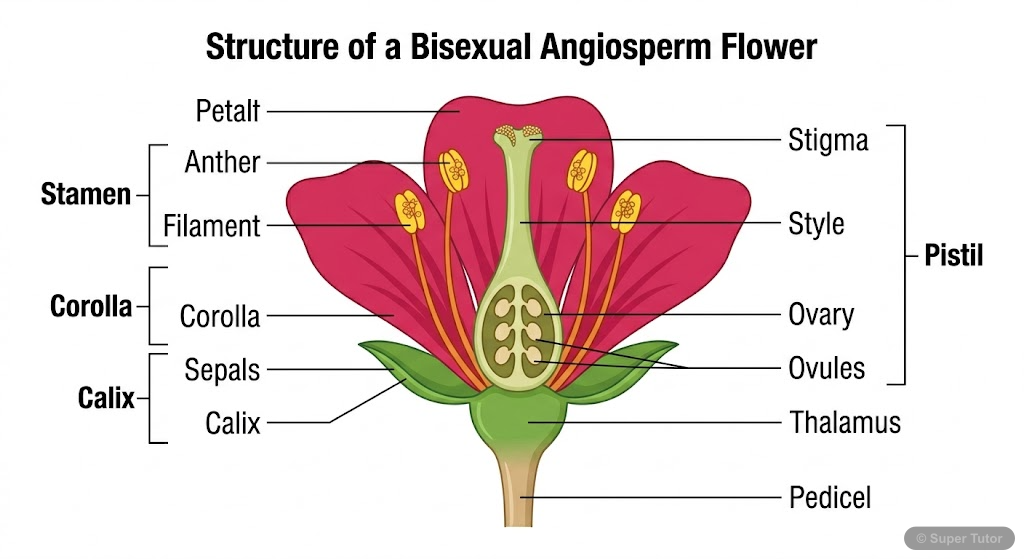
Learn better with visuals Super Tutor has hundreds of illustrations like this across every chapter — all free to try.
Get startedSample Questions
Which layer of the microsporangium wall nourishes the developing pollen grains?
Show answer
Tapetum
Step 1: The microsporangium wall has four layers — epidermis, endothecium, middle layers, and tapetum. Step 2: The tapetum is the innermost wall layer and it plays a very important role. Step 3: It nourishes the developing pollen grains. Tapetal cells have dense cytoplasm and often more than one nucleus, which supports their nutritive function. Step 4: Epidermis, endothecium, and middle layers mainly provide protection and help in anther dehiscence (opening). Step 5: So, tapetum is the nutritive layer — this is an important exam point.
What is the process of formation of microspores from the pollen mother cell called?
Show answer
Microsporogenesis
Step 1: The pollen mother cell (PMC) undergoes meiosis to produce microspores. Step 2: This process of forming microspores from PMC through meiosis is called microsporogenesis. Step 3: Megasporogenesis, on the other hand, is the formation of megaspores from the megaspore mother cell (MMC) — this happens in the ovule, not the anther. Step 4: The result of microsporogenesis is a microspore tetrad — a cluster of 4 microspores. Step 5: Each microspore then matures into a pollen grain (male gametophyte). So, microsporogenesis is the correct term.
In double fertilisation, the fusion of one male gamete with two polar nuclei produces:
Show answer
Primary Endosperm Nucleus
Step 1: Double fertilisation is a unique feature of angiosperms and involves two fusion events. Step 2: First fusion (Syngamy): One male gamete fuses with the egg cell → produces a diploid zygote → develops into embryo. Step 3: Second fusion (Triple fusion): The second male gamete fuses with the two polar nuclei in the central cell → produces a triploid Primary Endosperm Nucleus (PEN). Step 4: The PEN is triploid (3n) because it results from the fusion of 3 haploid nuclei. Step 5: The central cell after triple fusion becomes the Primary Endosperm Cell (PEC) and eventually develops into the end
Which of the following plants is an example of water pollination (hydrophily)?
Show answer
Vallisneria
Step 1: Pollination by water is called hydrophily and it is quite rare in flowering plants, limited to about 30 genera. Step 2: Vallisneria is a freshwater plant where the female flowers reach the surface of water through a long stalk, and male flowers or pollen grains are released on the water surface. Step 3: Pollen grains are carried by water currents and reach the female flowers. Step 4: Maize is pollinated by wind (anemophily) — you can see the feathery stigma (tassels) that trap airborne pollen. Step 5: Rose and sunflower are insect-pollinated (entomophily). So Vallisneria is the correct
+41 more questions available
Practice AllFrequently Asked Questions
What are the important topics in Sexual Reproduction in Flowering Plants for Punjab Board Class 12 Biology?
How to score full marks in Sexual Reproduction in Flowering Plants — Punjab Board Class 12 Biology?
How many important questions are there in Sexual Reproduction in Flowering Plants?
Sources & Official References
Content is aligned to the official syllabus. Refer to the board website for the latest curriculum.
More resources for Sexual Reproduction in Flowering Plants
Practice Quiz
Test yourself with a quick quiz
Revision Notes
Key points for last-minute revision
Formula Sheet
All formulas in one place
Chapter Summary
Understand the chapter at a glance
Concept Maps
See how topics connect visually
Study Plan
Step-by-step plan to ace this chapter
Flashcards
Quick-fire cards for active recall
Syllabus
What topics to cover
NCERT Solutions
Every textbook question solved step by step
For serious students
Get the full Sexual Reproduction in Flowering Plants chapter — for free.
Quizzes, flashcards, AI doubt-solver and a step-by-step study plan for Punjab Board Class 12 Biology.