Chapter 4 of 5
Revision Notes
Principles of Inheritance and Variation — Revision Notes
Punjab Board · Class 12 · Biology
Principles of Inheritance and Variation revision notes for Punjab Board Class 12 Biology: 4 topics in quick points.
42 questions31 flashcards5 concepts
Interactive on Super Tutor
Studying Principles of Inheritance and Variation? Get the full interactive chapter.
Quizzes, flashcards, AI doubt-solver and a step-by-step study plan — built for revision notes and more.
Free trial, no card needed.
Super Tutor
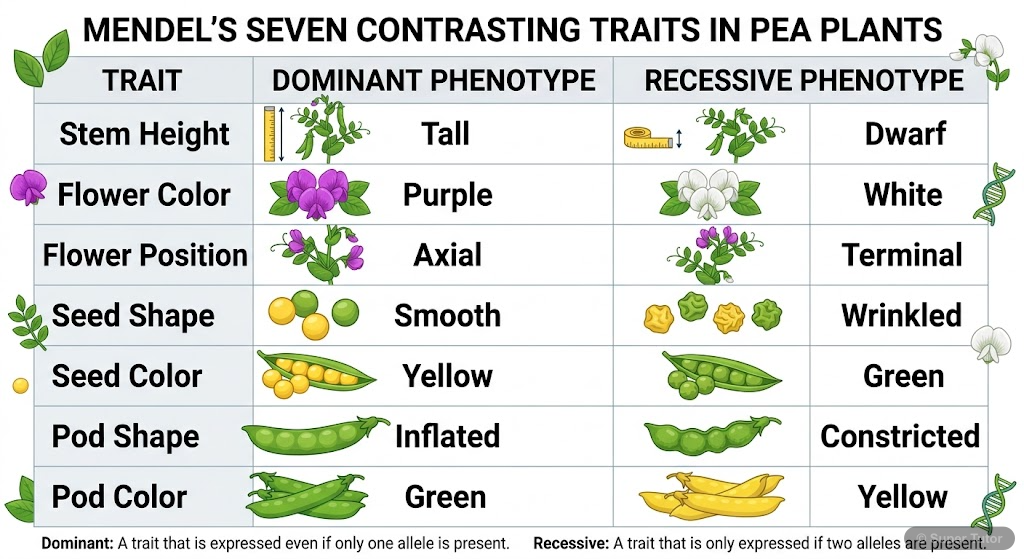
One of 15 illustrations for Principles of Inheritance and Variation in Super Tutor — alongside flashcards, concept maps and practice questions.
Key Topics to Revise
1
Mendel's Experiments and Laws of Inheritance
- Mendel worked on Pisum sativum (garden pea) for 7 years (1856–1863) and studied 7 pairs of contrasting traits.
- He used true-breeding lines – plants that show stable trait inheritance over several generations through continuous self-pollination.
- The 7 contrasting traits: Stem height (Tall/Dwarf), Flower colour (Violet/White), Flower position (Axial/Terminal), Pod shape (Inflated/Constricted), Pod colour (Green/Yellow), Seed shape (Round/Wrink
2
Inheritance of One Gene – Monohybrid Cross
- Monohybrid cross: Cross between parents differing in ONE pair of contrasting traits.
- Example: Tall (TT) × Dwarf (tt) → F1: All Tall (Tt) → F2: 3 Tall : 1 Dwarf.
- F1 phenotypic ratio: 1 (all Tall) | F2 phenotypic ratio: 3 Tall : 1 Dwarf.
3
Inheritance of Two Genes – Dihybrid Cross and Law of Independent Assortment
- Dihybrid cross: Cross between parents differing in TWO pairs of contrasting traits.
- Example: RRYY (Round, Yellow) × rryy (Wrinkled, Green) → F1: All RrYy (Round, Yellow).
- F1 self-pollination → F2 phenotypic ratio: 9 Round Yellow : 3 Wrinkled Yellow : 3 Round Green : 1 Wrinkled Green = 9:3:3:1.
4
Chromosomal Theory of Inheritance, Linkage and Recombination
- Chromosomal Theory of Inheritance was proposed by Walter Sutton and Theodore Boveri (1902).
- They noted that chromosome behaviour during meiosis parallels the behaviour of Mendel's factors (genes).
- Both chromosomes and genes: (a) occur in pairs, (b) segregate during gamete formation, (c) independent pairs segregate independently.
Get complete notes with diagrams and examples
Full NotesKey Concepts
Genes are units of inheritance containingWhen two contrasting alleles existDuring gamete formation (meiosis)When two or more gene pairsGenotype refers to the genetic composition
Frequently Asked Questions
What are the important topics in Principles of Inheritance and Variation for Punjab Board Class 12 Biology?
Key topics in Principles of Inheritance and Variation include Mendel's Experiments and Laws of Inheritance, Inheritance of One Gene – Monohybrid Cross, Inheritance of Two Genes – Dihybrid Cross and Law of Independent Assortment, Chromosomal Theory of Inheritance, Linkage and Recombination. Study these first, then practise questions on each for the Punjab Board Class 12 board exam.
How should I revise Principles of Inheritance and Variation for the Punjab Board Class 12 board exam?
Learn the core ideas first, then work through the 42 practice questions on Principles of Inheritance and Variation. Revise definitions regularly and use flashcards for quick recall before the exam.
Sources & Official References
Content is aligned to the official syllabus. Refer to the board website for the latest curriculum.
More resources for Principles of Inheritance and Variation
For serious students
Get the full Principles of Inheritance and Variation chapter — start free.
Quizzes, flashcards, an AI doubt solver and a study plan for Punjab Board Class 12 Biology. Free to start, no card needed.