Reproductive Health — Practice Quiz
Punjab Board · Class 12 · Biology
Try a 4-question quiz on Reproductive Health for Punjab Board Class 12 Biology: tap an answer to check it and see why.
Interactive on Super Tutor
Studying Reproductive Health? Get the full interactive chapter.
Quizzes, flashcards, AI doubt-solver and a step-by-step study plan — built for practice quiz and more.
Free trial, no card needed.
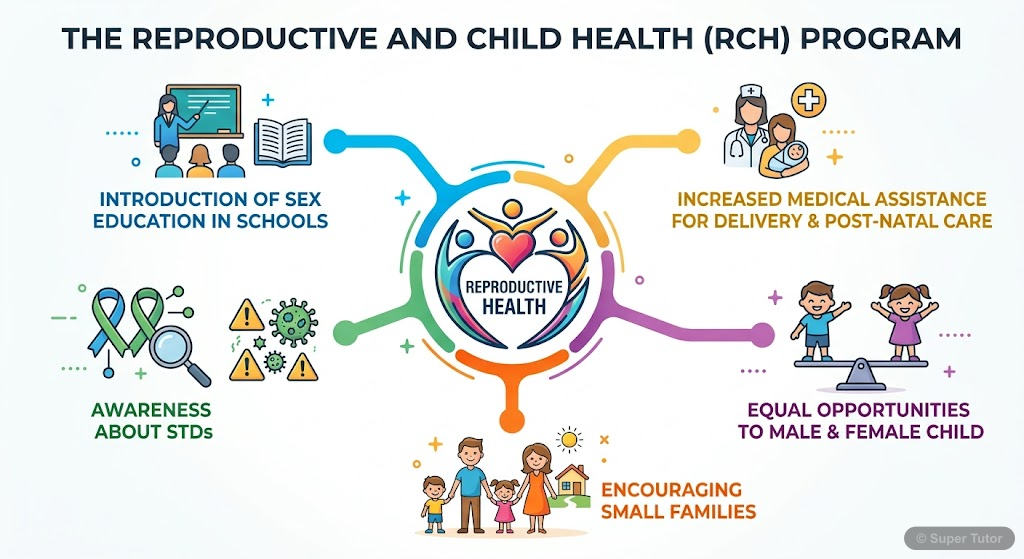
Learn better with visuals Super Tutor pairs illustrations like this with notes and quizzes for Reproductive Health.
Quick Quiz: Reproductive Health
0/4Tap an answer to check it instantly. No sign-up needed for these 4.
Saheli, the oral contraceptive pill developed by CDRI, Lucknow, differs from conventional oral contraceptive pills primarily because it:
A couple uses the lactational amenorrhea method as their sole contraceptive. Under which condition does this method FAIL to provide protection against pregnancy?
In the context of IUDs, which of the following correctly explains the mechanism of hormone-releasing IUDs like Progestasert and LNG-20 that makes them MORE effective than copper-releasing IUDs?
According to the Medical Termination of Pregnancy (Amendment) Act, 2017, what is the legal requirement for terminating a pregnancy that has lasted between 12 and 24 weeks?
Sample Questions
ZIFT and IUT are both embryo transfer techniques used in ART. The correct distinction between them is:
Show answer
ZIFT transfers the zygote or embryos up to 8 blastomeres into the fallopian tube; IUT transfers embryos with more than 8 blastomeres into the uterus
Step 1: In IVF (Test Tube Baby programme), fertilisation occurs outside the body and an embryo is formed in the laboratory. Step 2: ZIFT stands for Zygote Intra Fallopian Transfer — the zygote OR early embryos with UP TO 8 BLASTOMERES are transferred into the FALLOPIAN TUBE. Step 3: IUT stands for Intra Uterine Transfer — embryos with MORE THAN 8 BLASTOMERES are transferred directly into the UTERUS. Step 4: The logic behind this distinction: early embryos (up to 8-cell stage) are placed in the fallopian tube to mimic natural development. More developed embryos are placed directly into the uter
Amniocentesis is a foetal diagnostic technique. Its MISUSE that is specifically mentioned in the NCERT textbook relates to:
Show answer
Using foetal cells to determine sex of the unborn child followed by MTP if female
Step 1: Amniocentesis is a legitimate foetal diagnostic procedure where amniotic fluid is taken to analyse foetal cells and dissolved substances. Step 2: Its LEGAL uses include detection of genetic disorders like Down syndrome, haemophilia, sickle-cell anaemia, and to determine the survivability of the foetus — these are OPTIONS A, C, and D. Step 3: The MISUSE highlighted in the NCERT text is using amniocentesis to determine the SEX of the unborn child. Step 4: If the foetus is found to be female, it is frequently followed by MTP (female foeticide) — this is illegal and the government has impo
A patient is diagnosed with a Sexually Transmitted Infection. The doctor tells her that the infection CANNOT be completely cured even with proper treatment. Which of the following infections is she most likely suffering from?
Show answer
Genital herpes
Step 1: The NCERT text explicitly states that EXCEPT for hepatitis-B, genital herpes, and HIV infections, other STIs are completely curable if detected early and treated properly. Step 2: This means gonorrhoea (Option A), chlamydiasis (Option B), and trichomoniasis (Option D) are ALL completely curable with early detection and proper treatment. Step 3: The three incurable/difficult-to-cure STIs mentioned are: Hepatitis-B, Genital Herpes, and HIV. Step 4: Among the given options, only GENITAL HERPES (Option C) belongs to the group of STIs that cannot be completely cured. Step 5: Gonorrhoea, chl
In ICSI (Intra Cytoplasmic Sperm Injection), a sperm is directly injected into the ovum. This technique is MOST specifically useful for which condition?
Show answer
Cases where fertilisation fails to occur even when sperm and egg are placed together in vitro
Step 1: It is important to distinguish between different ART techniques and their specific indications. Step 2: GIFT (Gamete Intra Fallopian Transfer) — for females who cannot produce ova (Option A). Step 3: ZIFT/IUT — for females with blocked fallopian tubes or implantation issues (Option B). Step 4: AI (Artificial Insemination) — specifically for males who cannot inseminate or have very low sperm counts (Option C). Step 5: ICSI is a highly specialised procedure where a SINGLE SPERM is directly injected INTO the ovum (egg) in the laboratory. This is used when fertilisation cannot occur natura
+41 more questions on Reproductive Health (Punjab Board Class 12 Biology)
Practise AllFrequently Asked Questions
What are the important topics in Reproductive Health for Punjab Board Class 12 Biology?
How many practice questions are there for Reproductive Health?
Sources & Official References
Content is aligned to the official syllabus. Refer to the board website for the latest curriculum.
More resources for Reproductive Health
Important Questions
Exam-style questions with answers
Revision Notes
Key points for last-minute revision
Formula Sheet
The chapter's formulas in one place
Chapter Summary
Understand the chapter at a glance
Concept Maps
See how topics connect
Flashcards
Quick-fire cards for active recall
Syllabus
What topics to cover
For serious students
Get the full Reproductive Health chapter — start free.
Quizzes, flashcards, an AI doubt solver and a study plan for Punjab Board Class 12 Biology. Free to start, no card needed.