Coordination Compounds — Practice Quiz
Punjab Board · Class 12 · Chemistry
Try a 4-question quiz on Coordination Compounds for Punjab Board Class 12 Chemistry: tap an answer to check it and see why.
Interactive on Super Tutor
Studying Coordination Compounds? Get the full interactive chapter.
Quizzes, flashcards, AI doubt-solver and a step-by-step study plan — built for practice quiz and more.
Free trial, no card needed.
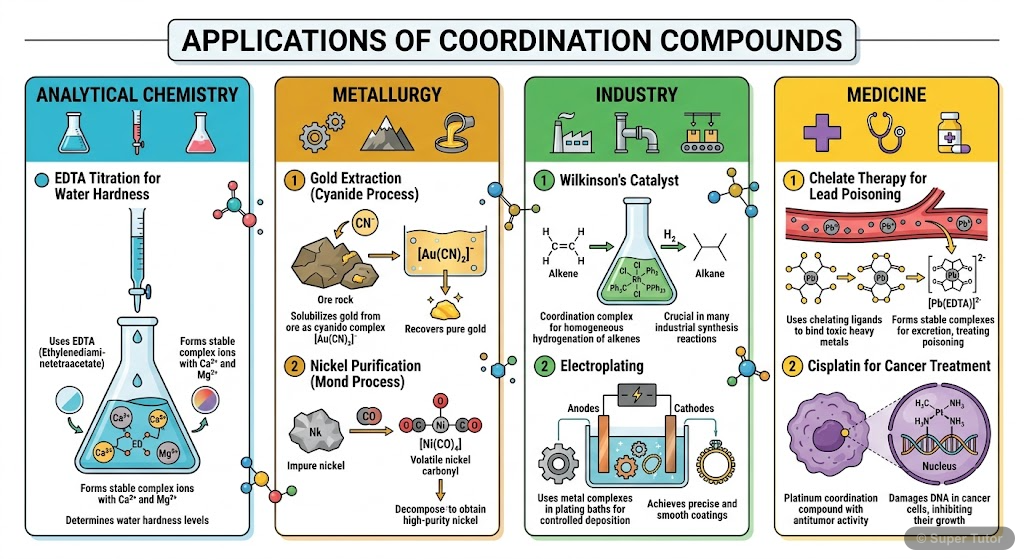
An illustration from Super Tutor's Coordination Compounds chapter — alongside flashcards, concept maps and practice questions.
Quick Quiz: Coordination Compounds
0/4Tap an answer to check it instantly. No sign-up needed for these 4.
Who proposed the theory of coordination compounds and won the Nobel Prize for it in 1913?
In the coordination compound K₄[Fe(CN)₆], what is the coordination number of iron?
Which of the following is the correct IUPAC name for [Co(NH₃)₆]Cl₃?
Which of the following ligands is a DIDENTATE ligand?
Sample Questions
What is the oxidation state of cobalt in the complex [Co(NH₃)₄Cl₂]⁺?
Show answer
+3
To find the oxidation state of Co: (1) Let the oxidation state of Co = x. (2) NH₃ is a neutral ligand, so it contributes 0. (3) Each Cl⁻ contributes −1, and there are 2 Cl⁻ ligands, contributing −2. (4) The overall charge of the complex ion is +1. (5) Setting up the equation: x + 0 + (−2) = +1, therefore x = +3. So cobalt is in the +3 oxidation state, written as Co(III).
Which type of isomerism arises when a ligand can bond to the metal through two different atoms?
Show answer
Linkage isomerism
Linkage isomerism arises because of ambidentate ligands — ligands that have two different donor atoms and can bind through either one. For example, NO₂⁻ can bind through nitrogen (giving −NO₂) or through oxygen (giving −ONO). Similarly, SCN⁻ can bind through S (M−SCN) or N (M−NCS). Geometric isomerism is about spatial arrangement (cis/trans). Coordination isomerism involves exchange of ligands between cationic and anionic metal centres. Ionisation isomerism involves exchange of ligands with counter ions.
The geometry of [Ni(CO)₄] is:
Show answer
Tetrahedral
In [Ni(CO)₄], nickel is in the zero oxidation state with electronic configuration 3d¹⁰. The hybridisation involves one s and three p orbitals (sp³), which gives a tetrahedral geometry. There are 4 CO ligands arranged at the corners of a tetrahedron. The complex is diamagnetic because all 3d electrons are paired in the d¹⁰ configuration. Square planar requires dsp² hybridisation (as in [Ni(CN)₄]²⁻), and octahedral requires 6 ligands. Trigonal bipyramidal involves 5 ligands like in Fe(CO)₅.
In Crystal Field Theory, the splitting of d orbitals in an octahedral field gives two sets. What are they called?
Show answer
eg and t2g
In an octahedral crystal field: (1) The 5 degenerate d orbitals split into two groups. (2) The eg set contains dx²−y² and dz² orbitals — these point directly towards the ligands along the axes and experience MORE repulsion, so they are raised in energy by (3/5)Δo. (3) The t2g set contains dxy, dyz, and dxz orbitals — these point between the axes and experience LESS repulsion, so they are lowered in energy by (2/5)Δo. The energy gap between them is called crystal field splitting energy, Δo.
+41 more questions on Coordination Compounds (Punjab Board Class 12 Chemistry)
Practise AllFrequently Asked Questions
What are the important topics in Coordination Compounds for Punjab Board Class 12 Chemistry?
How many practice questions are there for Coordination Compounds?
Sources & Official References
Content is aligned to the official syllabus. Refer to the board website for the latest curriculum.
More resources for Coordination Compounds
For serious students
Get the full Coordination Compounds chapter — start free.
Quizzes, flashcards, an AI doubt solver and a study plan for Punjab Board Class 12 Chemistry. Free to start, no card needed.