Chapter 5 of 5
Concept Maps
Coordination Compounds — Concept Maps
Punjab Board · Class 12 · Chemistry
3 concept maps of Coordination Compounds for Punjab Board Class 12 Chemistry, each also written out as a text outline.
45 questions36 flashcards5 concepts
Interactive on Super Tutor
Studying Coordination Compounds? Get the full interactive chapter.
Quizzes, flashcards, AI doubt-solver and a step-by-step study plan — built for concept maps and more.
Free trial, no card needed.
Super Tutor
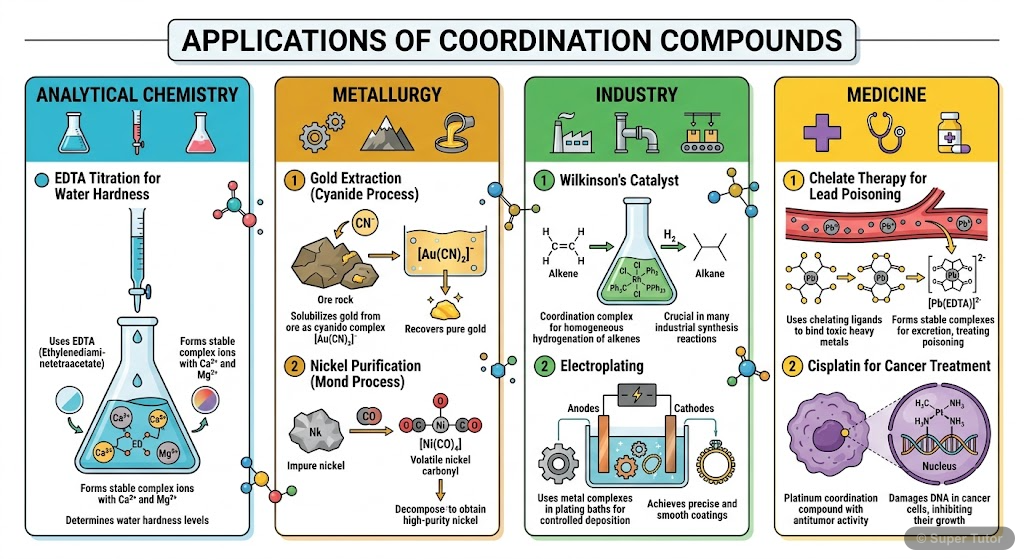
An illustration from Super Tutor's Coordination Compounds chapter — alongside flashcards, concept maps and practice questions.
3 Concept Maps
Classification of Isomerism in Coordination Compounds
The map in words
- Isomerism in Coordination Compounds
- Structural Isomerism
- Linkage Isomerism
- M-NCS vs M-SCN
- Coordination Isomerism
- Ligand Exchange
- Ionization Isomerism
- Counter Ion Exchange
- Solvate Isomerism
- Free vs Coordinated Solvent
- Linkage Isomerism
- Stereoisomerism
- Geometric Isomerism
- cis-trans arrangement
- Optical Isomerism
- d and l enantiomers
- Geometric Isomerism
- Structural Isomerism
Coordination Compounds - Complete Chapter Overview
The map in words
- Coordination Compounds
- Werner Theory
- Primary Valence
- Ionisable
- Satisfied by Negative Ions
- Equals Oxidation State
- Secondary Valence
- Non Ionisable
- Fixed for a Metal
- Equals Coordination Number
- Geometries
- Octahedral CN 6
- Tetrahedral CN 4
- Square Planar CN 4
- Primary Valence
- Key Terms
- Central Atom
- Lewis Acid
- Metal Ion
- Ligands
- Unidentate
- Didentate
- Polydentate
- Ambidentate
- Chelate
- Coordination Number
- Sigma Bonds Only
- Not Pi Bonds
- Coordination Sphere
- Inside Brackets
- Counter Ions Outside
- Central Atom
- Nomenclature
- Formula Rules
- Metal First
- Ligands Alphabetical
- Square Brackets
- Naming Rules
- Cation Named First
- Ligands Before Metal
- Anionic Complex Gets ate Suffix
- Latin Names
- Formula Rules
- Isomerism
- Stereoisomerism
- Geometric
- Cis Trans
- Fac Mer
- Optical
- Enantiomers
- Chiral
- Geometric
- Structural
- Linkage
- Coordination
- Ionisation
- Solvate
- Stereoisomerism
- Bonding Theories
- VBT
- Hybridisation
- Inner Orbital d2sp3
- Outer Orbital sp3d2
- Magnetic Properties
- CFT
- d Orbital Splitting
- Octahedral
- Tetrahedral
- High Spin Low Spin
- Colour
- VBT
- Applications
- Biological
- Chlorophyll Mg
- Haemoglobin Fe
- Vitamin B12 Co
- Industrial
- Mond Process Ni
- Cyanide Process Au
- Wilkinsons Catalyst
- Medicinal
- cis Platin Anticancer
- EDTA Lead Poisoning
- Analytical
- Water Hardness EDTA
- Qualitative Tests
- Biological
- Werner Theory
Coordination Compounds – Complete Chapter Overview
The map in words
- Coordination Compounds
- Werners Theory
- Primary Valence
- Ionisable
- Equals Oxidation State
- Secondary Valence
- Non Ionisable
- Equals CN
- Double Salt vs Complex
- Primary Valence
- Key Terms
- Coordination Entity
- Central Atom or Ion
- Lewis Acid
- Ligands
- Unidentate
- Didentate
- Polydentate
- Ambidentate
- Chelate
- Coordination Number
- Oxidation Number
- Homoleptic vs Heteroleptic
- Nomenclature
- IUPAC Rules
- Formula Writing
- Naming Rules
- Anionic Ligand ends in o
- Special Neutral Names
- Oxidation State in Roman
- Anionic Complex ends in ate
- Isomerism
- Stereoisomerism
- Geometric
- Cis and Trans
- Fac and Mer
- Optical
- Enantiomers
- Chiral Complexes
- Geometric
- Structural
- Linkage
- Coordination
- Ionisation
- Solvate
- Stereoisomerism
- Bonding Theories
- Valence Bond Theory
- Hybridisation
- Inner Orbital d2sp3
- Outer Orbital sp3d2
- Magnetic Moment
- Crystal Field Theory
- d Orbital Splitting
- Octahedral t2g and eg
- Tetrahedral e and t2
- Spectrochemical Series
- High Spin vs Low Spin
- Colour d-d Transition
- Valence Bond Theory
- Metal Carbonyls
- Synergic Bonding
- Sigma CO to M
- Pi Back Donation M to CO
- Applications
- Analytical EDTA DMG
- Metallurgy Gold Extraction
- Mond Process Nickel
- Biological Haemoglobin Chlorophyll
- Medicine Cisplatin
- Photography Fixing
- Werners Theory
Explore these maps interactively
Explore DiagramsFrequently Asked Questions
What are the important topics in Coordination Compounds for Punjab Board Class 12 Chemistry?
Key topics in Coordination Compounds include Werner's Theory of Coordination Compounds, Key Definitions and Terminology, Nomenclature of Coordination Compounds, Isomerism in Coordination Compounds. Study these first, then practise questions on each for the Punjab Board Class 12 board exam.
What do the concept maps for Coordination Compounds show?
The 3 maps show how the ideas in Coordination Compounds connect: Classification of Isomerism in Coordination Compounds; Coordination Compounds - Complete Chapter Overview. Each map is also written out as an outline on this page.
How should I revise Coordination Compounds for the Punjab Board Class 12 board exam?
Learn the core ideas first, then work through the 45 practice questions on Coordination Compounds. Revise definitions regularly and use flashcards for quick recall before the exam.
Sources & Official References
Content is aligned to the official syllabus. Refer to the board website for the latest curriculum.
More resources for Coordination Compounds
For serious students
Get the full Coordination Compounds chapter — start free.
Quizzes, flashcards, an AI doubt solver and a study plan for Punjab Board Class 12 Chemistry. Free to start, no card needed.