Coordination Compounds — Revision Notes
Punjab Board · Class 12 · Chemistry
Coordination Compounds revision notes for Punjab Board Class 12 Chemistry: 4 topics in quick points. Part of the Punjab Board Class 12 Chemistry syllabus.
Interactive on Super Tutor
Studying Coordination Compounds? Get the full interactive chapter.
Quizzes, flashcards, AI doubt-solver and a step-by-step study plan — built for revision notes and more.
Free trial, no card needed.
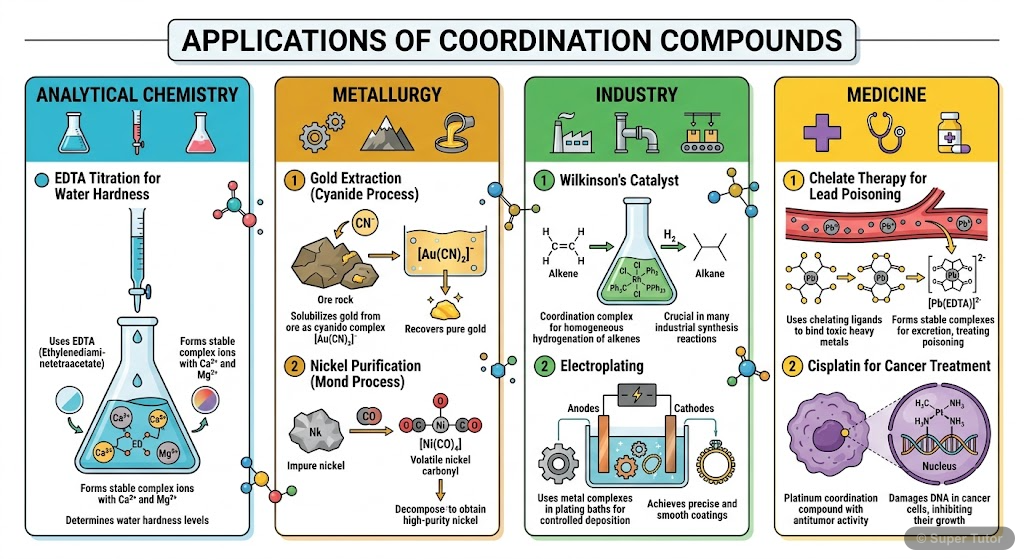
An illustration from Super Tutor's Coordination Compounds chapter — alongside flashcards, concept maps and practice questions.
Key Topics to Revise
Werner's Theory of Coordination Compounds
- Alfred Werner (1866–1919) was a Swiss chemist who first systematically explained coordination compounds and won the Nobel Prize in Chemistry in 1913.
- Werner proposed two types of valences for metal ions: PRIMARY VALENCE (ionisable, satisfied by negative ions) and SECONDARY VALENCE (non-ionisable, satisfied by neutral molecules or negative ions).
- Primary valence = oxidation state of the metal; Secondary valence = coordination number of the metal.
Key Definitions and Terminology
- COORDINATION ENTITY: The central metal atom/ion plus all its ligands, enclosed in square brackets.
- CENTRAL ATOM/ION: The metal atom or ion at the centre of the coordination entity; acts as a Lewis acid (electron pair acceptor). Examples: Ni²⁺ in [NiCl₂(H₂O)₄], Co³⁺ in [CoCl(NH₃)₅]²⁺, Fe³⁺ in [Fe(CN
- LIGAND: Ions or molecules bonded to the central atom; act as Lewis bases (electron pair donors). Can be simple ions (Cl⁻), small molecules (H₂O, NH₃), or large molecules (EDTA).
Nomenclature of Coordination Compounds
- IUPAC rules are used for systematic naming. The cation is always named FIRST, then the anion.
- FORMULA WRITING ORDER: Central metal first, then ligands listed ALPHABETICALLY. Entire coordination entity enclosed in square brackets [ ].
- NAMING ORDER: Ligands are named ALPHABETICALLY before the central metal name. (Reverse of formula writing for ligand order.)
Isomerism in Coordination Compounds
- ISOMERS: Compounds with same molecular formula but different arrangement of atoms, resulting in different properties.
- TWO MAIN TYPES: (A) Stereoisomerism — same bonds, different spatial arrangement; (B) Structural isomerism — different bonds.
- GEOMETRIC ISOMERISM (Stereoisomerism): Arises in heteroleptic complexes due to different spatial arrangements of ligands.
Get complete notes with diagrams and examples
Full NotesKey Concepts
Frequently Asked Questions
What are the important topics in Coordination Compounds for Punjab Board Class 12 Chemistry?
How should I revise Coordination Compounds for the Punjab Board Class 12 board exam?
Sources & Official References
Content is aligned to the official syllabus. Refer to the board website for the latest curriculum.
More resources for Coordination Compounds
For serious students
Get the full Coordination Compounds chapter — start free.
Quizzes, flashcards, an AI doubt solver and a study plan for Punjab Board Class 12 Chemistry. Free to start, no card needed.