Coordination Compounds — Chapter Summary
Punjab Board · Class 12 · Chemistry
Summary of Coordination Compounds for Punjab Board Class 12 Chemistry. Part of the Punjab Board Class 12 Chemistry syllabus.
Interactive on Super Tutor
Studying Coordination Compounds? Get the full interactive chapter.
Quizzes, flashcards, AI doubt-solver and a step-by-step study plan — built for chapter summary and more.
Free trial, no card needed.
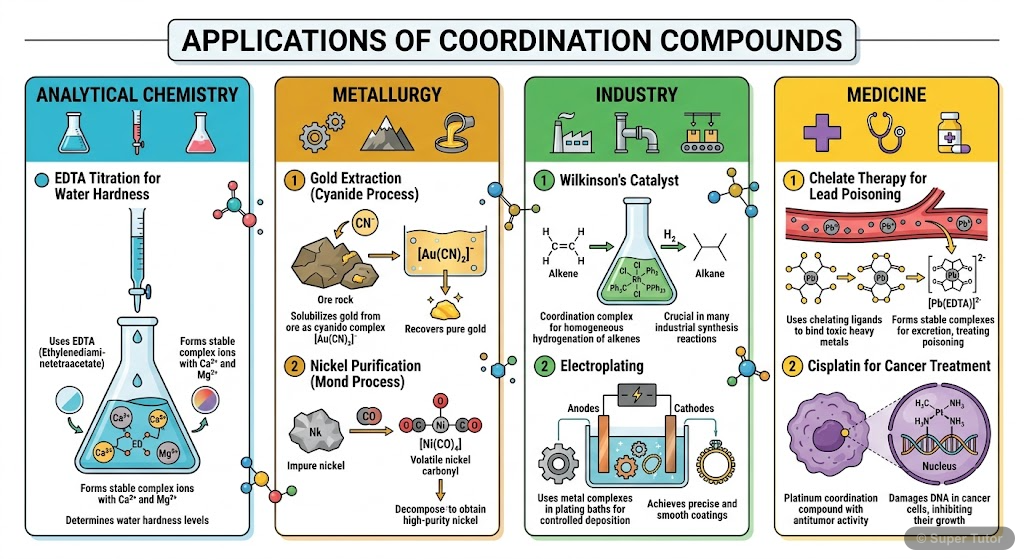
An illustration from Super Tutor's Coordination Compounds chapter — alongside flashcards, concept maps and practice questions.
Overview
Coordination compounds represent a fascinating branch of inorganic chemistry where central metal atoms or ions are bonded to ligands (ions or molecules) through coordinate covalent bonds. These compounds are fundamental to modern chemistry, from biological systems like hemoglobin and chlorophyll to
Key Concepts
A coordination compound consists of
A coordination compound consists of a central metal atom or ion bonded to a fixed number of ligands in a definite geometric arrangement. The metal-lig
Alfred Werner proposed that metals exhibit
Alfred Werner proposed that metals exhibit two types of valences: primary valence (ionizable, satisfied by anions) and secondary valence (non-ionizabl
Ligands are ions or molecules bonded
Ligands are ions or molecules bonded to the central metal atom. Classification: (1) Unidentate ligands bind through one donor atom (Cl⁻, NH₃, H₂O). (2
Coordination number (CN) is the number
Coordination number (CN) is the number of sigma bonds formed between ligand donor atoms and the central metal ion. For example, in [PtCl₆]²⁻, CN = 6;
The oxidation number of the central
The oxidation number of the central metal is the charge it would carry if all ligands and their electron pairs were removed. It is represented as a Ro
Learning Objectives
- Understand and appreciate the postulates of Werner's theory of coordination compounds
- Define and apply key terminology: coordination entity, ligand, coordination number, oxidation state, and coordination sphere
- Learn IUPAC nomenclature rules for writing formulas and names of coordination compounds
- Identify and classify different types of isomerism in coordination compounds
- Explain bonding in coordination compounds using Valence Bond Theory and Crystal Field Theory
Frequently Asked Questions
What are the important topics in Coordination Compounds for Punjab Board Class 12 Chemistry?
How should I revise Coordination Compounds for the Punjab Board Class 12 board exam?
Sources & Official References
Content is aligned to the official syllabus. Refer to the board website for the latest curriculum.
More resources for Coordination Compounds
For serious students
Get the full Coordination Compounds chapter — start free.
Quizzes, flashcards, an AI doubt solver and a study plan for Punjab Board Class 12 Chemistry. Free to start, no card needed.