Chapter 2 of 5
Revision Notes
Polynomials — Revision Notes
Punjab Board · Class 9 · Mathematics
Polynomials revision notes for Punjab Board Class 9 Mathematics: 4 topics in quick points. Part of the Punjab Board Class 9 Mathematics syllabus.
45 questions32 flashcards5 formulas & key relations5 concepts
Interactive on Super Tutor
Studying Polynomials? Get the full interactive chapter.
Quizzes, flashcards, AI doubt-solver and a step-by-step study plan — built for revision notes and more.
Free trial, no card needed.
Super Tutor
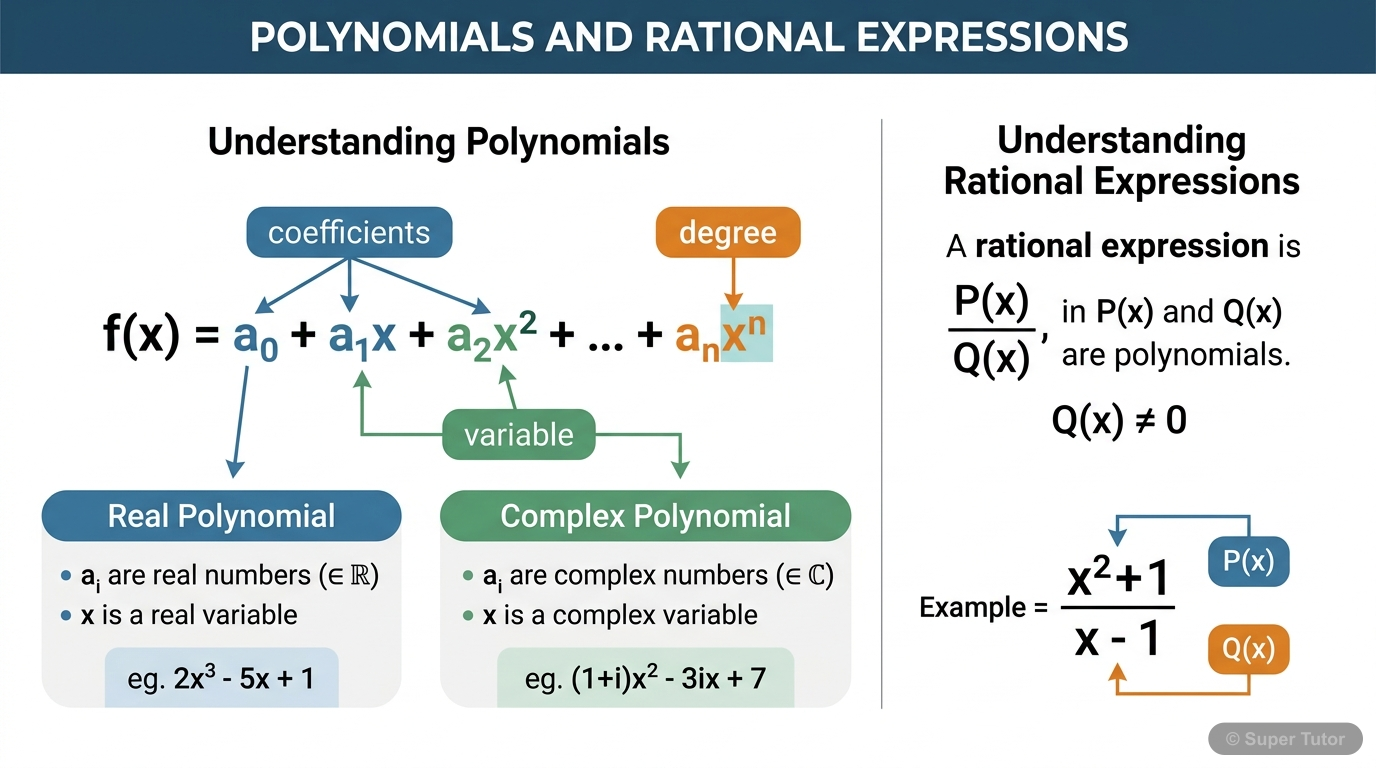
One of 3 illustrations for Polynomials in Super Tutor — alongside flashcards, concept maps and practice questions.
Key Topics to Revise
1
1. Polynomials in One Variable – Basic Concepts
- A polynomial in one variable x is an expression of the form a_n·x^n + a_(n-1)·x^(n-1) + ... + a_1·x + a_0, where all exponents are whole numbers (0, 1, 2, 3, ...).
- Each part of a polynomial separated by + or – signs is called a TERM.
- The number multiplied with the variable in each term is called the COEFFICIENT.
2
2. Zeroes of a Polynomial
- The VALUE of a polynomial p(x) at x = a is found by substituting x = a in the expression. It is denoted p(a).
- A ZERO of polynomial p(x) is a number 'c' such that p(c) = 0.
- Finding a zero means solving the equation p(x) = 0.
3
3. Remainder Theorem and Factor Theorem
- REMAINDER THEOREM: When polynomial p(x) is divided by (x – a), the remainder is p(a). You do NOT need to perform long division to find the remainder!
- FACTOR THEOREM: (x – a) is a factor of p(x) if and only if p(a) = 0.
- The Factor Theorem is a special case of the Remainder Theorem (when remainder = 0, the divisor is a factor).
4
4. Factorisation of Polynomials
- SPLITTING THE MIDDLE TERM: For ax^2 + bx + c, find two numbers p and q such that p + q = b and p × q = a × c. Rewrite bx as px + qx and factorise by grouping.
- USING FACTOR THEOREM for quadratics: Find a zero 'r' by trial, then (x – r) is a factor. Divide to get the other factor.
- CUBIC FACTORISATION STEPS: (1) Try x = ±1, ±2, ±3, ... (factors of constant term) to find one zero 'a'. (2) Write (x – a) as one factor. (3) Perform grouping or division to find quadratic factor. (4)
Get complete notes with diagrams and examples
Full NotesKey Concepts
A polynomial in one variable xEach part of a polynomial separatedThe degree is the highest powerPolynomials are classified by numberA zero of polynomial p(x)
Frequently Asked Questions
What are the important topics in Polynomials for Punjab Board Class 9 Mathematics?
Key topics in Polynomials include Polynomials in One Variable – Basic Concepts, Zeroes of a Polynomial, Remainder Theorem and Factor Theorem, Factorisation of Polynomials. Study these first, then practise questions on each for Class 9 exams.
How should I revise Polynomials for Class 9 exams?
Learn the core ideas first, then work through the 45 practice questions on Polynomials. Revise definitions regularly and use flashcards for quick recall before the exam.
Sources & Official References
Content is aligned to the official syllabus. Refer to the board website for the latest curriculum.
More resources for Polynomials
For serious students
Get the full Polynomials chapter — start free.
Quizzes, flashcards, an AI doubt solver and a study plan for Punjab Board Class 9 Mathematics. Free to start, no card needed.