Geometry — Practice Quiz
Tamil Nadu Board · Class 10 · Mathematics
Try a 4-question quiz on Geometry for Tamil Nadu Board Class 10 Mathematics: tap an answer to check it and see why. 44 questions in the full chapter test.
Interactive on Super Tutor
Studying Geometry? Get the full interactive chapter.
Quizzes, flashcards, AI doubt-solver and a step-by-step study plan — built for practice quiz and more.
Free trial, no card needed.
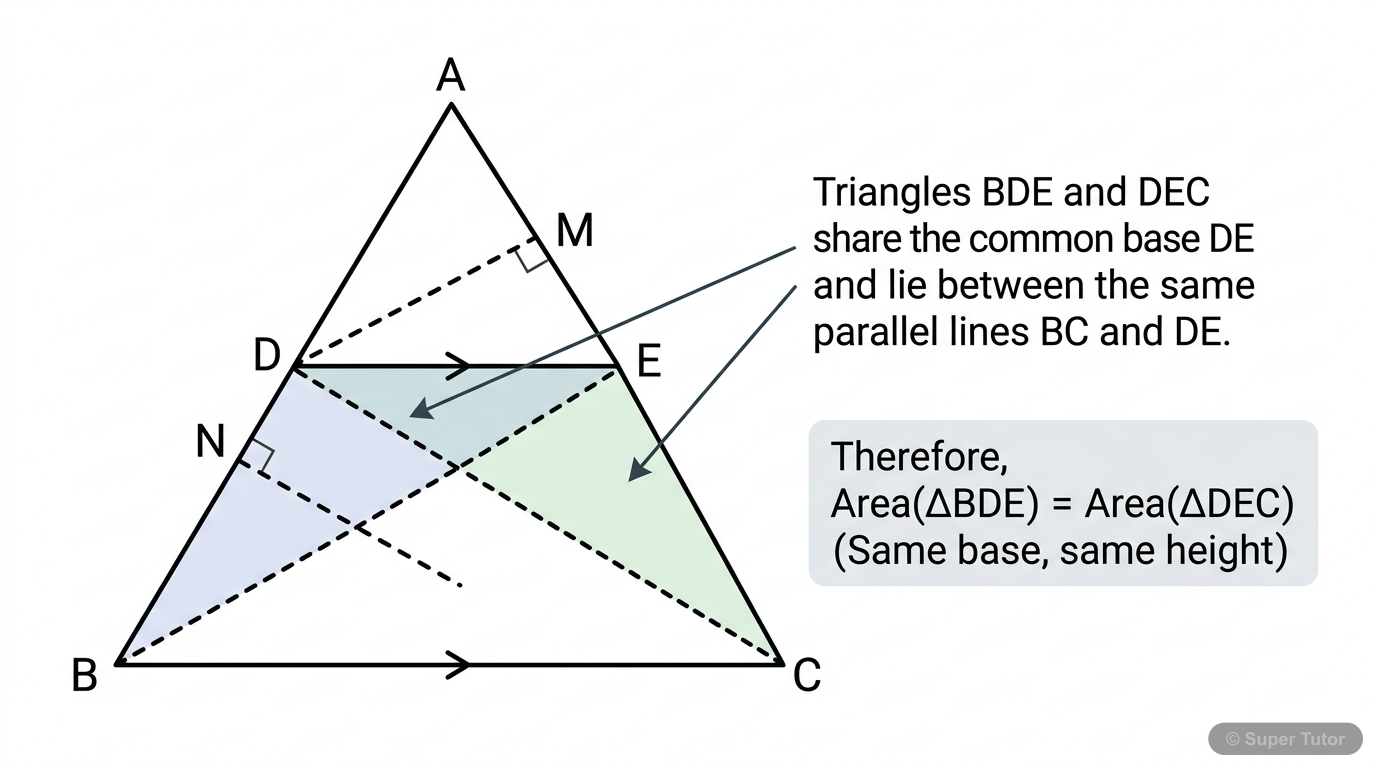
An illustration from Super Tutor's Geometry chapter — alongside flashcards, concept maps and practice questions.
Quick Quiz: Geometry
0/4Tap an answer to check it instantly. No sign-up needed for these 4.
In triangle ABC, DE is parallel to BC. If AD = 3x - 1, DB = 5x - 3, AE = x + 1 and EC = 3x - 1, find the value of x.
Triangle ABC is similar to triangle DEF. The area of triangle ABC is 36 cm² and the area of triangle DEF is 81 cm². If EF = 9 cm, what is the length of BC?
In triangle ABC, AD is the bisector of angle A. If AB = 12 cm, AC = 15 cm and BC = 18 cm, find BD.
A ladder 13 m long rests against a vertical wall. If the foot of the ladder is 5 m from the wall, and the foot is pushed 2 m further away from the wall, by how much does the top of the ladder slide down the wall?
Sample Questions
Two poles of heights 6 m and 11 m stand vertically on a plane ground. If the distance between their feet is 12 m, find the distance between their tops.
Show answer
13 m
Step 1: Let AB = 6 m (shorter pole) and CD = 11 m (taller pole), with AC = 12 m (distance between feet). Step 2: Draw BE perpendicular to CD. Then DE = CD - CE = 11 - 6 = 5 m (difference in heights), and BE = AC = 12 m (horizontal distance). Step 3: In right triangle BED: BD² = BE² + DE² = 12² + 5² = 144 + 25 = 169. Step 4: BD = √169 = 13 m. Common mistake: Students add heights (6 + 11 = 17) or use the full height of taller pole instead of the difference in heights (5 m). The key insight is to form a right triangle using the difference in heights and the horizontal distance.
In triangle PQR, PS is the perpendicular from P to QR. QS = 4 cm and SR = 9 cm. What is the length of PS?
Show answer
6 cm
Step 1: When a perpendicular is drawn from the right angle vertex to the hypotenuse, the altitude is the geometric mean of the two segments of the hypotenuse. Here PS ⊥ QR. Step 2: Using the geometric mean relation (from similar triangles): PS² = QS × SR. Step 3: PS² = 4 × 9 = 36. Step 4: PS = √36 = 6 cm. This result comes from the similarity: △PQS ~ △RSP (AA), giving PS/QS = SR/PS, so PS² = QS × SR. Common mistake: Students add QS and SR and take half (giving 6.5), or use PS = QS + SR = 13 directly.
The perimeters of two similar triangles are 30 cm and 20 cm. If one side of the first triangle is 12 cm, what is the corresponding side of the second triangle?
Show answer
8 cm
Step 1: For similar triangles, the ratio of corresponding sides equals the ratio of perimeters. Step 2: Ratio of perimeters = 30:20 = 3:2. Step 3: If one side of first triangle = 12 cm, let corresponding side of second = x cm. Then 12/x = 3/2. Step 4: 3x = 24, so x = 8 cm. Common mistake: Students use ratio of areas instead of ratio of perimeters, computing √(30/20) = √(3/2), giving an incorrect answer. For perimeters, the ratio is direct (not squared).
From an external point P, tangents PA and PB are drawn to a circle with centre O. If PA = 12 cm and OA = 5 cm, find OP.
Show answer
13 cm
Step 1: The radius OA is perpendicular to the tangent PA at the point of contact A (radius ⊥ tangent). Step 2: Triangle OAP is right-angled at A. Step 3: Using Pythagoras theorem: OP² = OA² + PA² = 5² + 12² = 25 + 144 = 169. Step 4: OP = √169 = 13 cm. Common mistake: Students sometimes use OP² = PA² - OA², reversing the formula. Since OP is the hypotenuse (longest side), OP² = OA² + PA².
+40 more questions on Geometry (Tamil Nadu Board Class 10 Mathematics)
Practise AllFrequently Asked Questions
What are the important topics in Geometry for Tamil Nadu Board Class 10 Mathematics?
How many practice questions are there for Geometry?
Sources & Official References
Content is aligned to the official syllabus. Refer to the board website for the latest curriculum.
More resources for Geometry
Important Questions
Exam-style questions with answers
Revision Notes
Key points for last-minute revision
Formula Sheet
The chapter's formulas in one place
Chapter Summary
Understand the chapter at a glance
Concept Maps
See how topics connect
Flashcards
Quick-fire cards for active recall
Syllabus
What topics to cover
For serious students
Get the full Geometry chapter — start free.
Quizzes, flashcards, an AI doubt solver and a study plan for Tamil Nadu Board Class 10 Mathematics. Free to start, no card needed.