Ray Optics — Important Questions
Tamil Nadu Board · Class 12 · Physics
45 important questions from Ray Optics for Tamil Nadu Board Class 12 Physics, with answers. Includes multiple choice questions.
Interactive on Super Tutor
Studying Ray Optics? Get the full interactive chapter.
Quizzes, flashcards, AI doubt-solver and a step-by-step study plan — built for important questions and more.
Free trial, no card needed.
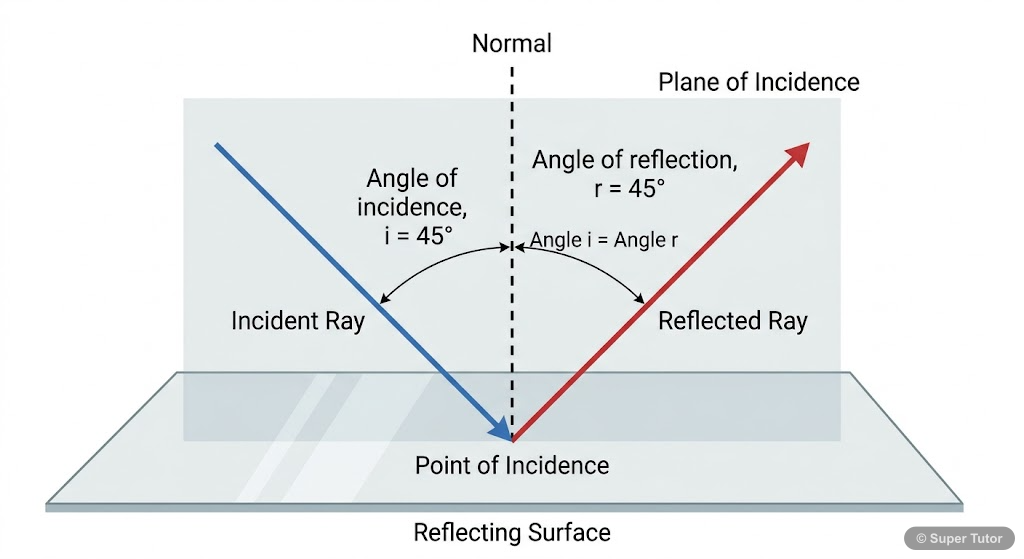
Learn better with visuals Super Tutor pairs illustrations like this with notes and quizzes for Ray Optics.
Important Questions from Ray Optics
A thin convex lens of focal length 20 cm and a concave mirror of focal length 15 cm are placed coaxially with the mirror facing the lens. Their separation is 50 cm. A point object is placed on the principal axis at 30 cm from the lens (on the side away from mirror). Where is the final image formed?
Show answer
At 30 cm from the lens, on the same side as the object
Step 1: For the convex lens, u = -30 cm, f = +20 cm. 1/v - 1/(-30) = 1/20 → 1/v = 1/20 - 1/30 = (3-2)/60 = 1/60. So v = 60 cm. Image I₁ forms 60 cm to the right of lens. Step 2: The mirror is 50 cm to the right of the lens. So the image I₁ is 60 - 50 = 10 cm behind the mirror (virtual object for mirror). For the concave mirror, u = +10 cm (virtual object, behind mirror), f = -15 cm. Step 3: Mirror equation: 1/v + 1/u = 1/f → 1/v = 1/(-15) - 1/(10) = -1/15 - 1/10 = (-2-3)/30 = -5/30 = -1/6. v = -6 cm. Image I₂ forms 6 cm in front of mirror (real image). Step 4: This image I₂ is at 50 - 6 = 44 c
The refractive index of the material of a prism is √2 and the apex angle is 45°. For what angle of incidence will the refracted ray inside the prism graze along the second surface (angle of emergence = 90°)?
Show answer
45°
Step 1: If the ray grazes the second surface, angle of refraction at second surface r₂ = 90° — no, this means angle of incidence at second surface equals critical angle iₒ. Step 2: Critical angle: sin iₒ = 1/n = 1/√2 → iₒ = 45°. So r₂ = 45°. Step 3: Since r₁ + r₂ = A = 45°, we get r₁ = 45° - 45° = 0°. Step 4: Applying Snell's law at first surface: n₁ sin i₁ = n₂ sin r₁ → 1 × sin i₁ = √2 × sin 0° = 0 → i₁ = 0°. Wait: r₁ = 0° gives i₁ = 0°. But the answer options say 45°. Let me redo: r₁ + r₂ = A = 45°. If grazing at second face, r₂ = iₒ = 45°. Then r₁ = 45° - 45° = 0°. So Snell's law: sin i₁ =
An optical fibre has core refractive index 1.6 and cladding refractive index 1.4. What is the numerical aperture (NA) of the fibre when placed in air?
Show answer
√0.60 ≈ 0.775
Step 1: Numerical aperture formula for optical fibre in air (n₃ = 1): NA = √(n₁² - n₂²). Step 2: n₁ = 1.6 (core), n₂ = 1.4 (cladding). Step 3: NA = √(1.6² - 1.4²) = √(2.56 - 1.96) = √0.60 = 0.7746 ≈ 0.775. Step 4: The acceptance angle iₐ = sin⁻¹(NA) = sin⁻¹(0.775) ≈ 50.8°. Why wrong options: 0.2 = n₁ - n₂ (wrong, that's not the formula); 1.0 has no basis; √0.40 would result from n₁=1.4, n₂=1.0 which mixes up the values.
A silvered plano-convex lens has its convex surface silvered. The radius of curvature of the convex surface is 20 cm and the refractive index of glass is 1.5. What is the focal length of the equivalent mirror?
Show answer
-10 cm
Step 1: For the silvered lens system, the effective power is P = 2P_lens + P_mirror. Step 2: Lens (plano-convex with flat surface facing object, convex silvered): R₁ = ∞ (flat), R₂ = -20 cm (convex surface, silvered). Power of lens: P_l = (n-1)(1/R₁ - 1/R₂) = (1.5-1)(1/∞ - 1/(-20)) = 0.5 × (0 + 1/20) = 0.5/20 = 1/40 D (in cm units). Step 3: Power of mirror (silvered convex surface): P_m = 1/(-f_m). For the convex surface, R = 20 cm, so f_m = R/2 = 10 cm. But since light hits the inner side (concave from light's perspective), f_m = -10 cm. P_m = 1/(-(-10)) = 1/10. Step 4: Total power P = 2(1/40
+41 more questions on Ray Optics (Tamil Nadu Board Class 12 Physics)
Practise AllFrequently Asked Questions
What are the important topics in Ray Optics for Tamil Nadu Board Class 12 Physics?
How many important questions are there in Ray Optics?
Sources & Official References
Content is aligned to the official syllabus. Refer to the board website for the latest curriculum.
More resources for Ray Optics
For serious students
Get the full Ray Optics chapter — start free.
Quizzes, flashcards, an AI doubt solver and a study plan for Tamil Nadu Board Class 12 Physics. Free to start, no card needed.