Ray Optics — Flashcards
Tamil Nadu Board · Class 12 · Physics
31 flashcards for Ray Optics (Tamil Nadu Board Class 12 Physics) to test yourself on key terms and facts. Sample: "State the Law of Reflection and explain.
Interactive on Super Tutor
Studying Ray Optics? Get the full interactive chapter.
Quizzes, flashcards, AI doubt-solver and a step-by-step study plan — built for flashcards and more.
Free trial, no card needed.
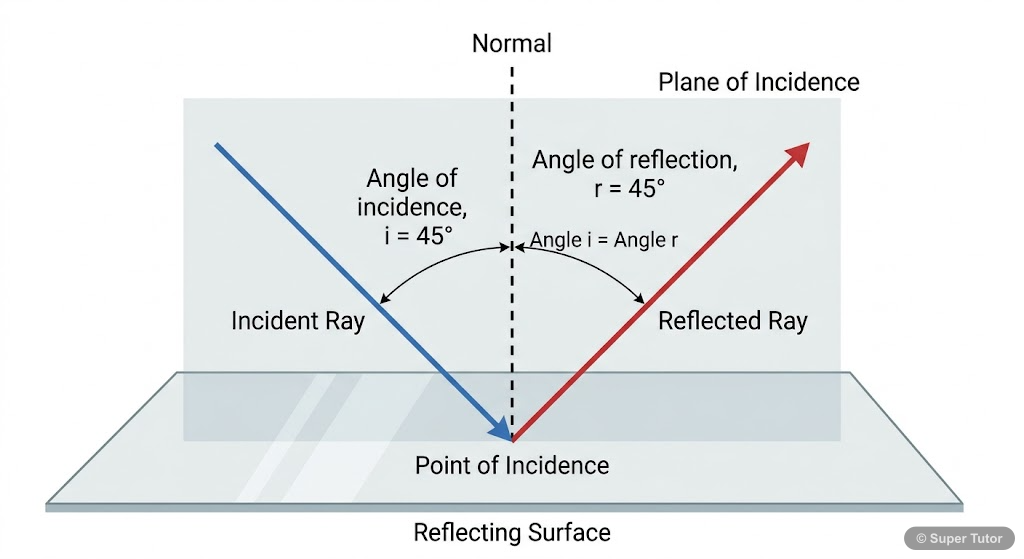
Learn better with visuals Super Tutor pairs illustrations like this with notes and quizzes for Ray Optics.
State the Law of Reflection and explain what it means.
Answer
Law of Reflection: The angle of incidence equals the angle of reflection (i = r). Meaning: When light hits a reflecting surface, the angle at which it strikes (measured from the normal) equals the an…
A light ray hits a plane mirror at an angle of incidence of 35°. What is the angle of reflection? What is the angle of deviation?
Answer
Step 1: Apply Law of Reflection Angle of reflection = Angle of incidence = 35° Step 2: Calculate angle of deviation Formula: d = 180° - (i + r) where i = angle of incidence, r = angle of reflection …
Why does a plane mirror always form a virtual, erect image? Explain using ray geometry.
Answer
Reason: When light from an object reflects off a plane mirror, the reflected rays appear to come from behind the mirror. Geometric explanation: 1. Two rays from object point A are drawn to mirror at …
A person of height 180 cm stands in front of a plane mirror. What is the minimum height of mirror required to see the full image?
Answer
Step 1: Understand the geometry Let eye position be E, head position be H, feet position be F Distance from eye to head = h₁ Distance from eye to feet = h₂ Total height h = h₁ + h₂ = 180 cm Step 2: A…
State the relationship between focal length (f) and radius of curvature (R) for a spherical mirror. Derive it briefly.
Answer
Relationship: f = R/2 (or 2f = R) Derivation: Consider a spherical mirror with center of curvature C and radius R. A ray parallel to principal axis hits mirror at point M. This ray reflects through f…
An object is placed 20 cm in front of a concave mirror with focal length 15 cm. Find (a) image distance, (b) nature of image, (c) magnification.
Answer
Given: u = -20 cm (object distance, negative as per sign convention) f = -15 cm (focal length, negative for concave mirror) Part (a): Image distance using Mirror Equation Formula: 1/v + 1/u = 1/f 1/v…
What are paraxial rays and marginal rays? Why is the distinction important in mirror optics?
Answer
Paraxial Rays: - Rays that travel very close to the principal axis - Make small angles with the principal axis - Fall on mirror very close to the pole - All paraxial rays from an object point converge…
Define refractive index. Calculate the speed of light in water (n = 1.33). How does it compare to speed in vacuum?
Answer
Definition of Refractive Index: Refractive index (n) of a medium = c/v where c = speed of light in vacuum (3 × 10⁸ m/s) v = speed of light in the medium Physical meaning: It tells how much the light …
+23 more flashcards
Practise AllFrequently Asked Questions
What are the important topics in Ray Optics for Tamil Nadu Board Class 12 Physics?
How many flashcards are available for Ray Optics?
How should I revise Ray Optics for the Tamil Nadu Board Class 12 board exam?
Sources & Official References
Content is aligned to the official syllabus. Refer to the board website for the latest curriculum.
More resources for Ray Optics
Practice Quiz
Test yourself with a quick quiz
Important Questions
Exam-style questions with answers
Revision Notes
Key points for last-minute revision
Formula Sheet
The chapter's formulas in one place
Chapter Summary
Understand the chapter at a glance
Concept Maps
See how topics connect
Syllabus
What topics to cover
For serious students
Get the full Ray Optics chapter — start free.
Quizzes, flashcards, an AI doubt solver and a study plan for Tamil Nadu Board Class 12 Physics. Free to start, no card needed.