Ray Optics — Chapter Summary
Tamil Nadu Board · Class 12 · Physics
Summary of Ray Optics for Tamil Nadu Board Class 12 Physics. Key concepts: When light strikes, A plane mirror produces and Spherical mirrors have a pole.
Interactive on Super Tutor
Studying Ray Optics? Get the full interactive chapter.
Quizzes, flashcards, AI doubt-solver and a step-by-step study plan — built for chapter summary and more.
Free trial, no card needed.
Learn better with visuals Super Tutor pairs illustrations like this with notes and quizzes for Ray Optics.
Overview
Ray Optics is the branch of light science that deals with light as rays traveling in straight lines through different media. This chapter explores how light behaves when it encounters reflecting and refracting surfaces, forming the foundation for understanding optical instruments like mirrors, lense
Key Concepts
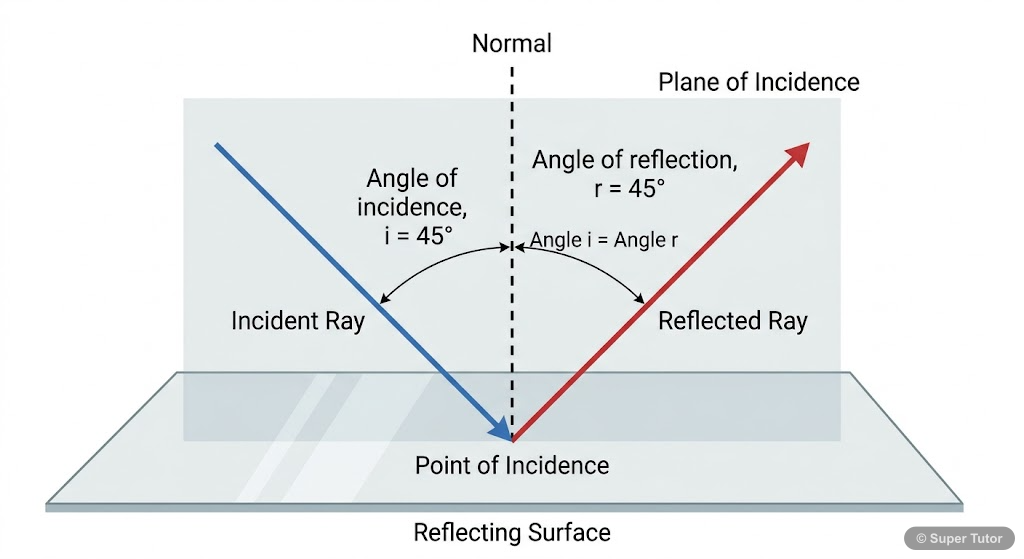
When light strikes a reflecting surface
When light strikes a reflecting surface, it bounces back. The angle of incidence equals the angle of reflection (i = r), with both angles measured fro
A plane mirror produces a virtual
A plane mirror produces a virtual image that is erect, same-sized as the object, and located at equal distance behind the mirror as the object is in f
Spherical mirrors have a pole (P)
Spherical mirrors have a pole (P), center of curvature (C), radius of curvature (R), principal axis, focal point (F), and focal length (f). The relati
The mirror equation (1/v + 1/u
The mirror equation (1/v + 1/u = 1/f) relates object distance (u), image distance (v), and focal length (f). Magnification m = -v/u gives image height
Distances measured right of pole
Distances measured right of pole are positive; left are negative. Object is always on left, so u is negative. Distances above principal axis are posit
Learning Objectives
- Understand the ray aspect of light and laws governing its behavior
- Apply laws of reflection and refraction to solve optical problems
- Analyze image formation in mirrors and lenses using mathematical equations
- Determine the speed of light and relate it to optical density through refractive index
- Explain phenomena like total internal reflection, dispersion, and scattering
Frequently Asked Questions
What are the important topics in Ray Optics for Tamil Nadu Board Class 12 Physics?
How should I revise Ray Optics for the Tamil Nadu Board Class 12 board exam?
Sources & Official References
Content is aligned to the official syllabus. Refer to the board website for the latest curriculum.
More resources for Ray Optics
For serious students
Get the full Ray Optics chapter — start free.
Quizzes, flashcards, an AI doubt solver and a study plan for Tamil Nadu Board Class 12 Physics. Free to start, no card needed.