Evolution — Chapter Summary
Tamil Nadu Board · Class 12 · Zoology
Summary of Evolution for Tamil Nadu Board Class 12 Zoology. Key concepts: Life on Earth originated, Earth's history is divided and Fossils are the primary.
Interactive on Super Tutor
Studying Evolution? Get the full interactive chapter.
Quizzes, flashcards, AI doubt-solver and a step-by-step study plan — built for chapter summary and more.
Free trial, no card needed.
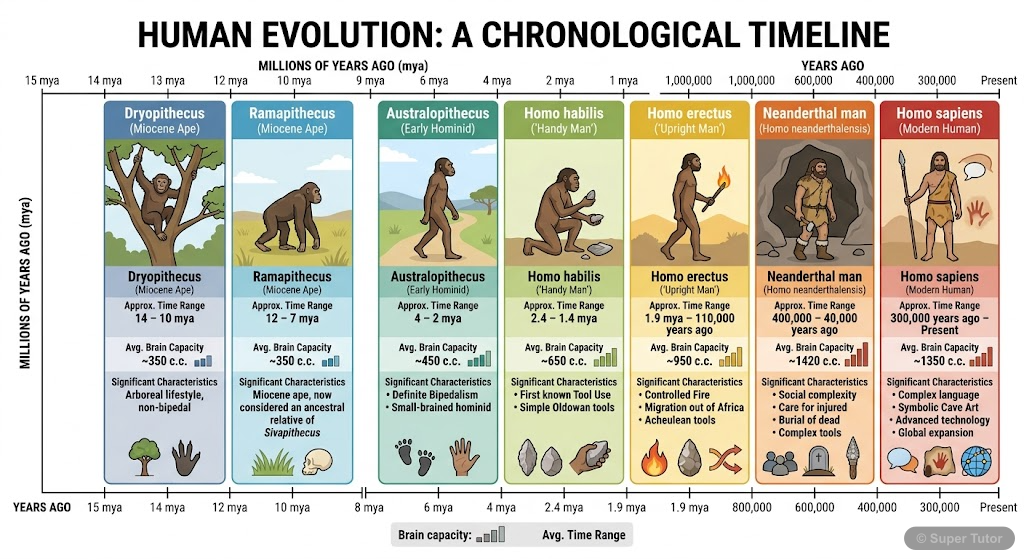
One of 2 illustrations for Evolution in Super Tutor — alongside flashcards, concept maps and practice questions.
Overview
Evolution is the process of heritable changes in one or more characteristics of a population of species from one generation to the next. This comprehensive chapter explores how life on Earth has changed over billions of years, from the origin of simple organisms to the complex diversity we see today
Key Concepts
Life on Earth originated approximately 3
Life on Earth originated approximately 3.5-4 billion years ago. The primitive Earth had no atmosphere but consisted of ammonia, methane, hydrogen, and
Earth's history is divided into major
Earth's history is divided into major eras: Paleozoic, Mesozoic, and Cenozoic. The Paleozoic era (earliest major fauna) is characterized by marine inv
Fossils are the primary evidence
Fossils are the primary evidence of past life and are considered documents of evolution. Fossilization occurs through three main methods: (1) Actual r
Homologous structures are anatomically similar organs
Homologous structures are anatomically similar organs with different functions, indicating common ancestry and divergent evolution. Examples include f
Embryological evidence shows remarkable similarities
Embryological evidence shows remarkable similarities in early development of different vertebrates. All vertebrate embryos develop from a single cell
Learning Objectives
- Understand the evolution of life on Earth and the origin of life from non-living matter
- Gain comprehensive knowledge on various theories of evolution including Lamarck, Darwin, and modern synthetic theory
- Interpret and evaluate multiple evidences for biological evolution (paleontological, anatomical, embryological, and molecular)
- Learn the principles of biological evolution and the mathematical foundations (Hardy-Weinberg principle)
- Understand the importance of gene frequencies in population genetics and natural selection
Frequently Asked Questions
What are the important topics in Evolution for Tamil Nadu Board Class 12 Zoology?
How should I revise Evolution for the Tamil Nadu Board Class 12 board exam?
Sources & Official References
Content is aligned to the official syllabus. Refer to the board website for the latest curriculum.
More resources for Evolution
For serious students
Get the full Evolution chapter — start free.
Quizzes, flashcards, an AI doubt solver and a study plan for Tamil Nadu Board Class 12 Zoology. Free to start, no card needed.