Evolution — Practice Quiz
Tamil Nadu Board · Class 12 · Zoology
Try a 4-question quiz on Evolution for Tamil Nadu Board Class 12 Zoology: tap an answer to check it and see why. 44 questions in the full chapter test.
Interactive on Super Tutor
Studying Evolution? Get the full interactive chapter.
Quizzes, flashcards, AI doubt-solver and a step-by-step study plan — built for practice quiz and more.
Free trial, no card needed.
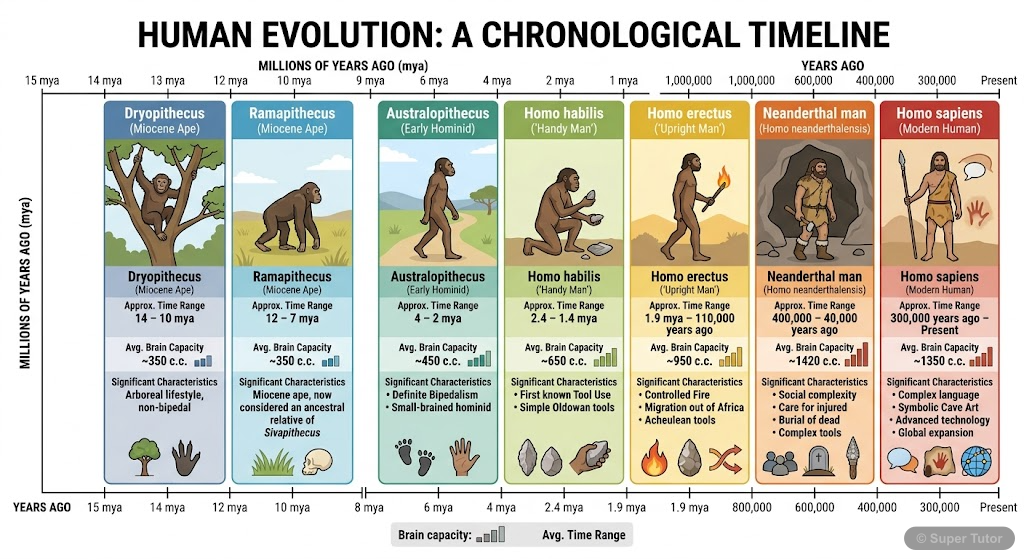
One of 2 illustrations for Evolution in Super Tutor — alongside flashcards, concept maps and practice questions.
Quick Quiz: Evolution
0/4Tap an answer to check it instantly. No sign-up needed for these 4.
Which scientists independently proposed that if the primitive atmosphere was reducing and had an appropriate energy supply, a wide range of organic compounds could be synthesized?
In the Urey-Miller experiment (1953), which of the following amino acids was NOT identified as a product?
The Mesozoic era is known as the 'Golden Age of Reptiles'. Which period of this era is famous for the dominance of Dinosaurs and the presence of the fossil bird Archaeopteryx?
The forelimbs of a whale, bat, human, and horse all have the same basic bone structure (humerus, radius, ulna, carpals, metacarpals, and phalanges) but perform different functions. What type of evolution does this represent?
Sample Questions
August Weismann disproved Lamarck's theory of inheritance of acquired characters by conducting an experiment. What was the key finding of his experiment?
Show answer
Cutting the tails of mice for 20 generations still produced mice with tails, proving somatoplasm changes are not inherited
Step 1: Lamarck proposed that characters acquired during an organism's lifetime can be inherited by offspring. Step 2: Weismann tested this by cutting the tails of mice for 20 consecutive generations. Step 3: All mice born across 20 generations still had tails, showing that the physical change (tail removal) was NOT inherited. Step 4: Weismann proposed his germplasm theory — only changes in the germplasm (reproductive cells) are inherited; changes in somatoplasm (body cells) are NOT transferred to the next generation. Step 5: Option D is wrong because Weismann's theory says germplasm changes C
Industrial melanism in the peppered moth (Biston betularia) is a classic example of which evolutionary concept?
Show answer
Natural selection
Step 1: Before industrialization, white-winged peppered moths were more common because they blended with light-coloured lichens on trees, escaping predators. Step 2: After industrialization, tree trunks turned dark due to soot and smoke, and lichens disappeared. Step 3: The white-winged moths became visible to predators on dark tree trunks, while dark-winged moths were better camouflaged. Step 4: Nature 'selected' the dark-winged moths by offering them a survival advantage — this is natural selection in action. Step 5: This is NOT genetic drift (which is random) or founder's effect (which invo
In a Hardy-Weinberg equilibrium population, the frequency of allele 'A' (p) is 0.6 and allele 'a' (q) is 0.4. What is the expected frequency of heterozygotes (Aa) in the population?
Show answer
0.48
Step 1: Recall the Hardy-Weinberg equation: (p + q)² = p² + 2pq + q² = 1. Step 2: The frequency of heterozygotes (Aa) is given by 2pq. Step 3: Substitute the values: p = 0.6 and q = 0.4. Step 4: 2pq = 2 × 0.6 × 0.4 = 2 × 0.24 = 0.48. Step 5: So the frequency of heterozygotes is 0.48 or 48%. The other options represent: p² = 0.36 (frequency of AA), q² = 0.16 (frequency of aa), and 0.24 = pq (without the factor of 2, which is a common mistake).
Which of the following is a post-zygotic isolating mechanism?
Show answer
Hybrid sterility
Step 1: Isolating mechanisms are divided into two categories: prezygotic (acting before fertilization) and post-zygotic (acting after fertilization). Step 2: Prezygotic mechanisms prevent mating or fertilization — these include ecological, seasonal, behavioural (ethological), morphological, physiological, and cytological isolation. Step 3: Post-zygotic mechanisms act AFTER fertilization and include hybrid inviability, hybrid sterility, and hybrid breakdown. Step 4: Hybrid sterility is a classic post-zygotic mechanism — the hybrid is formed but is sterile (e.g., a mule, which is a cross between
+40 more questions on Evolution (Tamil Nadu Board Class 12 Zoology)
Practise AllFrequently Asked Questions
What are the important topics in Evolution for Tamil Nadu Board Class 12 Zoology?
How many practice questions are there for Evolution?
Sources & Official References
Content is aligned to the official syllabus. Refer to the board website for the latest curriculum.
More resources for Evolution
For serious students
Get the full Evolution chapter — start free.
Quizzes, flashcards, an AI doubt solver and a study plan for Tamil Nadu Board Class 12 Zoology. Free to start, no card needed.