Immunology
Tamil Nadu Board · Class 12 · Zoology
Most important questions from Immunology for Tamil Nadu Board Class 12 Zoology board exam 2026. MCQs, short answer, and long answer questions with marks.
Interactive on Super Tutor
Studying Immunology? Get the full interactive chapter.
Quizzes, flashcards, AI doubt-solver and a step-by-step study plan — built for important questions and more.
1,000+ Class 12 students started this chapter today
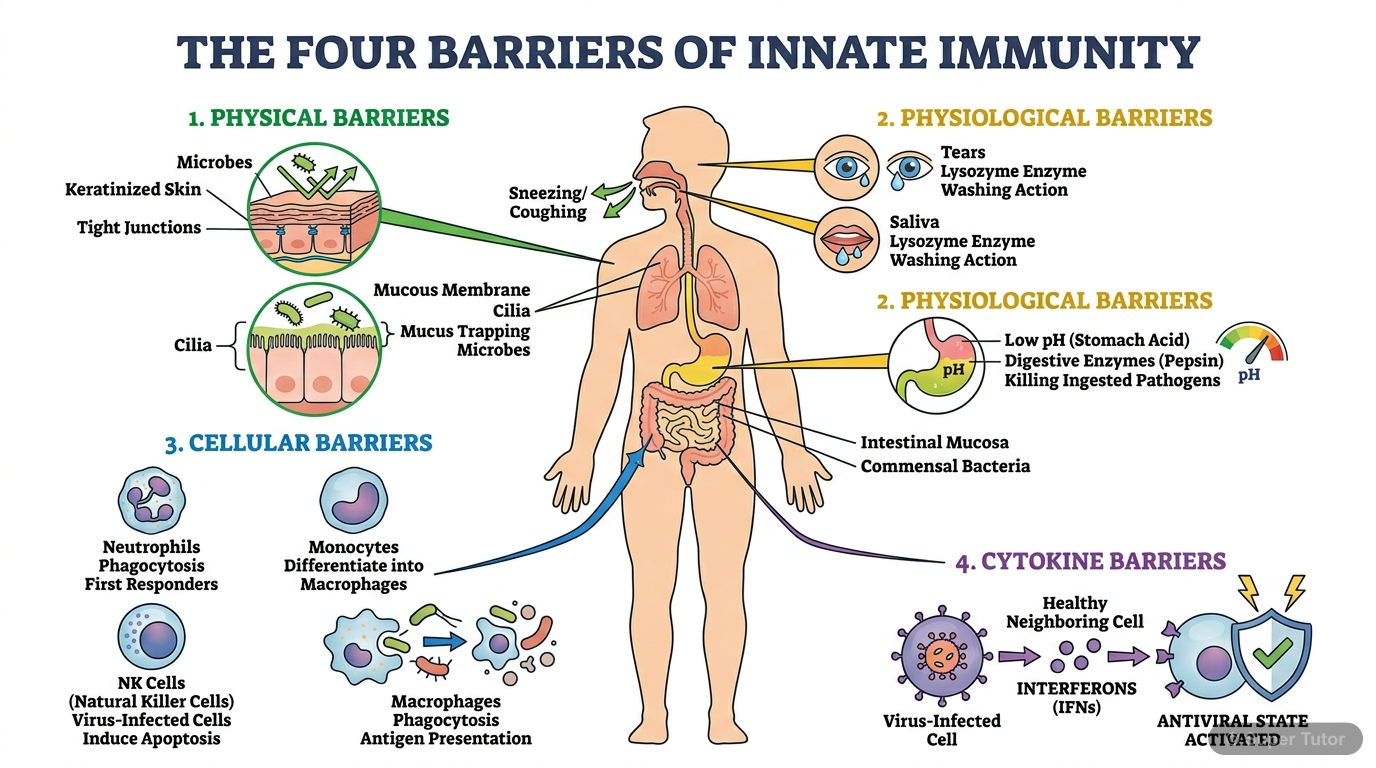
This is just one of 5+ visuals inside Super Tutor's Immunology chapter
Explore the full setSample Questions
Which type of immunity is received by a newborn baby through mother's milk (colostrum)?
Show answer
Naturally acquired passive immunity
Step 1: Passive immunity means antibodies are received from an outside source — the baby does not produce them itself. Step 2: Since the antibodies come from the mother's colostrum (first milk), this happens naturally, not through artificial means like injection. Step 3: So the immunity is both 'passive' (antibodies from outside) and 'naturally acquired'. Step 4: Active immunity would require the baby's own immune system to produce antibodies, which is not the case here. Step 5: Artificial immunity involves vaccines or injections given by doctors, not natural feeding.
The secondary immune response is also called the 'booster response' because:
Show answer
Antibody levels rise steeply and much higher than in the primary response
Step 1: The secondary immune response occurs when a person is exposed to the SAME antigen for the second time. Step 2: Because immunological memory has been established, the immune system recognizes the antigen quickly. Step 3: Within 2-3 days, antibody concentration rises steeply to much higher levels than in the primary response. Step 4: This rapid and stronger response is why it is called the 'booster response'. Step 5: Options A and C are incorrect descriptions of primary response features, and Option D is wrong because memory cells are the KEY feature of secondary immunity.
Where do T lymphocytes mature after leaving the bone marrow?
Show answer
Thymus gland
Step 1: Both B and T lymphocytes are produced in the bone marrow. Step 2: B lymphocytes mature within the bone marrow itself. Step 3: T lymphocytes, however, leave the bone marrow and travel to the thymus gland to mature. Step 4: In the thymus, T cells (called thymocytes) become immunocompetent (capable of mounting an immune response). Step 5: Spleen and lymph nodes are secondary lymphoid organs where mature lymphocytes accumulate — they are not sites of T cell maturation.
Which of the following is a PRIMARY lymphoid organ in humans?
Show answer
Thymus
Step 1: Lymphoid organs are classified as primary (central) and secondary (peripheral). Step 2: Primary lymphoid organs are where lymphocytes are produced and matured — they include the bone marrow and the thymus gland. Step 3: Thymus is a primary lymphoid organ where T cells mature. Step 4: Spleen, lymph nodes, and tonsils are all SECONDARY (peripheral) lymphoid organs — they trap antigens and expose them to mature lymphocytes. Step 5: Therefore, among the given options, only Thymus is a primary lymphoid organ.
+41 more questions available
Practice AllFrequently Asked Questions
What are the important topics in Immunology for Tamil Nadu Board Class 12 Zoology?
How to score full marks in Immunology — Tamil Nadu Board Class 12 Zoology?
How many important questions are there in Immunology?
Sources & Official References
Content is aligned to the official syllabus. Refer to the board website for the latest curriculum.
More resources for Immunology
Practice Quiz
Test yourself with a quick quiz
Revision Notes
Key points for last-minute revision
Formula Sheet
All formulas in one place
Chapter Summary
Understand the chapter at a glance
Concept Maps
See how topics connect visually
Study Plan
Step-by-step plan to ace this chapter
Flashcards
Quick-fire cards for active recall
Syllabus
What topics to cover
NCERT Solutions
Every textbook question solved step by step
For serious students
Get the full Immunology chapter — for free.
Quizzes, flashcards, AI doubt-solver and a step-by-step study plan for Tamil Nadu Board Class 12 Zoology.