Acids,Bases and Salts — NCERT Solutions
CBSE · Class 10 · Science
NCERT Solutions for Acids,Bases and Salts, CBSE Class 10 Science: 36 textbook questions solved step by step. Part of the CBSE Class 10 Science syllabus.
Interactive on Super Tutor
Studying Acids,Bases and Salts? Get the full interactive chapter.
Quizzes, flashcards, AI doubt-solver and a step-by-step study plan — built for NCERT solutions and more.
Free trial, no card needed.
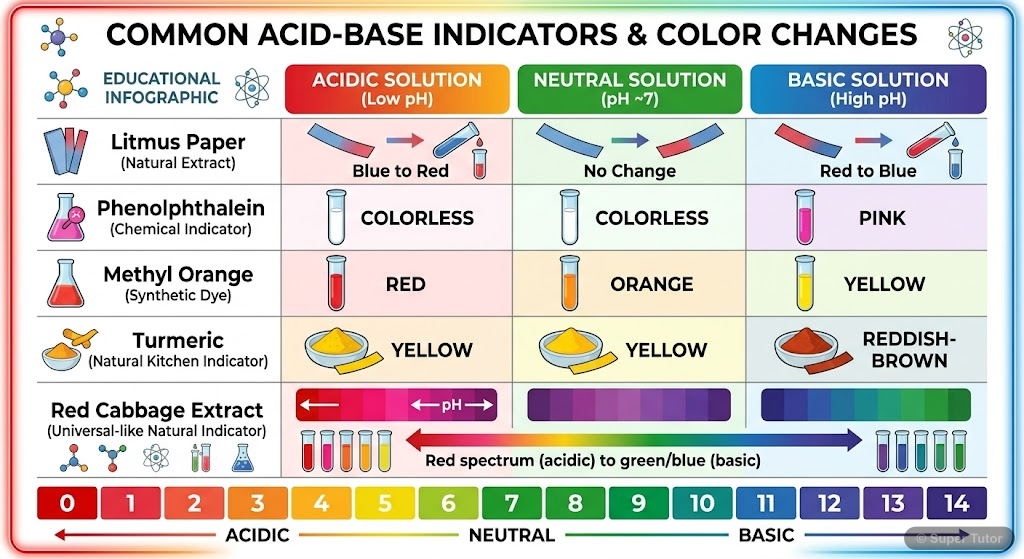
One of 14 illustrations for Acids,Bases and Salts in Super Tutor — alongside flashcards, concept maps and practice questions.
The first 18 solutions are open to read. The other 18 are free with a Super Tutor account.
Question
1You have been provided with three test tubes. One of them contains distilled water and the other two contain an acidic solution and a basic solution, respectively. If you are given only red litmus paper, how will you identify the contents of each test tube?Show solution
Take one test tube at a time and test it with red litmus.
- The test tube in which red litmus turns blue contains the basic solution.
- The test tube in which red litmus shows no change may contain either distilled water or an acidic solution, because red litmus does not change in acid or neutral solution.
- Now use the test tube identified as basic. Dip the same red litmus into the other two test tubes.
- If it turns blue there, that test tube is the base.
- If it does not change, that test tube is either acidic solution or distilled water.
- To separate these two, first dip a fresh strip of red litmus into one of them. The acidic solution will keep red litmus red, and the distilled water will also keep it red.
So, with only red litmus, you can identify the base directly, but you cannot distinguish acid from distilled water using red litmus alone. To identify all three uniquely, you need an additional indicator or prior identification of the base.
Questions
1Why should curd and sour substances not be kept in brass and copper vessels?Show solution
Curd and sour substances should not be kept in brass and copper vessels because they contain acids. The acids react with these metals to form harmful salts, which can contaminate the food and may be poisonous. Hence, such substances are stored in non-reactive containers.
2Which gas is usually liberated when an acid reacts with a metal? Illustrate with an example. How will you test for the presence of this gas?Show solution
When an acid reacts with a metal, the gas usually liberated is hydrogen gas.
Example:
To test for hydrogen, bring a burning candle or a burning splint near the gas. It burns with a 'pop' sound.
3Metal compound A reacts with dilute hydrochloric acid to produce effervescence. The gas evolved extinguishes a burning candle. Write a balanced chemical equation for the reaction if one of the compounds formed is calcium chloride.Show solution
The gas that extinguishes a burning candle is carbon dioxide. Since the product formed is calcium chloride, the metal compound A must be calcium carbonate.
Balanced equation:
Questions
1Why do HCl, HNO₃, etc., show acidic characters in aqueous solutions while solutions of compounds like alcohol and glucose do not show acidic character?Show solution
HCl, HNO₃, etc. show acidic character in aqueous solution because they produce hydrogen ions in water. These ions actually exist as hydronium ions, H₃O⁺.
Alcohol and glucose contain hydrogen, but they do not produce H⁺/H₃O⁺ ions in water, so they do not show acidic character.
2Why does an aqueous solution of an acid conduct electricity?Show solution
An aqueous solution of an acid conducts electricity because acids produce ions in water. The hydrogen ions (present as H₃O⁺) and the accompanying anions carry electric current through the solution.
4While diluting an acid, why is it recommended that the acid should be added to water and not water to the acid?Show solution
While diluting an acid, acid should be added to water, not water to acid, because the process is highly exothermic. Adding acid slowly to water with stirring allows the heat to be absorbed safely. If water is poured into concentrated acid, sudden heating may cause splashing and burns.
5How is the concentration of hydronium ions (H₂O⁺) affected when a solution of an acid is diluted?Show solution
When an acid is diluted, the concentration of hydronium ions decreases because the same amount of acid is spread over a larger volume of water.
Table 2.2
1Test the pH values of solutions given in Table 2.2.
Record your observations.
What is the nature of each substance on the basis of your observations?Show solution
The exact colour and pH values are approximate and can be recorded as follows:
| Solution | Nature |
|---|---|
| Saliva (before meal) | slightly acidic / near neutral |
| Saliva (after meal) | more acidic |
| Lemon juice | acidic |
| Colourless aerated drink | acidic |
| Carrot juice | slightly acidic |
| Coffee | acidic |
| Tomato juice | acidic |
| Tap water | neutral |
| 1M NaOH | basic |
| 1M HCl | strongly acidic |
On the basis of pH paper, acids show pH less than 7, neutral substances show pH 7, and bases show pH more than 7.
Questions
1You have two solutions, A and B. The pH of solution A is 6 and pH of solution B is 8. Which solution has more hydrogen ion concentration? Which of this is acidic and which one is basic?Show solution
Solution A has pH 6 and solution B has pH 8.
- Lower pH means higher hydrogen ion concentration.
- So A has more hydrogen ion concentration than B.
- A is acidic because its pH is less than 7.
- B is basic because its pH is more than 7.
3Do basic solutions also have H+(aq) ions? If yes, then why are these basic?Show solution
Yes, basic solutions also have H⁺(aq) ions, but their concentration is very low compared with OH⁻ ions. They are basic because the solution contains more hydroxide ions than hydrogen ions.
4Under what soil condition do you think a farmer would treat the soil of his fields with quick lime (calcium oxide) or slaked lime (calcium hydroxide) or chalk (calcium carbonate)?Show solution
A farmer would treat the soil with quick lime, slaked lime or chalk when the soil is too acidic. These substances are basic and help neutralise excess acidity in the soil.
Activity 2.13
1Write the chemical formulae of the salts given below. Potassium sulphate, sodium sulphate, calcium sulphate, magnesium sulphate, copper sulphate, sodium chloride, sodium nitrate, sodium carbonate and ammonium chloride.Show solution
The chemical formulae are:
- Potassium sulphate —
- Sodium sulphate —
- Calcium sulphate —
- Magnesium sulphate —
- Copper sulphate —
- Sodium chloride — \text{NaCl
- Sodium nitrate —
- Sodium carbonate —
- Ammonium chloride —
2Identify the acids and bases from which the above salts may be obtained.Show solution
The salts can be obtained from these acids and bases:
- Potassium sulphate — sulphuric acid and potassium hydroxide
- Sodium sulphate — sulphuric acid and sodium hydroxide
- Calcium sulphate — sulphuric acid and calcium hydroxide
- Magnesium sulphate — sulphuric acid and magnesium hydroxide
- Copper sulphate — sulphuric acid and copper hydroxide / copper oxide
- Sodium chloride — hydrochloric acid and sodium hydroxide
- Sodium nitrate — nitric acid and sodium hydroxide
- Sodium carbonate — carbonic acid and sodium hydroxide
- Ammonium chloride — hydrochloric acid and ammonium hydroxide
3Salts having the same positive or negative radicals are said to belong to a family. For example, NaCl and Na₂SO₄ belong to the family of sodium salts. Similarly, NaCl and KCl belong to the family of chloride salts. How many families can you identify among the salts given in this Activity?Show solution
The salts listed can be grouped into families based on common radicals:
- Sodium salts: Na₂SO₄, NaCl, NaNO₃, Na₂CO₃
- Sulphate salts: K₂SO₄, Na₂SO₄, CaSO₄, MgSO₄, CuSO₄
- Chloride salts: NaCl, NH₄Cl
So, three families can be clearly identified from the given salts.
Activity 2.14
1Collect the following salt samples – sodium chloride, potassium nitrate, aluminium chloride, zinc sulphate, copper sulphate, sodium acetate, sodium carbonate and sodium hydrogencarbonate (some other salts available can also be taken).
Check their solubility in water (use distilled water only).
Check the action of these solutions on litmus and find the pH using a pH paper.
Which of the salts are acidic, basic or neutral?
Identify the acid or base used to form the salt.
Report your observations in Table 2.4.Show solution
Using litmus and pH paper, the salts can be classified as follows:
- Neutral salts: sodium chloride, potassium nitrate
- Acidic salts: aluminium chloride, zinc sulphate, copper sulphate
- Basic salts: sodium acetate, sodium carbonate, sodium hydrogencarbonate
General idea:
- Salts formed from a strong acid and strong base are neutral.
- Salts formed from a strong acid and weak base are acidic.
- Salts formed from a strong base and weak acid are basic.
Acid/base used to form them:
- NaCl: HCl + NaOH
- KNO₃: HNO₃ + KOH
- AlCl₃: HCl + Al(OH)₃
- ZnSO₄: H₂SO₄ + Zn(OH)₂ / ZnO
- CuSO₄: H₂SO₄ + CuO / Cu(OH)₂
- CH₃COONa: CH₃COOH + NaOH
- Na₂CO₃: H₂CO₃ + NaOH
- NaHCO₃: H₂CO₃ + NaOH
QUESTIONS (In-text)
1What is the common name of the compound Ca(ClO)₂?Show solution
Given: Chemical formula Ca(ClO)₂
Answer: The common name of Ca(ClO)₂ (Calcium hypochlorite) is Bleaching Powder.
It is prepared by passing chlorine gas over dry slaked lime [Ca(OH)₂]:
Final Answer: The common name of Ca(ClO)₂ is Bleaching Powder.
2Name the substance which on treatment with chlorine yields bleaching powder.Show solution
Concept: Bleaching powder is produced by the action of chlorine on a dry base.
Reaction:
Final Answer: Dry slaked lime [Ca(OH)₂ — Calcium hydroxide] on treatment with chlorine yields bleaching powder.
Free with a Super Tutor account
Free with a Super Tutor account
Free with a Super Tutor account
Exercises
(a) 1
(b) 4
(c) 5
(d) 10
Free with a Super Tutor account
(a) NaCl
(b) HCl
(c) LiCl
(d) KCl
Free with a Super Tutor account
(a) 4 mL
(b) 8 mL
(c) 12 mL
(d) 16 mL
Free with a Super Tutor account
(a) Antibiotic
(b) Analgesic
(c) Antacid
(d) Antiseptic
Free with a Super Tutor account
(a) dilute sulphuric acid reacts with zinc granules.
(b) dilute hydrochloric acid reacts with magnesium ribbon.
(c) dilute sulphuric acid reacts with aluminium powder.
(d) dilute hydrochloric acid reacts with iron filings.
Free with a Super Tutor account
Free with a Super Tutor account
Free with a Super Tutor account
Free with a Super Tutor account
(a) neutral?
(b) strongly alkaline?
(c) strongly acidic?
(d) weakly acidic?
(e) weakly alkaline?
Arrange the pH in increasing order of hydrogen-ion concentration.
Free with a Super Tutor account
Free with a Super Tutor account
Free with a Super Tutor account
(a) Why does he shift the pH of the fresh milk from 6 to slightly alkaline?
(b) Why does this milk take a long time to set as curd?
Free with a Super Tutor account
Free with a Super Tutor account
Free with a Super Tutor account
Free with a Super Tutor account
18 more solved questions in Acids,Bases and Salts
They are free with a Super Tutor account, along with practice quizzes and flashcards for this chapter. Free to start, no card needed.
Frequently Asked Questions
What are the important topics in Acids,Bases and Salts for CBSE Class 10 Science?
Are these NCERT Solutions for Acids,Bases and Salts free?
How should I revise Acids,Bases and Salts for the CBSE Class 10 board exam?
Sources & Official References
- NCERT Official — ncert.nic.in
- CBSE Academic — cbseacademic.nic.in
- CBSE Official — cbse.gov.in
- National Education Policy 2020 — education.gov.in
Content is aligned to the official syllabus. Refer to the board website for the latest curriculum.
More resources for Acids,Bases and Salts
Practice Quiz
Test yourself with a quick quiz
Important Questions
Exam-style questions with answers
Revision Notes
Key points for last-minute revision
Formula Sheet
The chapter's formulas in one place
Chapter Summary
Understand the chapter at a glance
Concept Maps
See how topics connect
Study Plan
Step-by-step plan for this chapter
Flashcards
Quick-fire cards for active recall
Syllabus
What topics to cover
For serious students
Get the full Acids,Bases and Salts chapter — start free.
Quizzes, flashcards, an AI doubt solver and a study plan for CBSE Class 10 Science. Free to start, no card needed.