Heredity — NCERT Solutions
CBSE · Class 10 · Science
NCERT Solutions for Heredity, CBSE Class 10 Science: 10 textbook questions solved step by step. Covers Questions and Exercises.
Interactive on Super Tutor
Studying Heredity? Get the full interactive chapter.
Quizzes, flashcards, AI doubt-solver and a step-by-step study plan — built for NCERT solutions and more.
Free trial, no card needed.
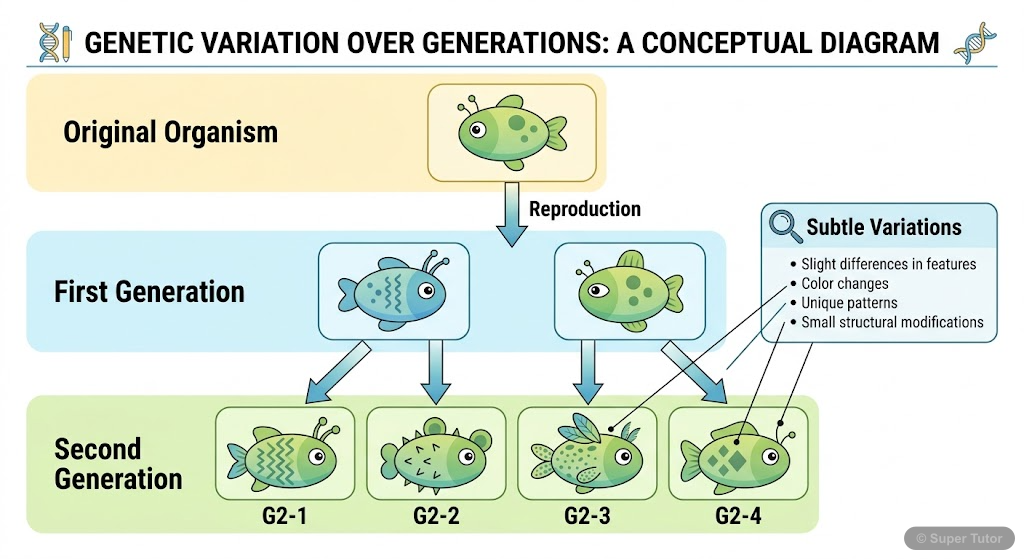
One of 7 illustrations for Heredity in Super Tutor — alongside flashcards, concept maps and practice questions.
The first 5 solutions are open to read. The other 5 are free with a Super Tutor account.
Questions
1If a trait A exists in 10% of a population of an asexually reproducing species and a trait B exists in 60% of the same population, which trait is likely to have arisen earlier?Show solution
In an asexually reproducing species, a trait that is found in a larger part of the population is more likely to have arisen earlier, because it had more time to be passed on to many descendants. Since trait B is present in 60% of the population, while trait A is present in only 10%, B is likely to have arisen earlier.
2How does the creation of variations in a species promote survival?Show solution
Variations promote survival because some variations give an individual advantage in a particular environment. If the environment changes, individuals with favourable variations are more likely to survive and reproduce. For example, bacteria that can withstand heat survive better during a heat wave. So, variations increase the chance that at least some members of a species will survive environmental change.
Questions
1How do Mendel's experiments show that traits may be dominant or recessive?Show solution
Given/Concept: Mendel performed monohybrid crosses using contrasting traits in pea plants (e.g., tall vs. short, round seeds vs. wrinkled seeds).
Explanation:
Step 1: Mendel crossed pure-breeding tall plants (TT) with pure-breeding short plants (tt). All plants in the F₁ generation were tall.
Step 2: When F₁ plants (Tt) were self-pollinated, the F₂ generation showed both tall and short plants in a ratio of approximately 3:1.
Step 3: The trait that appeared in F₁ (tallness) and in 3/4 of F₂ plants is called the dominant trait. The trait that disappeared in F₁ but reappeared in 1/4 of F₂ plants (shortness) is called the recessive trait.
Conclusion: Since the recessive trait (shortness) was hidden in F₁ but reappeared in F₂, Mendel concluded that traits can be dominant (expressed even in a single copy) or recessive (expressed only when both copies are identical). This shows that both copies of a gene are present in an organism, but only the dominant one is expressed when both are present together.
2How do Mendel's experiments show that traits are inherited independently?Show solution
Given/Concept: Mendel performed dihybrid crosses to study the inheritance of two traits simultaneously.
Explanation:
Step 1: Mendel crossed pure-breeding round yellow seed plants (RRYY) with pure-breeding wrinkled green seed plants (rryy).
Step 2: F₁ plants (RrYy) were self-pollinated to get F₂ generation.
Step 3: The F₂ generation showed four phenotypic classes in the ratio:
Step 4: New combinations — Round Green and Wrinkled Yellow — appeared in F₂ that were not present in either parent. This is only possible if the genes for seed shape and seed colour are inherited independently of each other.
Conclusion: If the two traits were linked and always inherited together, only parental combinations (Round Yellow and Wrinkled Green) would appear. The appearance of new combinations in a 9:3:3:1 ratio proves that traits are inherited independently (Law of Independent Assortment).
3A man with blood group A marries a woman with blood group O and their daughter has blood group O. Is this information enough to tell you which of the traits – blood group A or O – is dominant? Why or why not?Show solution
Given:
- Father's blood group = A
- Mother's blood group = O
- Daughter's blood group = O
Analysis:
Step 1: The daughter has blood group O. She received one allele from her father (blood group A) and one from her mother (blood group O).
Step 2: Since the daughter's blood group is O, the allele for blood group O must have been expressed. This means the father must have contributed an allele for O (not A) to the daughter.
Step 3: For the father (blood group A) to pass an O allele to his daughter, his genotype must be heterozygous (), i.e., he carries one A allele and one O allele. The daughter received the (O) allele from the father and (O) allele from the mother, making her genotype (blood group O).
Step 4: Since the father has blood group A with genotype , the A allele is expressed even in the presence of the O allele. This means blood group A is dominant over blood group O.
Conclusion: Yes, this information is enough to conclude that blood group A is dominant over blood group O, because the father expresses blood group A despite carrying an O allele, which means A masks O — confirming A is dominant and O is recessive.
Free with a Super Tutor account
Exercises
(a) TTWW
(b) TTww
(c) TtWW
(d) TtWw
Free with a Super Tutor account
Free with a Super Tutor account
Free with a Super Tutor account
Free with a Super Tutor account
5 more solved questions in Heredity
They are free with a Super Tutor account, along with practice quizzes and flashcards for this chapter. Free to start, no card needed.
Frequently Asked Questions
What are the important topics in Heredity for CBSE Class 10 Science?
Are these NCERT Solutions for Heredity free?
How should I revise Heredity for the CBSE Class 10 board exam?
Sources & Official References
- NCERT Official — ncert.nic.in
- CBSE Academic — cbseacademic.nic.in
- CBSE Official — cbse.gov.in
- National Education Policy 2020 — education.gov.in
Content is aligned to the official syllabus. Refer to the board website for the latest curriculum.
More resources for Heredity
Practice Quiz
Test yourself with a quick quiz
Important Questions
Exam-style questions with answers
Revision Notes
Key points for last-minute revision
Chapter Summary
Understand the chapter at a glance
Concept Maps
See how topics connect
Study Plan
Step-by-step plan for this chapter
Flashcards
Quick-fire cards for active recall
Syllabus
What topics to cover
For serious students
Get the full Heredity chapter — start free.
Quizzes, flashcards, an AI doubt solver and a study plan for CBSE Class 10 Science. Free to start, no card needed.