Human Reproduction
CBSE · Class 12 · Biology
Flashcards for Human Reproduction — CBSE Class 12 Biology. Quick Q&A cards covering key concepts, definitions, and formulas.
Interactive on Super Tutor
Studying Human Reproduction? Get the full interactive chapter.
Quizzes, flashcards, AI doubt-solver and a step-by-step study plan — built for flashcards and more.
1,000+ Class 12 students started this chapter today
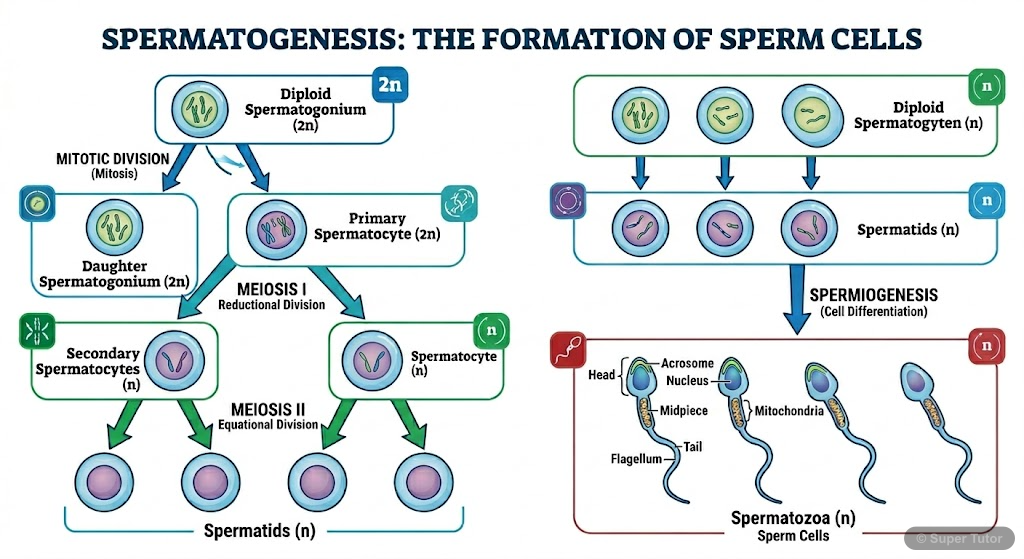
This is just one of 18+ visuals inside Super Tutor's Human Reproduction chapter
Explore the full setWhat are the main events of human reproduction?
Answer
Human reproduction includes gamete formation, insemination, fertilisation, formation of the zygote, blastocyst development, implantation, gestation, and parturition. It is a sexual and viviparous mode…
मानव प्रजनन की मुख्य घटनाएँ क्या हैं?
Answer
मानव प्रजनन में युग्मक निर्माण, गर्भाधान, निषेचन, युग्मनज का निर्माण, ब्लास्टोसिस्ट का विकास, आरोपण, गर्भधारण और प्रसव शामिल हैं। यह प्रजनन का एक यौन और जरायुज तरीका है।…
What are the testes and what is their function?
Answer
The testes are the primary male reproductive organs. They are paired, located in the scrotum outside the abdominal cavity, and produce sperm and androgens.
वृषण क्या होते हैं और उनका कार्य क्या है?
Answer
अंडकोष (testes) नर के मुख्य जनन अंग हैं। ये जोड़े में होते हैं, उदर गुहा के बाहर अंडकोश में स्थित होते हैं और शुक्राणु तथा एण्ड्रोजन का उत्पादन करते हैं।…
Why are the testes located in the scrotum?
Answer
The scrotum maintains the low temperature of the testes, about 2 to 2.5 degree Celsius lower than normal internal body temperature, which is necessary for spermatogenesis.
अंडकोष अंडकोश में क्यों स्थित होते हैं?
Answer
अंडकोश वृषण के कम तापमान को बनाए रखता है, जो सामान्य आंतरिक शरीर के तापमान से लगभग 2 से 2.5 डिग्री सेल्सियस कम होता है, जो शुक्राणुजनन के लिए आवश्यक है।…
What is the structure of a testis at the tissue level?
Answer
Each testis is oval, about 4 to 5 cm long and 2 to 3 cm wide. It has about 250 testicular lobules, and each lobule contains 1 to 3 highly coiled seminiferous tubules.
ऊतक स्तर पर वृषण की संरचना क्या है?
Answer
प्रत्येक वृषण अंडाकार, लगभग 4 से 5 cm लंबा और 2 से 3 cm चौड़ा होता है। इसमें लगभग 250 वृषण लोबुल होते हैं, और प्रत्येक लोबुल में 1 से 3 अत्यधिक कुंडलित सेमिनिफेरस नलिकाएं होती हैं।…
+66 more flashcards available
Practice AllFrequently Asked Questions
What are the important topics in Human Reproduction for CBSE Class 12 Biology?
How to score full marks in Human Reproduction — CBSE Class 12 Biology?
How many flashcards are available for Human Reproduction?
Sources & Official References
- NCERT Official — ncert.nic.in
- CBSE Academic — cbseacademic.nic.in
- CBSE Official — cbse.gov.in
- National Education Policy 2020 — education.gov.in
Content is aligned to the official syllabus. Refer to the board website for the latest curriculum.
More resources for Human Reproduction
Practice Quiz
Test yourself with a quick quiz
Important Questions
Practice with board exam-style questions
Revision Notes
Key points for last-minute revision
Formula Sheet
All formulas in one place
Chapter Summary
Understand the chapter at a glance
Concept Maps
See how topics connect visually
Study Plan
Step-by-step plan to ace this chapter
Syllabus
What topics to cover
NCERT Solutions
Every textbook question solved step by step
For serious students
Get the full Human Reproduction chapter — for free.
Quizzes, flashcards, AI doubt-solver and a step-by-step study plan for CBSE Class 12 Biology.