Human Reproduction
CBSE · Class 12 · Biology
Summary of Human Reproduction for CBSE Class 12 Biology. Key concepts, important points, and chapter overview.
Interactive on Super Tutor
Studying Human Reproduction? Get the full interactive chapter.
Quizzes, flashcards, AI doubt-solver and a step-by-step study plan — built for chapter summary and more.
1,000+ Class 12 students started this chapter today
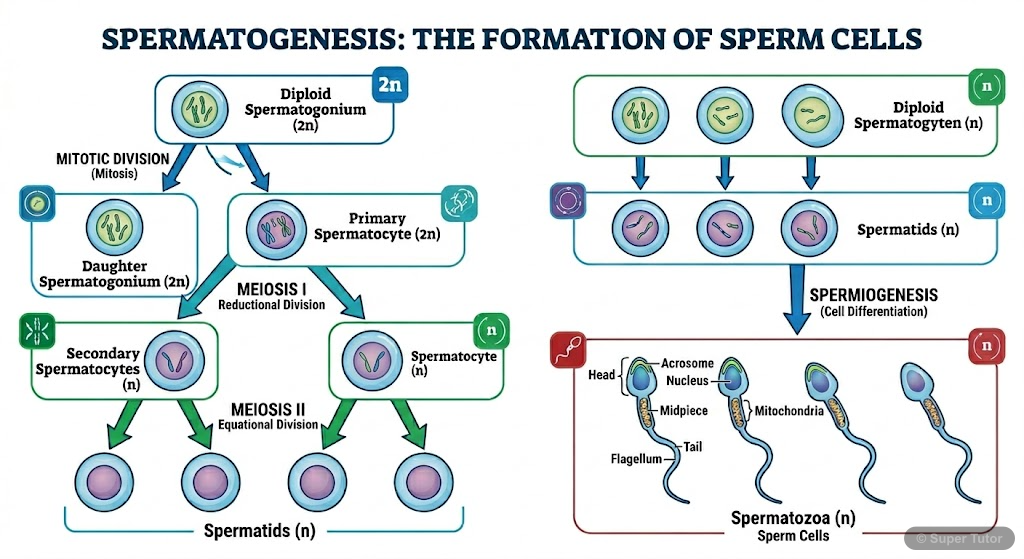
This is just one of 18+ visuals inside Super Tutor's Human Reproduction chapter
Explore the full setOverview
Human reproduction is sexual and viviparous. It includes the formation of gametes, transfer of sperm into the female reproductive tract, fertilisation, formation of the zygote, implantation of the blastocyst, embryonic development, parturition, and lactation. The male system produces sperms continuo
Key Concepts
The male reproductive system lies
The male reproductive system lies in the pelvic region and includes a pair of testes, accessory ducts, accessory glands, and external genitalia. Each
Spermatogenesis begins at puberty because GnRH
Spermatogenesis begins at puberty because GnRH secretion increases. GnRH stimulates the anterior pituitary to release LH and FSH. LH acts on Leydig ce
A sperm has a head
A sperm has a head, neck, middle piece, and tail. The head contains a haploid nucleus, and the acrosome contains enzymes that help fertilisation. The
The female reproductive system includes
The female reproductive system includes a pair of ovaries, oviducts, uterus, cervix, vagina, external genitalia, and mammary glands. Each ovary is 2 t
Oogenesis starts during embryonic development
Oogenesis starts during embryonic development. Oogonia are formed only during fetal life and no new oogonia are added after birth. Primary oocytes rem
Learning Objectives
- Identify the organs of the male and female reproductive systems and state their functions.
- Explain spermatogenesis and oogenesis with their main stages.
- Describe the menstrual cycle and the hormonal changes that control it.
- Explain fertilisation, implantation, placenta formation, and early embryonic development.
- Describe pregnancy, parturition, and lactation, including the role of key hormones.
Frequently Asked Questions
What are the important topics in Human Reproduction for CBSE Class 12 Biology?
How to score full marks in Human Reproduction — CBSE Class 12 Biology?
Sources & Official References
- NCERT Official — ncert.nic.in
- CBSE Academic — cbseacademic.nic.in
- CBSE Official — cbse.gov.in
- National Education Policy 2020 — education.gov.in
Content is aligned to the official syllabus. Refer to the board website for the latest curriculum.
More resources for Human Reproduction
Practice Quiz
Test yourself with a quick quiz
Important Questions
Practice with board exam-style questions
Revision Notes
Key points for last-minute revision
Formula Sheet
All formulas in one place
Concept Maps
See how topics connect visually
Study Plan
Step-by-step plan to ace this chapter
Flashcards
Quick-fire cards for active recall
Syllabus
What topics to cover
NCERT Solutions
Every textbook question solved step by step
For serious students
Get the full Human Reproduction chapter — for free.
Quizzes, flashcards, AI doubt-solver and a step-by-step study plan for CBSE Class 12 Biology.