Human Reproduction
CBSE · Class 12 · Biology
NCERT Solutions for Human Reproduction — CBSE Class 12 Biology.
Interactive on Super Tutor
Studying Human Reproduction? Get the full interactive chapter.
Quizzes, flashcards, AI doubt-solver and a step-by-step study plan — built for ncert solutions and more.
1,000+ Class 12 students started this chapter today
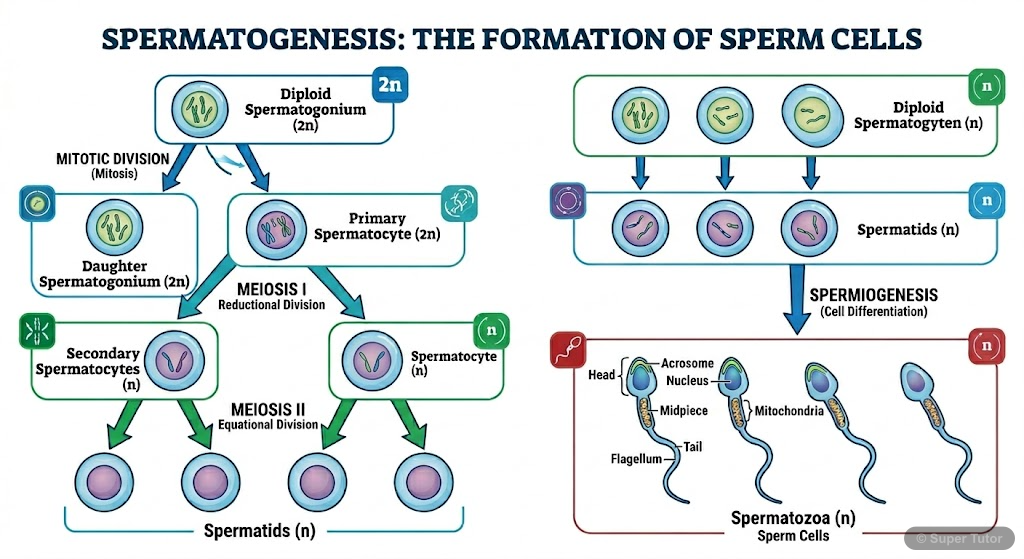
This is just one of 18+ visuals inside Super Tutor's Human Reproduction chapter
Explore the full set21 worked solutions below. Unlock all 41 free in Super Tutor
EXERCISES
1(a)Humans reproduce ________ (asexually/sexually)Show solution
Not sure why a step works? check your working in Super Tutor
1(b)Humans are ________ (oviparous, viviparous, ovoviviparous)Show solution
Not sure why a step works? check your working in Super Tutor
1(c)Fertilisation is ________ in humans (external/internal)Show solution
Not sure why a step works? check your working in Super Tutor
1(d)Male and female gametes are ________ (diploid/haploid)Show solution
Not sure why a step works? check your working in Super Tutor
1(e)Zygote is ________ (diploid/haploid)Show solution
Not sure why a step works? check your working in Super Tutor
1(f)The process of release of ovum from a mature follicle is called ________Show solution
Not sure why a step works? check your working in Super Tutor
1(g)Ovulation is induced by a hormone called ________Show solution
Not sure why a step works? check your working in Super Tutor
1(h)The fusion of male and female gametes is called ________Show solution
Not sure why a step works? check your working in Super Tutor
1(i)Fertilisation takes place in ________Show solution
Not sure why a step works? check your working in Super Tutor
1(j)Zygote divides to form ________ which is implanted in uterus.Show solution
Not sure why a step works? check your working in Super Tutor
1(k)The structure which provides vascular connection between foetus and uterus is called ________Show solution
Not sure why a step works? check your working in Super Tutor
2Draw a labelled diagram of male reproductive system.Show solution
Not sure why a step works? check your working in Super Tutor
3Draw a labelled diagram of female reproductive system.Show solution
Not sure why a step works? check your working in Super Tutor
4Write two major functions each of testis and ovary.Show solution
1. Produces sperms by spermatogenesis.
2. Secretes androgens (testicular hormones) by Leydig cells.
Ovary:
1. Produces the ovum.
2. Secretes ovarian hormones (steroid hormones).
Not sure why a step works? check your working in Super Tutor
5Describe the structure of a seminiferous tubule.Show solution
Not sure why a step works? check your working in Super Tutor
6What is spermatogenesis? Briefly describe the process of spermatogenesis.Show solution
Briefly:
- Spermatogonia multiply by mitosis and increase in number.
- Some become primary spermatocytes.
- Each primary spermatocyte undergoes meiosis I to form two secondary spermatocytes.
- Secondary spermatocytes undergo meiosis II to form four haploid spermatids.
- Spermatids change into spermatozoa by spermiogenesis.
- Mature sperms are released from seminiferous tubules by spermiation.
Not sure why a step works? check your working in Super Tutor
7Name the hormones involved in regulation of spermatogenesis.Show solution
Not sure why a step works? check your working in Super Tutor
8Define spermiogenesis and spermiation.Show solution
Spermiation is the release of sperms from the seminiferous tubules into the lumen.
Not sure why a step works? check your working in Super Tutor
9Draw a labelled diagram of sperm.Show solution
Not sure why a step works? check your working in Super Tutor
10What are the major components of seminal plasma?Show solution
Not sure why a step works? check your working in Super Tutor
11What are the major functions of male accessory ducts and glands?Show solution
The male accessory glands add secretions to form seminal plasma, which is rich in fructose, calcium and certain enzymes. These secretions help in nourishing the sperms, and the bulbourethral glands also help in lubrication of the penis.
Not sure why a step works? check your working in Super Tutor
20 more solved questions in Human Reproduction
Every remaining exercise is solved step by step in Super Tutor, plus practice quizzes and flashcards for this chapter. Free to start.
Stuck on a step?
Ask Super Tutor AI to explain any solution on this page in a simpler way — free, 24x7.
Ask a Doubt FreeFrequently Asked Questions
What are the important topics in Human Reproduction for CBSE Class 12 Biology?
How to score full marks in Human Reproduction — CBSE Class 12 Biology?
Where can I get free NCERT Solutions for Human Reproduction Class 12 Biology?
Sources & Official References
- NCERT Official — ncert.nic.in
- CBSE Academic — cbseacademic.nic.in
- CBSE Official — cbse.gov.in
- National Education Policy 2020 — education.gov.in
Content is aligned to the official syllabus. Refer to the board website for the latest curriculum.
More resources for Human Reproduction
Practice Quiz
Test yourself with a quick quiz
Important Questions
Practice with board exam-style questions
Revision Notes
Key points for last-minute revision
Formula Sheet
All formulas in one place
Chapter Summary
Understand the chapter at a glance
Concept Maps
See how topics connect visually
Study Plan
Step-by-step plan to ace this chapter
Flashcards
Quick-fire cards for active recall
Syllabus
What topics to cover
For serious students
Get the full Human Reproduction chapter — for free.
Quizzes, flashcards, AI doubt-solver and a step-by-step study plan for CBSE Class 12 Biology.