Molecular Basis of Inheritance
CBSE · Class 12 · Biology
Complete topic list for Molecular Basis of Inheritance in CBSE Class 12 Biology. Key concepts, sub-topics, and what to focus on for board exams.
Interactive on Super Tutor
Studying Molecular Basis of Inheritance? Get the full interactive chapter.
Quizzes, flashcards, AI doubt-solver and a step-by-step study plan — built for syllabus and more.
1,000+ Class 12 students started this chapter today
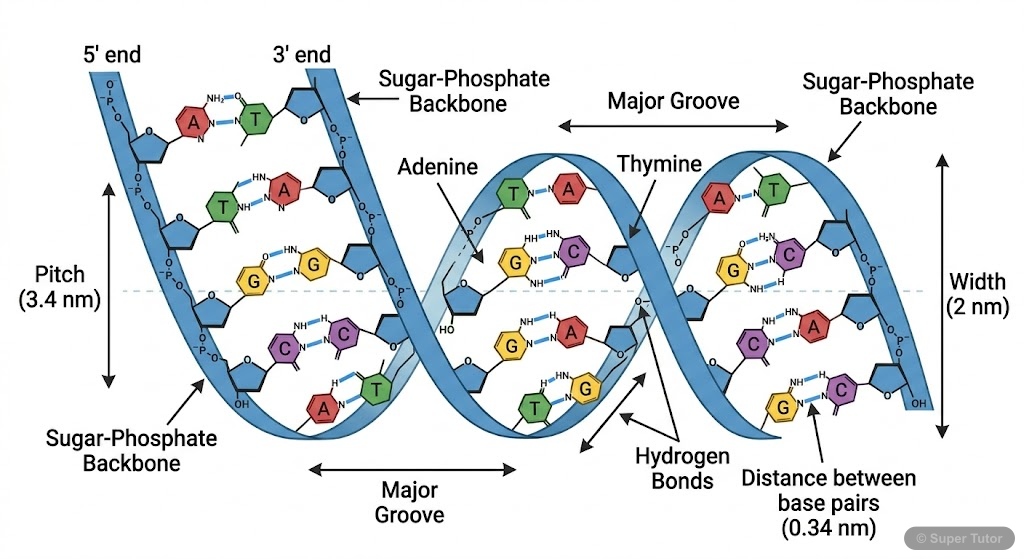
This is just one of 22+ visuals inside Super Tutor's Molecular Basis of Inheritance chapter
Explore the full setTopics in Molecular Basis of Inheritance
1. DNA: Structure and Packaging
- DNA is a long polymer of deoxyribonucleotides.
- A nucleotide has three parts: a nitrogenous base, a pentose sugar, and a phosphate group.
- Purines are adenine and guanine.
2. Search for the Genetic Material
- DNA was first identified as an acidic nuclear substance by Friedrich Meischer in 1869 and named Nuclein.
- Frederick Griffith worked with Streptococcus pneumoniae S and R strains in 1928.
- S strain is virulent and R strain is non-virulent.
3. DNA versus RNA and RNA World
- DNA is more stable than RNA because it lacks the 2' OH group and contains thymine.
- RNA has an extra 2' OH group, making it more reactive and less stable.
- RNA acts as genetic material in some viruses such as TMV and QB bacteriophage.
4. DNA Replication
- Watson and Crick proposed a copying mechanism based on complementary base pairing.
- DNA replication is semiconservative.
- Each daughter DNA molecule has one parental strand and one newly synthesised strand.
Key Concepts
Central concept: Molecular basis of inheritance explains how DNA and RNA store, copy, transmit, and express genetic information, and how this knowledge led to ideas such as the genetic code, gene regulation, the Human Genome Project, and DNA fingerprinting.
Frequently Asked Questions
What are the important topics in Molecular Basis of Inheritance for CBSE Class 12 Biology?
How to score full marks in Molecular Basis of Inheritance — CBSE Class 12 Biology?
Sources & Official References
- NCERT Official — ncert.nic.in
- CBSE Academic — cbseacademic.nic.in
- CBSE Official — cbse.gov.in
- National Education Policy 2020 — education.gov.in
Content is aligned to the official syllabus. Refer to the board website for the latest curriculum.
More resources for Molecular Basis of Inheritance
Practice Quiz
Test yourself with a quick quiz
Important Questions
Practice with board exam-style questions
Revision Notes
Key points for last-minute revision
Formula Sheet
All formulas in one place
Chapter Summary
Understand the chapter at a glance
Concept Maps
See how topics connect visually
Study Plan
Step-by-step plan to ace this chapter
Flashcards
Quick-fire cards for active recall
NCERT Solutions
Every textbook question solved step by step
For serious students
Get the full Molecular Basis of Inheritance chapter — for free.
Quizzes, flashcards, AI doubt-solver and a step-by-step study plan for CBSE Class 12 Biology.