Molecular Basis of Inheritance
CBSE · Class 12 · Biology
NCERT Solutions for Molecular Basis of Inheritance — CBSE Class 12 Biology.
Interactive on Super Tutor
Studying Molecular Basis of Inheritance? Get the full interactive chapter.
Quizzes, flashcards, AI doubt-solver and a step-by-step study plan — built for ncert solutions and more.
1,000+ Class 12 students started this chapter today
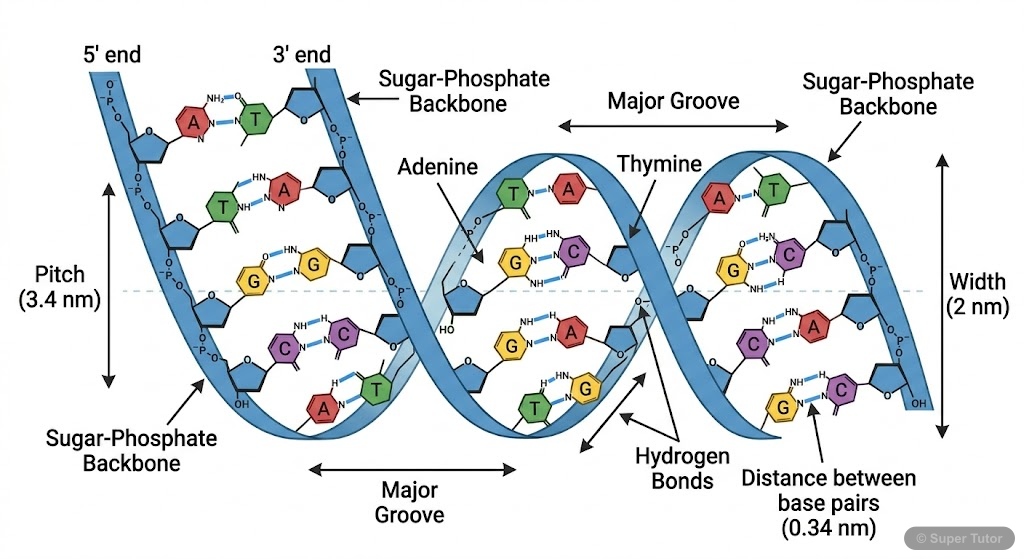
This is just one of 22+ visuals inside Super Tutor's Molecular Basis of Inheritance chapter
Explore the full set11 worked solutions below. Unlock all 21 free in Super Tutor
EXERCISES
1Group the following as nitrogenous bases and nucleosides:
Adenine, Cytidine, Thymine, Guanosine, Uracil and Cytosine.Show solution
- Bases: Adenine, Thymine, Uracil, Cytosine
- Nucleosides: Cytidine, Guanosine
Not sure why a step works? check your working in Super Tutor
2If a double stranded DNA has 20 per cent of cytosine, calculate the per cent of adenine in the DNA.Show solution
Given C = 20%, so G = 20%.
Thus, .
Remaining percentage for A and T = .
Since A = T,
.
Not sure why a step works? check your working in Super Tutor
3If the sequence of one strand of DNA is written as follows:
5'-ATGCATGCATGCATGCATGCATGC-3'
Write down the sequence of complementary strand in 5'-8' direction.Show solution
Given strand:
So the complementary strand is antiparallel:
Written in 5'→3' direction, it becomes:
.
The question asks for the complementary strand in 5'-3' direction.
Not sure why a step works? check your working in Super Tutor
4If the sequence of the coding strand in a transcription unit is written as follows:
5'-ATGCATGCATGCATGCATGCATGC-3'
Write down the sequence of mRNA.Show solution
Coding strand given:
So mRNA is:
Not sure why a step works? check your working in Super Tutor
5Which property of DNA double helix led Watson and Crick to hypothesise semi-conservative mode of DNA replication? Explain.Show solution
Watson and Crick proposed that the two strands are held together by specific hydrogen bonding between complementary bases: A pairs with T and G pairs with C. Because of this, if the two strands separate, each strand can serve as a template for the formation of a new complementary strand. Therefore, after replication, each daughter DNA molecule contains one parental strand and one newly synthesised strand, which is the semi-conservative mode of replication.
Not sure why a step works? check your working in Super Tutor
6Depending upon the chemical nature of the template (DNA or RNA) and the nature of nucleic acids synthesised from it (DNA or RNA), list the types of nucleic acid polymerases.Show solution
- DNA → DNA : DNA-dependent DNA polymerase
- DNA → RNA : DNA-dependent RNA polymerase
These are the nucleic acid polymerases discussed in the chapter.
Not sure why a step works? check your working in Super Tutor
7How did Hershey and Chase differentiate between DNA and protein in their experiment while proving that DNA is the genetic material?Show solution
- Viruses grown in ** contained radioactive DNA, because DNA has phosphorus.
- Viruses grown in contained radioactive protein, because proteins contain sulfur but DNA does not.
They let these phages infect E. coli, then used a blender to remove the viral coats from the bacterial cells and a centrifuge to separate the bacterial pellet from the phage coats.
The bacteria infected with -labeled phages were radioactive, showing that DNA entered the bacteria. The bacteria infected with -labeled phages were not radioactive, showing that protein did not enter**. Thus, DNA was identified as the genetic material.
Not sure why a step works? check your working in Super Tutor
8(a)Repetitive DNA and Satellite DNAShow solution
Satellite DNA refers to these repetitive sequences when they separate as distinct minor peaks from the bulk genomic DNA during density gradient centrifugation.
So, repetitive DNA is the sequence type, while satellite DNA is the fraction/peak obtained on centrifugation.
Not sure why a step works? check your working in Super Tutor
8(b)mRNA and tRNAShow solution
tRNA carries specific amino acids to the ribosome and has an anticodon that reads the codon on mRNA.
Thus, mRNA carries the message, while tRNA serves as the adapter molecule.
Not sure why a step works? check your working in Super Tutor
8(c)Template strand and Coding strandShow solution
The coding strand has 5'→3' polarity and its sequence is the same as the RNA transcript except that T is present instead of U. It does not serve as the template.
Not sure why a step works? check your working in Super Tutor
9List two essential roles of ribosome during translation.Show solution
1. It binds the mRNA and positions the tRNAs correctly so amino acids can be added in order.
2. It catalyses peptide bond formation; in bacteria, 23S rRNA acts as the ribozyme for this reaction.
Not sure why a step works? check your working in Super Tutor
10 more solved questions in Molecular Basis of Inheritance
Every remaining exercise is solved step by step in Super Tutor, plus practice quizzes and flashcards for this chapter. Free to start.
Stuck on a step?
Ask Super Tutor AI to explain any solution on this page in a simpler way — free, 24x7.
Ask a Doubt FreeFrequently Asked Questions
What are the important topics in Molecular Basis of Inheritance for CBSE Class 12 Biology?
How to score full marks in Molecular Basis of Inheritance — CBSE Class 12 Biology?
Where can I get free NCERT Solutions for Molecular Basis of Inheritance Class 12 Biology?
Sources & Official References
- NCERT Official — ncert.nic.in
- CBSE Academic — cbseacademic.nic.in
- CBSE Official — cbse.gov.in
- National Education Policy 2020 — education.gov.in
Content is aligned to the official syllabus. Refer to the board website for the latest curriculum.
More resources for Molecular Basis of Inheritance
Practice Quiz
Test yourself with a quick quiz
Important Questions
Practice with board exam-style questions
Revision Notes
Key points for last-minute revision
Formula Sheet
All formulas in one place
Chapter Summary
Understand the chapter at a glance
Concept Maps
See how topics connect visually
Study Plan
Step-by-step plan to ace this chapter
Flashcards
Quick-fire cards for active recall
Syllabus
What topics to cover
For serious students
Get the full Molecular Basis of Inheritance chapter — for free.
Quizzes, flashcards, AI doubt-solver and a step-by-step study plan for CBSE Class 12 Biology.