The d-and f-Block Elements
CBSE · Class 12 · Chemistry
Flashcards for The d-and f-Block Elements — CBSE Class 12 Chemistry. Quick Q&A cards covering key concepts, definitions, and formulas.
Interactive on Super Tutor
Studying The d-and f-Block Elements? Get the full interactive chapter.
Quizzes, flashcards, AI doubt-solver and a step-by-step study plan — built for flashcards and more.
1,000+ Class 12 students started this chapter today
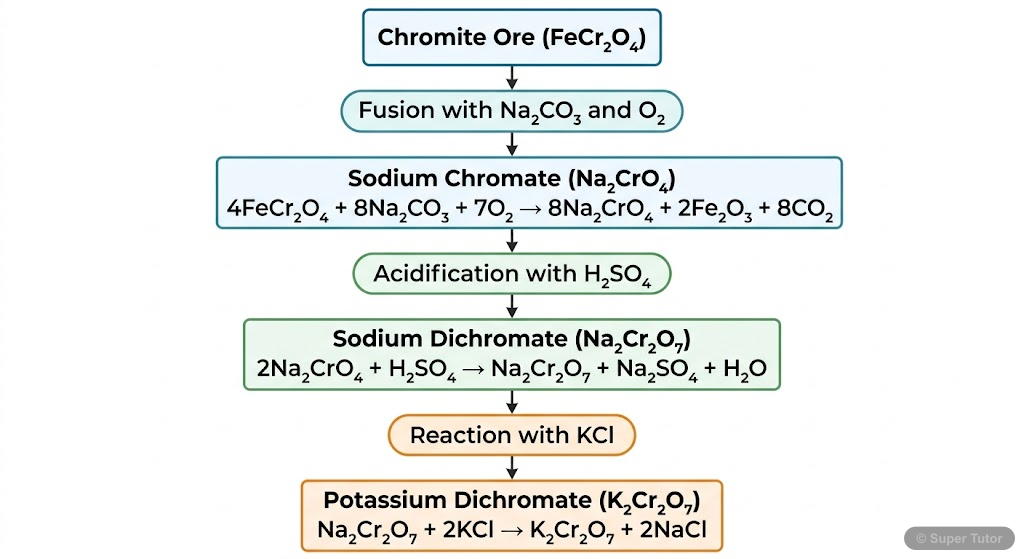
Super Tutor has 16+ illustrations like this for The d-and f-Block Elements alone — flashcards, concept maps, and step-by-step visuals.
See them allसंक्रमण धातुएँ क्या होती हैं?
Answer
संक्रमण धातुएँ वे धातुएँ हैं जिनके उदासीन परमाणु में या उनके किसी आयन में d उपकोशिका अपूर्ण होती है। वे परिवर्ती ऑक्सीकरण अवस्थाएँ, रंगीन आयन, जटिल निर्माण, उत्प्रेरक क्रिया और अनुचुंबकत्व दर्शाते हैं…
What are transition metals?
Answer
Transition metals are metals with an incomplete d subshell in the neutral atom or in one of their ions. They show variable oxidation states, coloured ions, complex formation, catalytic activity, and p…
Why is scandium a transition element but zinc is not?
Answer
Scandium has an incompletely filled 3d subshell in the ground state, so it is a transition element. Zinc has a completely filled 3d10 configuration in the ground state and in its common oxidation stat…
स्कैंडियम एक संक्रमण तत्व क्यों है लेकिन जस्ता नहीं है?
Answer
स्कैंडियम का भू-अवस्था में 3d उपकोशिका अधूरा भरा हुआ होता है, अतः यह एक संक्रमण तत्व है। जस्ता का भू-अवस्था में 3d10 पूर्ण भरा हुआ विन्यास होता है और इसकी सामान्य ऑक्सीकरण अवस्था में भी, अतः इसे संक्र…
जस्ता, कैडमियम और पारा को संक्रमण धातु क्यों नहीं माना जाता है?
Answer
इनकी पूर्ण d10 विन्यास इनकी मूल अवस्था में और इनकी सामान्य ऑक्सीकरण अवस्थाओं में भी होती है। चूँकि परमाणु या आयन में कोई अपूर्ण d उपकोश नहीं होता है, इसलिए ये संक्रमण धातु नहीं हैं।…
Why are zinc, cadmium, and mercury not regarded as transition metals?
Answer
They have full d10 configuration in their ground state and also in their common oxidation states. Since no incomplete d subshell is present in the atom or ion, they are not transition metals.
What is the general electronic configuration of d-block elements?
Answer
The general outer electronic configuration is (n-1)d1-10 ns1-2. Palladium is an exception with configuration 4d10 5s0. Chromium and copper also show exceptions due to extra stability of half-filled an…
डी-ब्लॉक तत्वों का सामान्य इलेक्ट्रॉनिक विन्यास क्या है?
Answer
सामान्य बाह्य इलेक्ट्रॉनिक विन्यास (n-1)d1-10 ns1-2 है। पैलेडियम एक अपवाद है जिसका विन्यास 4d10 5s0 है। अर्ध-भरे और पूर्ण भरे हुए d उपकोशों की अतिरिक्त स्थिरता के कारण क्रोमियम और तांबा भी अपवाद दिखात…
+72 more flashcards available
Practice AllFrequently Asked Questions
What are the important topics in The d-and f-Block Elements for CBSE Class 12 Chemistry?
How to score full marks in The d-and f-Block Elements — CBSE Class 12 Chemistry?
How many flashcards are available for The d-and f-Block Elements?
Sources & Official References
- NCERT Official — ncert.nic.in
- CBSE Academic — cbseacademic.nic.in
- CBSE Official — cbse.gov.in
- National Education Policy 2020 — education.gov.in
Content is aligned to the official syllabus. Refer to the board website for the latest curriculum.
More resources for The d-and f-Block Elements
Practice Quiz
Test yourself with a quick quiz
Important Questions
Practice with board exam-style questions
Revision Notes
Key points for last-minute revision
Formula Sheet
All formulas in one place
Chapter Summary
Understand the chapter at a glance
Concept Maps
See how topics connect visually
Study Plan
Step-by-step plan to ace this chapter
Syllabus
What topics to cover
NCERT Solutions
Every textbook question solved step by step
For serious students
Get the full The d-and f-Block Elements chapter — for free.
Quizzes, flashcards, AI doubt-solver and a step-by-step study plan for CBSE Class 12 Chemistry.