The d-and f-Block Elements
CBSE · Class 12 · Chemistry
NCERT Solutions for The d-and f-Block Elements — CBSE Class 12 Chemistry.
Interactive on Super Tutor
Studying The d-and f-Block Elements? Get the full interactive chapter.
Quizzes, flashcards, AI doubt-solver and a step-by-step study plan — built for ncert solutions and more.
1,000+ Class 12 students started this chapter today
Super Tutor has 16+ illustrations like this for The d-and f-Block Elements alone — flashcards, concept maps, and step-by-step visuals.
See them all19 worked solutions below. Unlock all 38 free in Super Tutor
Exercises
4.1Write down the electronic configuration of:Show solution
- **Cr**: Cr is , so losing 3 electrons gives **.
- Pm: Pm is a lanthanoid; the stable trivalent ion is .
- Cu**: Cu is , so losing one electron gives **.
- Ce**: Ce is ; losing 4 electrons gives **.
- Co**: Co is , so losing 2 electrons gives **.
- Lu**: Lu is ; losing 2 electrons gives **.
- Mn**: Mn is , so losing 2 electrons gives **.
- Th**: Th is ; losing 4 electrons gives ****.
Not sure why a step works? check your working in Super Tutor
4.2Why are compounds more stable than towards oxidation to their +3 state?Show solution
- **Mn has the configuration , which is a half-filled subshell** and therefore especially stable.
- If Mn is oxidised to Mn, it becomes **, which is less stable.
- Fe has ** configuration.
- Oxidation of Fe to Fe gives **, the stable half-filled configuration.
So, Mn resists oxidation, while Fe is more readily oxidised** because the product Fe is more stable.
Not sure why a step works? check your working in Super Tutor
4.3Explain briefly how +2 state becomes more and more stable in the first half of the first row transition elements with increasing atomic number?Show solution
- the increasing nuclear charge makes the ions more stable,
- electrons are added to the inner subshell, so the electrons** are removed first and the formation of ions is easy,
- the stability of the resulting ions depends on electronic arrangements such as ** or other relatively stable configurations.
As a result, in this part of the series the oxidation state is commonly observed and becomes progressively more stable**.
Not sure why a step works? check your working in Super Tutor
4.4To what extent do the electronic configurations decide the stability of oxidation states in the first series of the transition elements? Illustrate your answer with examples.Show solution
- Certain configurations are especially stable, such as **, , and .
- Therefore, oxidation states leading to these configurations are favoured. For example:
- Mn is stable because it is .
- Fe is relatively stable because it is also .
- Zn is stable because it is .
- Cr is reducing because it changes to Cr, , which is more stable.
But electronic configuration is not the only factor. Stability also depends on ionisation enthalpy, enthalpy of atomisation, hydration enthalpy, lattice energy, and ligand effects. For example:
- Cu** is more stable in aqueous solution than Cu because Cu has much greater hydration enthalpy.
- **Mn** is much less stable than Fe even though both are transition ions, because the energy required to form Mn is high.
So, electronic configuration strongly influences oxidation-state stability, but the final stability is determined by several factors together.
Not sure why a step works? check your working in Super Tutor
4.5What may be the stable oxidation state of the transition element with the following electron configurations in the ground state of their atoms : , , and ?Show solution
- ** →
- →
- →
- → **
These correspond to the more common stable oxidation states discussed for the first-row transition elements.
Not sure why a step works? check your working in Super Tutor
4.6Name the oxometal anions of the first series of the transition metals in which the metal exhibits the oxidation state equal to its group number.Show solution
- Chromate:
- Dichromate:
- Vanadate:
- Permanganate:
In these ions, the metal shows an oxidation state equal to its group number.
Not sure why a step works? check your working in Super Tutor
4.7What is lanthanoid contraction? What are the consequences of lanthanoid contraction?Show solution
It happens because the added 4f electrons shield the nuclear charge very poorly. As a result, the effective nuclear attraction on the outer electrons increases, and the size decreases.
Consequences of lanthanoid contraction:
- The 4d and 5d transition elements become nearly the same in size, for example Zr (160 pm) and Hf (159 pm).
- Hence the second and third transition series show very similar properties.
- It explains the difficulty in separating some chemically similar elements.
- It influences the chemistry of elements that follow the lanthanoids.
Not sure why a step works? check your working in Super Tutor
4.8What are the characteristics of the transition elements and why are they called transition elements? Which of the -block elements may not be regarded as the transition elements?Show solution
Their main characteristics are:
- typical metallic properties such as lustre, malleability and conductivity,
- high melting and boiling points,
- variable oxidation states,
- formation of coloured ions,
- tendency to form complex compounds,
- catalytic activity,
- paramagnetism, and
- formation of interstitial compounds and alloys**.
Among the -block elements, Zn, Cd and Hg are not regarded as transition elements because their ground-state and common oxidation-state configurations are ****, i.e. the subshell is complete.
Not sure why a step works? check your working in Super Tutor
4.9In what way is the electronic configuration of the transition elements different from that of the non transition elements?Show solution
In non-transition elements**, the subshell is either absent or completely filled and not involved in the usual chemistry. Their valence electrons are mainly in the ** and orbitals**.
Because of the close energy of and orbitals, transition elements can lose or use both types of electrons, which is why they show variable oxidation states and other special properties.
Not sure why a step works? check your working in Super Tutor
4.10What are the different oxidation states exhibited by the lanthanoids?Show solution
So the oxidation states are , , and , with ** being the most common.
Not sure why a step works? check your working in Super Tutor
4.11Explain giving reasons:Show solution
- Paramagnetism: due to unpaired electrons. - High enthalpy of atomisation: due to strong metallic bonding from many unpaired electrons. - Coloured compounds: due to **– electronic transitions. - Catalytic activity: due to variable oxidation states and complex formation**.
Not sure why a step works? check your working in Super Tutor
4.12What are interstitial compounds? Why are such compounds well known for transition metals?Show solution
They are common with transition metals because these metals have metallic lattices with interstitial spaces that can accommodate such small atoms.
Their main properties are:
- high melting points,
- great hardness,
- metallic conductivity,
- chemical inertness, and
- often non-stoichiometric composition.
Examples include **TiC, MnN, FeH, VH and TiH**.
Not sure why a step works? check your working in Super Tutor
4.13How is the variability in oxidation states of transition metals different from that of the non transition metals? Illustrate with examples.Show solution
- in transition metals, oxidation states often differ by one unit;
- in non-transition elements, oxidation states normally differ by two units.
This happens because transition metals have **incompletely filled orbitals**, so both and electrons can take part in bonding.
Examples:
- Transition metals: **V, V, V, V
- Non-transition elements: Sn and Sn, Pb and Pb
So transition metals show greater variability** in oxidation states.
Not sure why a step works? check your working in Super Tutor
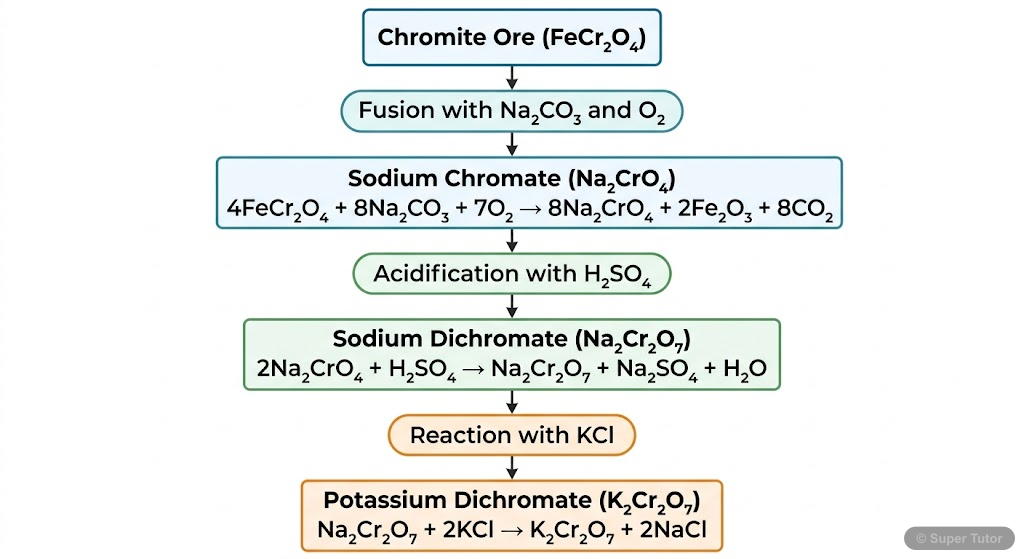
4.14Describe the preparation of potassium dichromate from iron chromite ore. What is the effect of increasing pH on a solution of potassium dichromate?Show solution
The yellow solution of sodium chromate is filtered and acidified with sulphuric acid to give sodium dichromate. Then sodium dichromate is treated with potassium chloride to obtain potassium dichromate:
Effect of increasing pH: chromate and dichromate are interconvertible. On increasing pH, the equilibrium shifts from dichromate to chromate:
So a more alkaline solution favours chromate.
Not sure why a step works? check your working in Super Tutor
4.15Describe the oxidising action of potassium dichromate and write the ionic equations for its reaction with:Show solution
Ionic equations:
1. With iodide:
2. With iron(II) solution:
3. With hydrogen sulphide:
So acidified dichromate is reduced to **** while the other species are oxidised.
Not sure why a step works? check your working in Super Tutor
4.16Describe the preparation of potassium permanganate. How does the acidified permanganate solution react with (i) iron(II) ions (ii) SO₂ and (iii) oxalic acid? Write the ionic equations for the reactions.Show solution
1. ** is fused with KOH and an oxidising agent such as / ** to form potassium manganate:
2. The manganate ion is then converted to permanganate by disproportionation in acidic/neutral medium or by electrolytic oxidation:
Reactions of acidified permanganate:
(i) With iron(II):
(ii) With sulphur dioxide / sulphite in acid medium:
(iii) With oxalic acid / oxalate:
So acidified permanganate acts as a powerful oxidising agent.
Not sure why a step works? check your working in Super Tutor
4.17For M²⁺/M and M³⁺/M²⁺ systems the E° values for some metals are as follows:Show solution
This irregularity is explained by the irregular variation of ionisation enthalpies and the stability of certain electronic configurations:
- **, , and are especially stable.
- The first and second ionisation enthalpies and even sublimation enthalpies** vary irregularly.
So the observed values depend on a balance of these factors, not just on atomic number.
Not sure why a step works? check your working in Super Tutor
4.18Predict which of the following will be coloured in aqueous solution? Ti³⁺, V³⁺, Cu⁺, Sc³⁺, Mn²⁺, Fe³⁺ and Co²⁺. Give reasons for each.Show solution
- Ti**: coloured —
- **V**: coloured —
- **Cu**: colourless —
- **Sc**: colourless —
- **Mn**: coloured —
- **Fe**: coloured —
- **Co**: coloured —
So the coloured ions are **Ti, V, Mn, Fe and Co**.
Not sure why a step works? check your working in Super Tutor
4.19Compare the stability of +2 oxidation state for the elements of the first transition series.Show solution
- In the first half** of the series, the state becomes progressively more stable as atomic number increases.
- This is because the resulting ** ions are increasingly favoured electronically.
- Mn is particularly stable due to the half-filled configuration.
- At the end of the series, Cu and Zn are also important; Zn is especially stable because it has the filled ** configuration.
Thus, the state is most stable when it leads to especially stable -subshell arrangements.
Not sure why a step works? check your working in Super Tutor
19 more solved questions in The d-and f-Block Elements
Every remaining exercise is solved step by step in Super Tutor, plus practice quizzes and flashcards for this chapter. Free to start.
Stuck on a step?
Ask Super Tutor AI to explain any solution on this page in a simpler way — free, 24x7.
Ask a Doubt FreeFrequently Asked Questions
What are the important topics in The d-and f-Block Elements for CBSE Class 12 Chemistry?
How to score full marks in The d-and f-Block Elements — CBSE Class 12 Chemistry?
Where can I get free NCERT Solutions for The d-and f-Block Elements Class 12 Chemistry?
Sources & Official References
- NCERT Official — ncert.nic.in
- CBSE Academic — cbseacademic.nic.in
- CBSE Official — cbse.gov.in
- National Education Policy 2020 — education.gov.in
Content is aligned to the official syllabus. Refer to the board website for the latest curriculum.
More resources for The d-and f-Block Elements
Practice Quiz
Test yourself with a quick quiz
Important Questions
Practice with board exam-style questions
Revision Notes
Key points for last-minute revision
Formula Sheet
All formulas in one place
Chapter Summary
Understand the chapter at a glance
Concept Maps
See how topics connect visually
Study Plan
Step-by-step plan to ace this chapter
Flashcards
Quick-fire cards for active recall
Syllabus
What topics to cover
For serious students
Get the full The d-and f-Block Elements chapter — for free.
Quizzes, flashcards, AI doubt-solver and a step-by-step study plan for CBSE Class 12 Chemistry.