Data Communication
CBSE · Class 12 · Computer Science
NCERT Solutions for Data Communication — CBSE Class 12 Computer Science.
Interactive on Super Tutor
Studying Data Communication? Get the full interactive chapter.
Quizzes, flashcards, AI doubt-solver and a step-by-step study plan — built for ncert solutions and more.
1,000+ Class 12 students started this chapter today
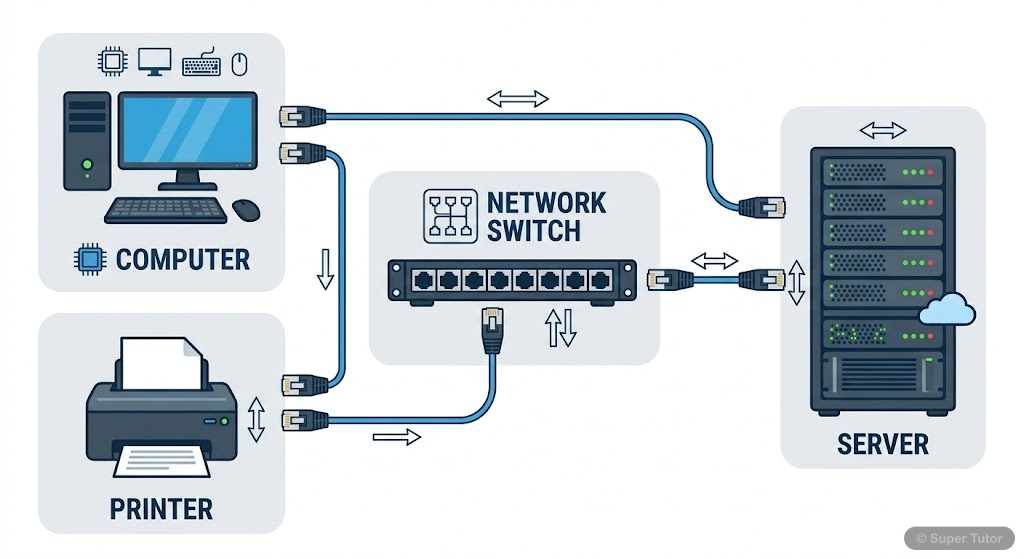
This is just one of 20+ visuals inside Super Tutor's Data Communication chapter
Explore the full set7 worked solutions below. Unlock all 13 free in Super Tutor
EXERCISE
1What is data communication? What are the main components of data communication?Show solution
The main components of data communication are:
1. Sender — the device that sends data.
2. Receiver — the device that receives data.
3. Message — the data or information being exchanged.
4. Communication medium — the path or link through which the message travels.
5. Protocols — the rules that must be followed for successful communication.
Not sure why a step works? check your working in Super Tutor
2Which communication mode allows communication in both directions simultaneously?Show solution
Not sure why a step works? check your working in Super Tutor
3Among LAN, MAN, and WAN, which has the highest speed and which one can cover the largest area?Show solution
Not sure why a step works? check your working in Super Tutor
4What are three categories of wired media? Explain them.Show solution
1. Twisted pair cable — It consists of two copper wires twisted together and insulated with plastic covers. The twisted configuration reduces electrical interference. It is inexpensive and commonly used in telephone lines and LANs.
2. Coaxial cable — It has a copper wire at the core, surrounded by insulating material and an outer conductor. It is better shielded than twisted pair and has more bandwidth. It is used to carry higher-frequency signals over longer distances.
3. Optical fibre cable — It carries data as light through a thin glass fibre. It is light in weight, has high bandwidth, allows long-distance transmission, and is not affected by electromagnetic noise. However, it is expensive and unidirectional.
Not sure why a step works? check your working in Super Tutor
5Compare wired and wireless media.Show solution
Wireless media do not use a physical cable. Data travels through air as electromagnetic waves using antennas. Examples include radio waves, microwaves, infrared waves, Bluetooth, and Wi-Fi. Wireless media provide mobility and flexibility, but they are more prone to interference and signal loss.
So, the main difference is that wired media are physical and cable-based, while wireless media are air-based and cable-free.
Not sure why a step works? check your working in Super Tutor
6Which transmission media carries signals in the form of light?Show solution
Not sure why a step works? check your working in Super Tutor
7List out the advantages and disadvantages of optical fiber cable.Show solution
- It is light in weight.
- It has higher bandwidth, so the data transfer rate is higher.
- Signals can travel longer distances.
- It is not affected by electromagnetic noise or interference.
Disadvantages of optical fibre cable:
- It is expensive.
- It is unidirectional.
- Two cables are required for full-duplex communication.
Not sure why a step works? check your working in Super Tutor
6 more solved questions in Data Communication
Every remaining exercise is solved step by step in Super Tutor, plus practice quizzes and flashcards for this chapter. Free to start.
Stuck on a step?
Ask Super Tutor AI to explain any solution on this page in a simpler way — free, 24x7.
Ask a Doubt FreeFrequently Asked Questions
What are the important topics in Data Communication for CBSE Class 12 Computer Science?
How to score full marks in Data Communication — CBSE Class 12 Computer Science?
Where can I get free NCERT Solutions for Data Communication Class 12 Computer Science?
Sources & Official References
- NCERT Official — ncert.nic.in
- CBSE Academic — cbseacademic.nic.in
- CBSE Official — cbse.gov.in
- National Education Policy 2020 — education.gov.in
Content is aligned to the official syllabus. Refer to the board website for the latest curriculum.
More resources for Data Communication
Practice Quiz
Test yourself with a quick quiz
Important Questions
Practice with board exam-style questions
Revision Notes
Key points for last-minute revision
Formula Sheet
All formulas in one place
Chapter Summary
Understand the chapter at a glance
Concept Maps
See how topics connect visually
Study Plan
Step-by-step plan to ace this chapter
Flashcards
Quick-fire cards for active recall
Syllabus
What topics to cover
For serious students
Get the full Data Communication chapter — for free.
Quizzes, flashcards, AI doubt-solver and a step-by-step study plan for CBSE Class 12 Computer Science.