Database Concepts
CBSE · Class 12 · Computer Science
NCERT Solutions for Database Concepts — CBSE Class 12 Computer Science.
Interactive on Super Tutor
Studying Database Concepts? Get the full interactive chapter.
Quizzes, flashcards, AI doubt-solver and a step-by-step study plan — built for ncert solutions and more.
1,000+ Class 12 students started this chapter today
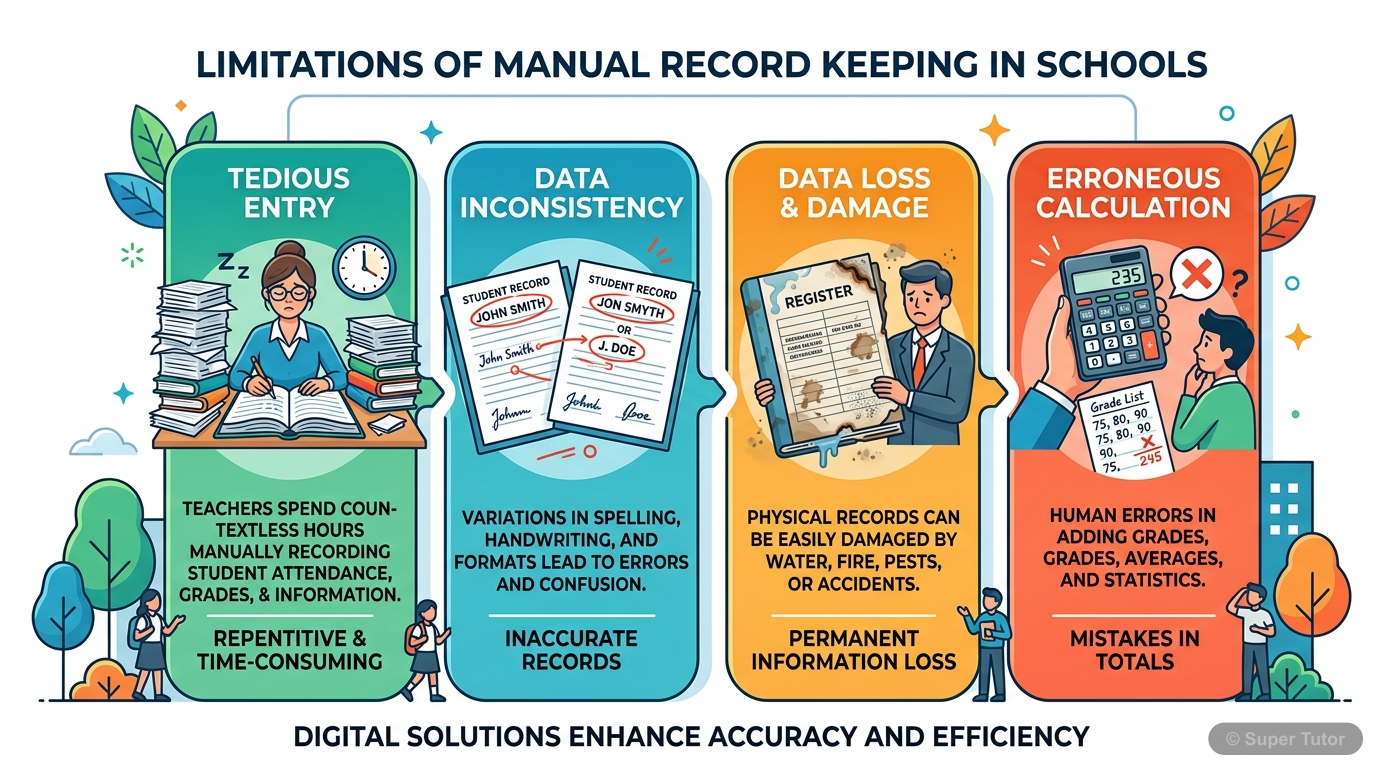
Learn better with visuals Super Tutor has hundreds of illustrations like this across every chapter — all free to try.
Get started18 worked solutions below. Unlock all 35 free in Super Tutor
EXERCISE
1Give the terms for each of the following:Show solution
b) The file that contains description about the data stored in the database is called meta-data or data dictionary.
c) An attribute that can uniquely identify tuples in a relation is a candidate key.
d) The special value stored when actual data is unknown is NULL.
e) An attribute that can uniquely identify tuples but is not chosen as the primary key is an alternate key.
f) The software used to create, manipulate, and maintain a relational database is a DBMS.
Not sure why a step works? check your working in Super Tutor
2Why foreign keys are allowed to have NULL values? Explain with an example.Show solution
For example, in the STUDENT table, GUID is a foreign key referring to GUARDIAN(GUID). If a student’s guardian details are not available, then GUID can be NULL. The chapter also states that a foreign key can take NULL value if it is not part of the primary key of the foreign table.
Not sure why a step works? check your working in Super Tutor
3Differentiate between:Show solution
- Database schema is the design or skeleton of the database. It describes table names, columns, data types, constraints, and relationships.
- Database state or database instance is the snapshot of the database at a given time after data is loaded.
### b) Primary key and foreign key
- A primary key uniquely identifies tuples within the same relation.
- A foreign key is an attribute whose value is derived from the primary key of another relation and is used to relate two tables.
### c) Degree and cardinality of a relation
- Degree = number of attributes in a relation.
- Cardinality = number of tuples/rows in a relation.
Not sure why a step works? check your working in Super Tutor
4Compared to a file system, how does a database management system avoid redundancy in data through a database?Show solution
In the school example, instead of repeating the student name and guardian details in the attendance file, the database keeps:
- STUDENT table for student details
- GUARDIAN table for guardian details
- ATTENDANCE table for attendance records
The RollNumber links ATTENDANCE with STUDENT, and GUID links STUDENT with GUARDIAN. Also, guardian details are stored only once in the GUARDIAN table, so the same guardian information is not repeated for siblings. This reduces redundancy and helps avoid inconsistency.
Not sure why a step works? check your working in Super Tutor
5What are the limitations of file system that can be overcome by a relational DBMS?Show solution
- Difficulty in access
- Data redundancy
- Data inconsistency
- Data isolation
- Data dependence
- Controlled data sharing
A relational DBMS helps manage related data efficiently, supports linking between tables, and allows controlled access through keys and queries.
Not sure why a step works? check your working in Super Tutor
6A school has a rule that each student must participate in a sports activity. So each one should give only one preference for sports activity. Suppose there are five students in a class, each having a unique roll number. The class representative has prepared a list of sports preferences as shown below. Answer the following:Show solution
Not sure why a step works? check your working in Super Tutor
6aRoll no 24 may not be interested in sports. Can a NULL value be assigned to that student's preference field?Show solution
Not sure why a step works? check your working in Super Tutor
6bRoll no 17 has given two preferences in sports. Which property of relational DBMC is violated here? Can we use any constraint or key in the relational DBMS to check against such violation, if any?Show solution
Yes, we can use a constraint/key to check this. Since the school rule says each student should give only one preference, we can make Roll_no a primary key or at least place a UNIQUE constraint on it so that the same roll number cannot appear twice in the relation.
Not sure why a step works? check your working in Super Tutor
6cKabaddi was not chosen by any student. Is it possible to have this tuple in the Sports Preferences relation?Show solution
Not sure why a step works? check your working in Super Tutor
7In another class having 2 sections, the two respective class representatives have prepared 2 separate Sports Preferences tables, as shown below:Show solution
Reason:
- The sequence of attributes is different in the two relations, and according to the chapter, attribute order is immaterial.
- The sequence of tuples is also immaterial.
- However, to be equivalent as relation states, they must represent the same set of tuples with the same attributes and values.
Here, both tables contain the same roll numbers and sports values, just arranged differently. So as relations, they represent the same information and are equivalent.
Not sure why a step works? check your working in Super Tutor
8The school canteen wants to maintain records of items available in the school canteen and generate bills when students purchase any item from the canteen. The school wants to create a canteen database to keep track of items in the canteen and the items purchased by students. Design a database by answering the following questions:Show solution
A suitable design is:
- ITEM relation for item name, price, and calories
- BILL/ORDER relation for purchase details such as item bought and quantity
This separation avoids redundancy and allows billing for multiple orders.
Not sure why a step works? check your working in Super Tutor
8aTo store each item name along with its price, what relation should be used? Decide appropriate attribute names along with their data type. Each item and its price should be stored only once. What restriction should be used while defining the relation?Show solution
A suitable choice of attributes is:
- ItemID: integer, unique identifier
- ItemName: string/text
- Price: numeric/decimal
Since each item and its price should be stored only once, the ItemID should be defined as the primary key or at least UNIQUE, so duplicate item records are not inserted.
Not sure why a step works? check your working in Super Tutor
8bIn order to generate bill, we should know the quantity of an item purchased. Should this information be in a new relation or a part of the previous relation? If a new relation is required, decide appropriate name and data type for attributes. Also, identify appropriate primary key and foreign key so that the following two restrictions are satisfied:Show solution
A suitable relation can be BILL or ORDER with attributes like:
- BillNo / OrderNo: integer
- ItemID: integer
- Quantity: integer
- optionally Date: date
To satisfy the restrictions:
1. The same bill cannot be generated for different orders → use BillNo/OrderNo as the primary key.
2. Bill can be generated only for available items → make ItemID a foreign key referencing ITEM(ItemID).
This way only valid items can appear in billing records.
Not sure why a step works? check your working in Super Tutor
8cThe school wants to find out how many calories students intake when they order an item. In which relation should the attribute 'calories' be stored?Show solution
Not sure why a step works? check your working in Super Tutor
9An organisation wants to create a database EMP-DEPENDENT to maintain following details about its employees and their dependent.Show solution
- EMPLOYEE(AadharNumber, Name, Address, Department, EmployeeID)
- DEPENDENT(EmployeeID, DependentName, Relationship)
These relations can be used to store employee details and dependent details. The key idea is that EmployeeID links the dependent to the correct employee.
Not sure why a step works? check your working in Super Tutor
9aName the attributes of EMPLOYEE, which can be used as candidate keys.Show solution
Not sure why a step works? check your working in Super Tutor
9bThe company wants to retrieve details of dependent of a particular employee. Name the tables and the key which are required to retrieve this detail.Show solution
- EMPLOYEE
- DEPENDENT
The required key is EmployeeID, because it is the common link between the two tables and is the primary key in EMPLOYEE and a foreign key in DEPENDENT.
Not sure why a step works? check your working in Super Tutor
9cWhat is the degree of EMPLOYEE and DEPENDENT relation?Show solution
- EMPLOYEE(AadharNumber, Name, Address, Department, EmployeeID) has 5 attributes, so its degree is 5.
- DEPENDENT(EmployeeID, DependentName, Relationship) has 3 attributes, so its degree is 3.
Not sure why a step works? check your working in Super Tutor
17 more solved questions in Database Concepts
Every remaining exercise is solved step by step in Super Tutor, plus practice quizzes and flashcards for this chapter. Free to start.
Stuck on a step?
Ask Super Tutor AI to explain any solution on this page in a simpler way — free, 24x7.
Ask a Doubt FreeFrequently Asked Questions
What are the important topics in Database Concepts for CBSE Class 12 Computer Science?
How to score full marks in Database Concepts — CBSE Class 12 Computer Science?
Where can I get free NCERT Solutions for Database Concepts Class 12 Computer Science?
Sources & Official References
- NCERT Official — ncert.nic.in
- CBSE Academic — cbseacademic.nic.in
- CBSE Official — cbse.gov.in
- National Education Policy 2020 — education.gov.in
Content is aligned to the official syllabus. Refer to the board website for the latest curriculum.
More resources for Database Concepts
Practice Quiz
Test yourself with a quick quiz
Important Questions
Practice with board exam-style questions
Revision Notes
Key points for last-minute revision
Formula Sheet
All formulas in one place
Chapter Summary
Understand the chapter at a glance
Concept Maps
See how topics connect visually
Study Plan
Step-by-step plan to ace this chapter
Flashcards
Quick-fire cards for active recall
Syllabus
What topics to cover
For serious students
Get the full Database Concepts chapter — for free.
Quizzes, flashcards, AI doubt-solver and a step-by-step study plan for CBSE Class 12 Computer Science.