Government Budget and the Economy
CBSE · Class 12 · Economics
Summary of Government Budget and the Economy for CBSE Class 12 Economics. Key concepts, important points, and chapter overview.
Interactive on Super Tutor
Studying Government Budget and the Economy? Get the full interactive chapter.
Quizzes, flashcards, AI doubt-solver and a step-by-step study plan — built for chapter summary and more.
1,000+ Class 12 students started this chapter today
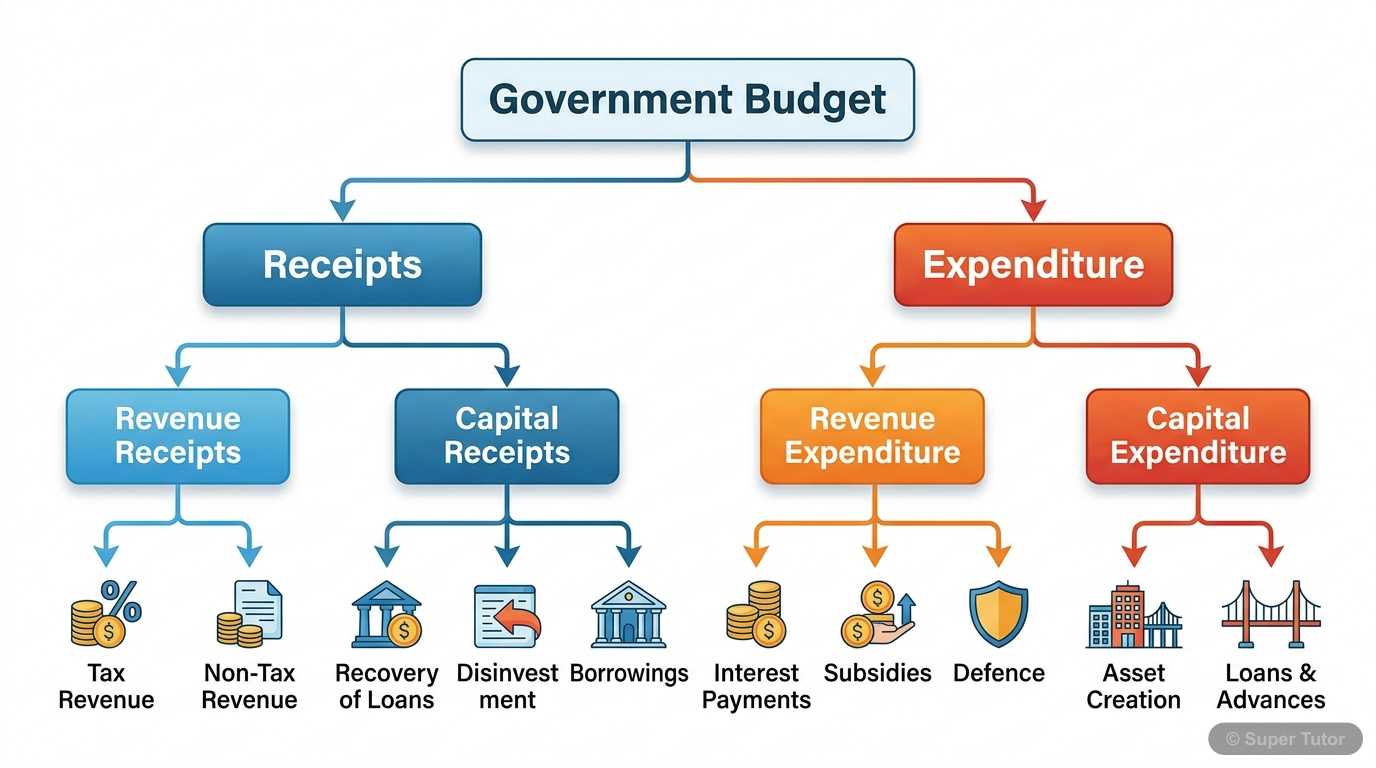
Super Tutor has 11+ illustrations like this for Government Budget and the Economy alone — flashcards, concept maps, and step-by-step visuals.
See them allOverview
Government budget is the main tool through which the Government collects revenue, spends on public needs, redistributes income, and stabilises the economy. India follows a financial year from 1 April to 31 March, and the main budget document is the Annual Financial Statement. The chapter connects th
Key Concepts
An economy in which there
An economy in which there is both the private sector and the Government is known as a mixed economy. The private sector consists of firms and househol
The main budget document of
The main budget document of the Government is the Annual Financial Statement. It presents estimated receipts and expenditures for every financial year
The revenue account is also called
The revenue account is also called the revenue budget, and the capital account is also called the capital budget. Revenue items relate to current inco
National defence
National defence, roads, and government administration are public goods. Public provision means that they are financed through the budget and can be u
The Government changes the distribution
The Government changes the distribution of income through taxes and transfers. Taxes reduce disposable income, while transfers raise it. Direct taxes
Learning Objectives
- Understand the meaning and components of the government budget
- Distinguish between revenue account and capital account
- Classify receipts and expenditure into correct categories
- Explain the meaning of revenue deficit, fiscal deficit, and primary deficit
- Understand the role of taxes, transfers, and government spending in aggregate demand
Frequently Asked Questions
What are the important topics in Government Budget and the Economy for CBSE Class 12 Economics?
How to score full marks in Government Budget and the Economy — CBSE Class 12 Economics?
Sources & Official References
- NCERT Official — ncert.nic.in
- CBSE Academic — cbseacademic.nic.in
- CBSE Official — cbse.gov.in
- National Education Policy 2020 — education.gov.in
Content is aligned to the official syllabus. Refer to the board website for the latest curriculum.
More resources for Government Budget and the Economy
Practice Quiz
Test yourself with a quick quiz
Important Questions
Practice with board exam-style questions
Revision Notes
Key points for last-minute revision
Formula Sheet
All formulas in one place
Concept Maps
See how topics connect visually
Study Plan
Step-by-step plan to ace this chapter
Flashcards
Quick-fire cards for active recall
Syllabus
What topics to cover
NCERT Solutions
Every textbook question solved step by step
For serious students
Get the full Government Budget and the Economy chapter — for free.
Quizzes, flashcards, AI doubt-solver and a step-by-step study plan for CBSE Class 12 Economics.